Designing Data-Intensive Applications
本文最后更新于:2 个月前
– [作者] Martin Kleppmann
分布式系统的神书! 高屋建瓴,把分布式系统和数据库等独立的知识整合到了一起, 帮助快速构建分布式系统领域的系统性思维框架。
Part I. Foundations of Data Systems
Chapter 1. Reliable, Scalable, and Maintainable Applications
第一章. 可靠,可扩张和和维护的应用程序
Reliability
Reliability The system should continue to work correctly (performing the correct function at the desired level of performance) even in the face of adversity (hardware or soft‐ ware faults, and even human error)
可靠性(Reliability):系统即使在面临不利情况时(包括硬件或软件故障,甚至人为错误),也应当能够继续正确地运行,并在期望的性能水平下完成其应有的功能。
Scalability As the system grows (in data volume, traffic volume, or complexity), there should be reasonable ways of dealing with that growth.
可扩展性(Scalability):随着系统规模的增长(例如数据量、流量规模或系统复杂度的提升),应当有合理可行的方式来应对这种增长。
Maintainability Over time, many different people will work on the system (engineering and oper‐ ations, both maintaining current behavior and adapting the system to new use cases), and they should all be able to work on it productively
可维护性(Maintainability):随着时间推移,许多不同的人都会参与到系统的工作中(包括工程和运维人员,既要维护现有行为,也要将系统适配到新的使用场景),并且他们都应当能够高效、富有成效地开展工作。
Hardware Faults
Hard disks are reported as having a mean time to failure (MTTF) of about 10 to 50years [5, 6]. Thus, on a storage cluster with 10,000 disks, we should expect on averageone disk to die per day.
硬盘通常被报告其平均无故障时间(MTTF)约为 10 到 50 年 [5, 6]。因此,在一个拥有 10,000 块磁盘的存储集群中,平均每天都会有一块磁盘发生故障。
Maintainability
It is well known that the majority of the cost of software is not in its initial develop‐ment, but in its ongoing maintenance—fixing bugs, keeping its systems operational,investigating failures, adapting it to new platforms,modifying it for new use cases,repaying technical debt, and adding new features.
众所周知,软件成本的大头并不在最初的开发阶段,而是在其持续的维护过程中——包括修复缺陷、保障系统持续运行、排查故障、适配新的平台、支持新的使用场景、偿还技术债务以及添加新功能。
Operability Make it easy for operations teams to keep the system runningsmoothly.
可运维性(Operability): 使运维团队能够轻松地保障系统平稳、持续地运行。
Simplicity Make it easy for new engineers to understand the system, byremoving as muchcomplexity as possible from the system. (Note this is notthe same as simplicityof the user interface.)
简单性(Simplicity):通过尽可能消除系统中的复杂性,使新工程师能够容易地理解系统。(注意:这并不等同于用户界面的简单性。)
EvolvabilityMake it easy for engineers to make changes to the system in thefuture, adaptingit for unanticipated use cases as requirements change. Alsoknown as extensibil‐ity, modifiability, or plasticity.
可演进性(Evolvability):使工程师能够在未来方便地对系统进行修改,以适应需求变化下事先未预料到的使用场景。
也称为可扩展性(extensibility)、**可修改性(modifiability)**或**可塑性(plasticity)**。
One of the best tools we have for removing accidental complexity is abstraction. Agood abstraction can hide a great deal of implementationdetail behind a clean,simple-to-understand façade. A good abstraction canalso be used for a wide range ofdifferent applications. Not only is this reusemore efficient than reimplementing asimilar thing multiple times, but it alsoleads to higher-quality software, as qualityimprovements in the abstractedcomponent benefit all applications that use it.
我们用于消除偶然复杂性的最佳工具之一是抽象。一个良好的抽象能够将大量的实现细节隐藏在清晰、易于理解的外观(接口之后。
好的抽象还可以被广泛应用于不同的场景。这种复用不仅比多次重新实现类似功能更加高效,而且还能带来更高质量的软件,因为对被抽象组件所做的质量改进,会惠及所有使用该组件的应用。
Chapter 2. Data Models and Query Languages
第二章 数据模型和查询语言
Relational Model Versus Document Model
关系模型和文档模型
The advantage of using an ID is that because it has no meaning to humans,it neverneeds to change: the ID can remain the same, even if the informationit identifieschanges. Anything that is meaningful to humans may need tochange sometime inthe future—and if that information is duplicated, all theredundant copies need to beupdated. That incurs write overheads, and risksinconsistencies (where some copiesof the information are updated butothers aren’t). Removing such duplication is thekey idea behind normalization in databases
使用标识符(ID)的优势在于,它对人类不具备任何语义含义,因此永远无需修改:即便其标识的信息发生变化,ID 也可以保持不变。任何对人类有语义含义的信息,未来都有可能需要修改 —— 而且如果这类信息存在重复存储的情况,那么所有冗余副本都需要逐一更新。这不仅会产生写入开销,还会带来数据不一致的风险(即部分信息副本完成了更新,其他副本却未同步更新)。消除此类数据冗余,正是数据库规范化设计的核心理念。
Chapter 3. Storage and Retrieval
第三章. 存储和检索
Data Structures That Power Your Database
This is an important trade-off in storage systems: well-chosen indexesspeed up readqueries, but every index slows down writes.
这是存储系统中的一个重要权衡:合理选择的索引可以加速读取查询,但每个索引都会减慢写入操作。
Chapter 4. Encoding and Evolution
第 四章. 编码与进化
Modes of Dataflow
However, there is an additional snag. Say you add a field to a record schema, and thenewer code writes a value for that new field to the database. Subsequently, an olderversion of the code (which doesn’t yet know about the new field) reads the record,updates it, and writes it back. In this situation, the desirable behavior is usually forthe old code to keep the new field intact, even though it couldn’t be interpreted.
然而,这里还有一个额外的陷阱。假设你向记录模式中添加了一个字段,较新的代码会将该字段的值写入数据库。随后,旧版本的代码(尚未知晓新字段)读取该记录、更新并重新写回。在这种情况下,理想的行为通常是旧代码应保持新字段的完整性,即使它无法解析该字段。
The encoding formats discussed previously support such preservation of unknownfields, but sometimes you need to take care at an application level, as illustrated inFigure 4-7. For example, if you decode a database value into model objects in theapplication, and later reencode those model objects, the unknown field might be lostin that translation process. Solving this is not a hard problem; you just need to beaware of it.
前面讨论的编码格式支持保留未知字段的功能,但在某些情况下你需要在应用程序层面特别注意,如图4-7所示。例如,如果将数据库值解码为应用程序中的模型对象,随后又重新编码这些模型对象时,未知字段可能会在转换过程中丢失。这个问题的解决方案并不困难,你只需要意识到它的存在即可。
Schema evolution thus allows the entire database to appear as if it was encoded with asingle schema, even though the underlying storage may contain records encoded withvarious historical versions of the schema.
因此,模式演变使得整个数据库看起来仿佛是使用单一模式编码的,即使其底层存储可能包含使用不同历史版本模式编码的记录。
The actor model is a programming model for concurrency in a single process. Ratherthan dealing directly with threads (and the associated problems of race conditions,locking, and deadlock), logic is encapsulated in actors. Each actor typically representsone client or entity, it may have some local state (which is not shared with any otheractor), and it communicates with other actors by sending and receiving asynchro‐nous messages. Message delivery is not guaranteed: in certain error scenarios, mes‐sages will be lost. Since each actor processes only one message at a time, it doesn’tneed to worry about threads, and each actor can be scheduled independently by theframework.
Actor模型是一种用于单个进程内并发的编程模型。它而不是直接处理线程(以及由此产生的竞态条件、锁和死锁等问题),而是将逻辑封装在Actor中。每个Actor通常代表一个客户端或实体,它可能拥有某些局部状态(该状态不会与其他Actor共享),并通过发送和接收异步消息与其他Actor通信。消息传递不保证可靠:在某些错误场景下,消息可能会丢失。由于每个Actor一次只处理一个消息,因此它无需担心线程问题,且每个Actor都可以由框架独立调度。
Part II. Distributed Data
Chapter 5. Replication
第 5 章 复制
Leaders and Followers
You could make the files on disk consistent by locking the database (making itunavailable for writes), but that would go against our goal of high availability. Fortu‐nately, setting up a follower can usually be done without downtime. Conceptually,the process looks like this:
- Take a consistent snapshot of the leader’s database at some point in time—if pos‐ sible, without taking a lock on the entire database. Most databases have this fea‐ ture, as it is also required for backups. In some cases, third-party tools are needed, such as innobackupex for MySQL.
- Copy the snapshot to the new follower node.
- The follower connects to the leader and requests all the data changes that have happened since the snapshot was taken. This requires that the snapshot is associ‐ ated with an exact position in the leader’s replication log. That position has vari‐ ous names: for example, PostgreSQL calls it the log sequence number, and MySQL calls it the binlog coordinates.
- When the follower has processed the backlog of data changes since the snapshot,we say it has caught up. It can now continue to process data changes from the leader as they happen.
你可以通过锁定数据库(使其无法写入)来使磁盘上的文件保持一致,但这会违背我们追求高可用性的目标。幸运的是,通常可以在不中断服务的情况下完成从库的搭建。从概念上看,具体流程如下:
- 获取主库的一致快照:在某个时间点对主库数据库创建一个一致性的快照——尽可能避免对整个数据库加锁。大多数数据库都支持此功能(因为备份时也需要)。在某些情况下需要第三方工具,例如 MySQL 的
innobackupex。 - 复制快照到新从库节点:将快照文件完整复制到新的从库节点。
- 同步增量数据:从库连接主库,请求从快照创建时刻起所有后续的数据变更。这要求快照必须关联到主库复制日志中的一个精确位置,不同数据库对此位置有不同的称呼:
- PostgreSQL 称其为 日志序列号(LSN)
- MySQL 称其为 二进制日志坐标(binlog 坐标)
- 完成数据同步:当从库处理完快照创建后积累的所有数据变更时,我们称其已追上主库进度。此后,从库即可持续接收并处理主库实时产生的数据变更。
Leader failure: Failover
领导者故障:故障转移
Handling a failure of the leader is trickier: one of the followers needs to be promotedto be the new leader, clients need to be reconfigured to send their writes to the newleader, and the other followers need to start consuming data changes from the newleader. This process is called failover.
处理领导者故障更为复杂:需要将某个从库提升为新的领导者,客户端需重新配置以向新领导者发送写请求,其他从库需开始从新领导者消费数据变更。这一过程称为故障转移。
Failover can happen manually (an administrator is notified that the leader has failedand takes the necessary steps to make a new leader) or automatically. An automaticfailover process usually consists of the following steps:
- Determining that the leader has failed. There are many things that could poten‐ tially go wrong: crashes, power outages, network issues, and more. There is no foolproof way of detecting what has gone wrong, so most systems simply use a timeout: nodes frequently bounce messages back and forth between each other,and if a node doesn’t respond for some period of time—say, 30 seconds—it is assumed to be dead. (If the leader is deliberately taken down for planned mainte‐ nance, this doesn’t apply.)
- Choosing a new leader. This could be done through an election process (where the leader is chosen by a majority of the remaining replicas), or a new leader could be appointed by a previously elected controller node. The best candidate for leadership is usually the replica with the most up-to-date data changes from the old leader (to minimize any data loss). Getting all the nodes to agree on a new leader is a consensus problem, discussed in detail in Chapter 9.
- Reconfiguring the system to use the new leader. Clients now need to send their write requests to the new leader (we discuss this in “Request Routing” on page 214). If the old leader comes back, it might still believe that it is the leader,not realizing that the other replicas have forced it to step down. The system needs to ensure that the old leader becomes a follower and recognizes the new leader.
故障转移可以是人工(管理员收到领导者故障通知后手动操作)或自动。自动故障转移通常包含以下步骤:
*确认领导者故障*. 潜在故障原因多样:崩溃、断电、网络问题等。无法100%可靠检测故障原因,因此多数系统采用超时机制:
- 节点间频繁互发心跳包,若某节点在指定时间内(如30秒)无响应,则判定为故障。
- 例外:若领导者因计划性维护被主动下线,则不触发此机制。
*选举新领导者*
- 选举机制:剩余副本通过多数表决(majority)选出新领导者。
- 指定机制:由预选的控制器节点(controller node)直接任命。
- 最优候选:通常选择从旧领导者处数据变更最完整的副本(以最小化数据丢失风险)。
- 共识问题:所有节点需就新领导者达成一致,此问题在第9章详细讨论。
*系统重新配置*
- 客户端路由:客户端需将写请求重定向到新领导者(详见[第214页]的“请求路由”)。
- 旧领导者恢复处理:若旧领导者重新上线,可能仍自认为是领导者(未意识到已被强制下线)。系统需确保:
- 旧领导者降级为从库
- 旧领导者接受新领导者的权威
Failover is fraught with things that can go wrong:
- If asynchronous replication is used, the new leader may not have received all the writes from the old leader before it failed. If the former leader rejoins the cluster after a new leader has been chosen, what should happen to those writes? The new leader may have received conflicting writes in the meantime. The most common solution is for the old leader’s unreplicated writes to simply be discarded, which may violate clients’ durability expectations.
- Discarding writes is especially dangerous if other storage systems outside of the database need to be coordinated with the database contents. For example, in one incident at GitHub [13], an out-of-date MySQL follower was promoted to leader. The database used an autoincrementing counter to assign primary keys to new rows, but because the new leader’s counter lagged behind the old leader’s, itreused some primary keys that were previously assigned by the old leader. Theseprimary keys were also used in a Redis store, so the reuse of primary keys resul‐ted in inconsistency between MySQL and Redis, which caused some private datato be disclosed to the wrong users.
- In certain fault scenarios (see Chapter 8), it could happen that two nodes both believe that they are the leader. This situation is called split brain, and it is dan‐ gerous: if both leaders accept writes, and there is no process for resolving con‐ flicts (see “Multi-Leader Replication” on page 168), data is likely to be lost or corrupted. As a safety catch, some systems have a mechanism to shut down one node if two leaders are detected.ii However, if this mechanism is not carefully designed, you can end up with both nodes being shut down [14].
- What is the right timeout before the leader is declared dead? A longer timeout means a longer time to recovery in the case where the leader fails. However, if the timeout is too short, there could be unnecessary failovers. For example, a tempo‐ rary load spike could cause a node’s response time to increase above the timeout,or a network glitch could cause delayed packets. If the system is already strug‐ gling with high load or network problems, an unnecessary failover is likely to make the situation worse, not better.
故障转移的过程中,往往潜藏着诸多容易导致异常的风险点:
- 若采用异步复制机制,新主节点在旧主节点故障时,可能并未接收完旧主节点的所有写入操作。倘若旧主节点在新主节点当选后重新加入集群,这些未同步的写入操作该如何处理?在此期间,新主节点可能已经接收了与之冲突的写入操作。最常用的解决方案是直接丢弃旧主节点中未复制的写入操作,但这种做法可能会违背客户端对数据持久性的预期。
- 当数据库之外的其他存储系统需要与数据库中的数据保持协同一致时,丢弃写入操作的做法会格外危险。例如,GitHub 曾发生过这样一起事故 [13]:一台数据滞后的 MySQL 从节点被提升为主节点。该数据库原本依靠自增计数器为新数据行分配主键,而由于新主节点的计数器数值落后于旧主节点,它复用了一些旧主节点此前已经分配过的主键。这些主键同时也被用于 Redis 存储系统,主键的复用最终导致 MySQL 与 Redis 之间出现数据不一致,进而造成部分私密数据被泄露给错误的用户。
- 在某些故障场景下(详见第 8 章),可能会出现两个节点均认为自己是主节点的情况。这种现象被称为脑裂,具有极大的危险性:如果两个主节点都接收写入操作,且系统没有冲突解决机制(详见第 168 页的 “多主复制” 章节),数据很可能会丢失或损坏。作为一种安全兜底机制,部分系统会在检测到双主节点并存时,自动关闭其中一个节点。ii 但如果该机制的设计不够严谨,最终可能会导致两个节点都被关闭 [14]。
- 判定主节点失效的超时阈值设置为多少才合理?超时阈值过长,意味着主节点故障后系统需要更长的时间才能完成恢复;但如果阈值过短,则可能引发不必要的故障转移。例如,临时的负载峰值可能导致节点响应时间超过阈值,或是网络瞬断会造成数据包延迟。如果系统本就正受困于高负载或网络问题,一次不必要的故障转移非但无法缓解问题,反而可能让情况雪上加霜。
Problems with Replication Lag
复制延迟的问题
Reading Your Own Writes
Unfortunately, if an application reads from an asynchronous follower, it may see out‐dated information if the follower has fallen behind. This leads to apparent inconsis‐tencies in the database: if you run the same query on the leader and a follower at thesame time, you may get different results, because not all writes have been reflected inthe follower. This inconsistency is just a temporary state—if you stop writing to thedatabase and wait a while, the followers will eventually catch up and become consis‐tent with the leader. For that reason, this effect is known as eventual consistency
遗憾的是,如果应用程序从异步从节点读取数据,当从节点的数据同步滞后时,就可能获取到过期的信息。这会导致数据库出现表面上的数据不一致:倘若你同时在主节点和从节点上执行相同的查询,可能会得到不同的结果 —— 原因是从节点中尚未同步所有的写入操作。但这种不一致只是一种临时状态:如果停止向数据库写入数据,等待一段时间后,从节点最终会追平数据,与主节点保持一致。正是因为这一特性,这种现象被称为最终一致性。
In this situation, we need read-after-write consistency, also known as read-your-writes consistency [24]. This is a guarantee that if the user reloads the page, they will alwayssee any updates they submitted themselves. It makes no promises about other users:other users’ updates may not be visible until some later time. However, it reassuresthe user that their own input has been saved correctly.
在这种情况下,我们就需要写后读一致性(也称为读己写一致性)[24]。这是一项保障机制:当用户刷新页面时,总能看到自己提交的所有更新内容。该机制不会对其他用户的操作做出承诺 —— 其他用户提交的更新,可能要等到一段时间后才能被看见。但它能让用户放心,自己输入的内容已经被正确保存。
How can we implement read-after-write consistency in a system with leader-based replication? There are various possible techniques. To mention a few:
- When reading something that the user may have modified, read it from the leader; otherwise, read it from a follower. This requires that you have some way of knowing whether something might have been modified, without actually querying it. For example, user profile information on a social network is nor‐ mally only editable by the owner of the profile, not by anybody else. Thus, a sim‐ ple rule is: always read the user’s own profile from the leader, and any other users’ profiles from a follower.
- If most things in the application are potentially editable by the user, that approach won’t be effective, as most things would have to be read from the leader (negating the benefit of read scaling). In that case, other criteria may be used to decide whether to read from the leader. For example, you could track the time of the last update and, for one minute after the last update, make all reads from the leader. You could also monitor the replication lag on followers and pre‐ vent queries on any follower that is more than one minute behind the leader.
- The client can remember the timestamp of its most recent write—then the sys‐ tem can ensure that the replica serving any reads for that user reflects updates at least until that timestamp. If a replica is not sufficiently up to date, either the read can be handled by another replica or the query can wait until the replica has caught up. The timestamp could be a logical timestamp (something that indicates ordering of writes, such as the log sequence number) or the actual system clock(in which case clock synchronization becomes critical; see “Unreliable Clocks”on page 287).
- If your replicas are distributed across multiple datacenters (for geographical proximity to users or for availability), there is additional complexity. Any request that needs to be served by the leader must be routed to the datacenter that con‐ tains the leader.
在基于主节点的复制系统中,我们该如何实现写后读一致性呢?具体有多种可行的技术方案,以下列举其中几种:
- 当读取用户可能已修改过的数据时,从主节点读取;其余情况下,从从节点读取。这要求系统具备一种判断逻辑 —— 无需实际查询数据,就能确定某条数据是否有可能被修改。例如,社交网络中的用户资料通常只有账号所有者可以编辑,其他用户无权修改。基于这一特点,我们可以制定一条简单规则:始终从主节点读取用户自己的资料,而从从节点读取其他用户的资料。
- 若应用中的大部分数据都存在被用户修改的可能,那么上述方案的效果就会大打折扣 —— 因为绝大多数读取请求都需要路由到主节点,这样就会抵消读扩展带来的优势。这种情况下,就需要借助其他判断标准来决定读取请求的路由目标。例如,系统可以记录每条数据的最后更新时间戳,在数据更新后的一分钟内,所有针对该数据的读取请求都定向到主节点;也可以实时监控从节点的复制延迟,一旦某个从节点与主节点的延迟超过一分钟,就暂时禁止向该从节点发送查询请求。
- 客户端可以记录自己最近一次写入操作的时间戳,之后系统就需要确保:为该用户提供读取服务的副本,至少包含该时间戳之前的所有更新数据。如果某个副本的数据同步进度未达标,那么要么将读取请求转发至其他同步完成的副本,要么让该查询请求等待副本追平数据后再执行。这里的时间戳可以是逻辑时间戳(用于标记写入操作顺序的标识,比如日志序列号),也可以是实际的系统时钟时间(这种情况下,时钟同步就会变得至关重要,详见第 287 页的 “不可靠时钟” 章节)。
- 若数据库副本分布在多个数据中心(此举或是为了让服务地理位置更贴近用户,或是为了提升系统可用性),则会引入额外的复杂度。所有需要由主节点处理的请求,都必须精准路由到主节点所在的数据中心。
Another complication arises when the same user is accessing your service from mul‐tiple devices, for example a desktop web browser and a mobile app. In this case youmay want to provide cross-device read-after-write consistency: if the user enters someinformation on one device and then views it on another device, they should see theinformation they just entered.
当同一用户通过多台设备访问服务时(例如桌面端网页浏览器和移动端应用),会衍生出另一个复杂问题。这种情况下,你可能需要实现跨设备写后读一致性:如果用户在一台设备上录入了某些信息,之后用另一台设备查看,应该能看到自己刚录入的内容。
In this case, there are some additional issues to consider:
- Approaches that require remembering the timestamp of the user’s last update become more difficult, because the code running on one device doesn’t know what updates have happened on the other device. This metadata will need to be centralized.
- If your replicas are distributed across different datacenters, there is no guarantee that connections from different devices will be routed to the same datacenter. (For example, if the user’s desktop computer uses the home broadband connec‐ tion and their mobile device uses the cellular data network, the devices’ network routes may be completely different.) If your approach requires reading from the leader, you may first need to route requests from all of a user’s devices to the same datacenter.
这种场景下,还需要考虑以下额外问题:
- 那些需要记录用户最近一次更新时间戳的方案,实施难度会有所增加。因为运行在某一台设备上的代码,无法知晓其他设备上发生过哪些更新操作。这类元数据必须进行集中存储。
- 若数据库副本分布在不同的数据中心,那么来自用户不同设备的请求,无法保证会被路由到同一个数据中心。(例如,用户的台式机使用的是家庭宽带网络,而移动设备使用的是蜂窝数据网络,两台设备的网络路由可能完全不同。)如果你的方案要求读取请求必须由主节点处理,那么首先需要将该用户所有设备的请求,统一路由至同一个数据中心。
Monotonic Reads
Monotonic reads [23] is a guarantee that this kind of anomaly does not happen. It’s alesser guarantee than strong consistency, but a stronger guarantee than eventual con‐sistency. When you read data, you may see an old value; monotonic reads only meansthat if one user makes several reads in sequence, they will not see time go backward—i.e., they will not read older data after having previously read newer data.
单调读 [23] 是一种保证,用来避免上述这类异常情况的发生。它比强一致性弱,但比最终一致性强。当你读取数据时,可能会看到旧值;单调读只保证:如果同一个用户按顺序进行了多次读取,那么他们不会看到时间倒退——也就是说,在已经读到较新数据之后,不会再读到更旧的数据。
One way of achieving monotonic reads is to make sure that each user always makestheir reads from the same replica (different users can read from different replicas).For example, the replica can be chosen based on a hash of the user ID, rather thanrandomly. However, if that replica fails, the user’s queries will need to be rerouted toanother replica.
实现单调读的一种方式是:确保每个用户始终从同一个副本读取数据(不同用户可以从不同的副本读取)。例如,可以根据用户 ID 的哈希值来选择副本,而不是随机选择。不过,如果该副本发生故障,用户的查询就需要被重定向到另一个副本。
Consistent Prefix Reads
一致前缀读
Preventing this kind of anomaly requires another type of guarantee: consistent prefix reads [23]. This guarantee says that if a sequence of writes happens in a certain order,then anyone reading those writes will see them appear in the same order.
要防止这种异常,需要另一种保证:一致前缀读(consistent prefix reads) [23]。这种保证意味着:如果一系列写操作是按某个顺序发生的,那么任何读取这些写操作的读者,看到的结果也会按照同样的顺序出现。
This is a particular problem in partitioned (sharded) databases, which we will discussin Chapter 6. If the database always applies writes in the same order, reads always seea consistent prefix, so this anomaly cannot happen. However, in many distributed databases, different partitions operate independently, so there is no global ordering ofwrites: when a user reads from the database, they may see some parts of the databasein an older state and some in a newer state.
这在分区(分片)数据库中是一个特别突出的问题,我们将在第 6 章中讨论。如果数据库总是以相同的顺序应用写操作,那么读操作总是能看到一个一致的前缀,因此这种异常就不会发生。然而,在许多分布式数据库中,不同的分区是彼此独立运行的,并不存在全局的写入顺序:当用户从数据库读取数据时,可能会看到数据库的某些部分仍处于较旧的状态,而另一些部分已经处于较新的状态。
Multi-Leader Replicatoin
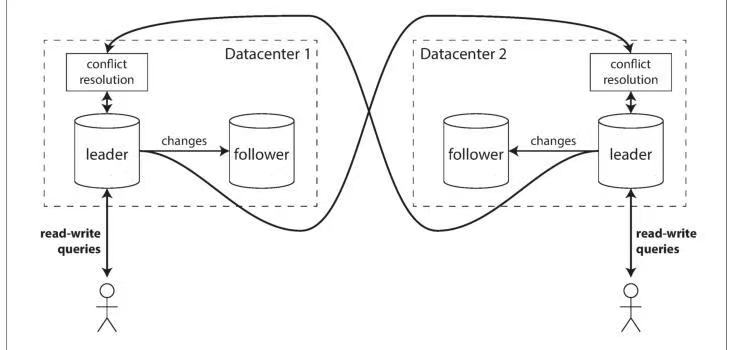
In a multi-leader configuration, you can have a leader in eachdatacenter. Figure 5-6shows what this architecture might look like. Within each datacenter, regular leader–follower replication is used; between datacenters, each datacenter’s leader replicatesits changes to the leaders in other datacenters.
在多主(multi-leader)配置中,可以在每个数据中心各自设置一个主节点。图 5-6 展示了这种架构的大致样子。在每个数据中心内部,使用常规的主从复制(leader–follower replication);而在数据中心之间,则由各个数据中心的主节点将其变更复制到其他数据中心的主节点。
Let’s compare how the single-leader and multi-leader configurations fare in a multi-datacenter deployment:
下面对比一下单主(single-leader)和多主(multi-leader)配置在多数据中心部署下的表现:
Performance In a single-leader configuration, every write must go over the internet to the datacenter with the leader. This can add significant latency to writes and might contravene the purpose of having multiple datacenters in the first place. In a multi-leader configuration, every write can be processed in the local datacenter and is replicated asynchronously to the other datacenters. Thus, the inter- datacenter network delay is hidden from users, which means the perceived per‐ formance may be better.
性能(Performance). 在单主配置中,每一次写入都必须通过互联网发送到主节点所在的数据中心。这会显著增加写入延迟,甚至可能违背部署多个数据中心的初衷。而在多主配置中,每次写入都可以在本地数据中心直接处理,然后再异步复制到其他数据中心。这样一来,跨数据中心的网络延迟对用户是不可感知的,因此用户感受到的性能通常会更好。
Tolerance of datacenter outages In a single-leader configuration, if the datacenter with the leader fails, failover can promote a follower in another datacenter to be leader. In a multi-leader con‐ figuration, each datacenter can continue operating independently of the others,and replication catches up when the failed datacenter comes back online.
数据中心故障容忍性(Tolerance of datacenter outages). 在单主配置中,如果主节点所在的数据中心发生故障,需要通过故障转移(failover),将另一个数据中心中的某个从节点提升为主节点。在多主配置中,每个数据中心都可以独立于其他数据中心继续运行;当发生故障的数据中心恢复上线后,再通过复制机制将数据追赶同步。
Tolerance of network problems Traffic between datacenters usually goes over the public internet, which may be less reliable than the local network within a datacenter. A single-leader configu‐ ration is very sensitive to problems in this inter-datacenter link, because writes are made synchronously over this link. A multi-leader configuration with asyn‐ chronous replication can usually tolerate network problems better: a temporary network interruption does not prevent writes being processed.
网络问题容忍性(Tolerance of network problems). 数据中心之间的通信通常经过公网,这往往比数据中心内部的本地网络更不可靠。单主配置对这种跨数据中心链路的问题非常敏感,因为写操作需要通过该链路同步完成。而采用异步复制的多主配置通常能更好地容忍网络问题:短暂的网络中断并不会阻止写操作的正常处理。
Although multi-leader replication has advantages, it also has a big downside: the same data may be concurrently modified in two different datacenters, and those write conflicts must be resolved (indicated as “conflict resolution” in Figure 5-6). We willdiscuss this issue in “Handling Write Conflicts” on page 171.
尽管多主复制具有一些优势,但它也有一个很大的缺点:同一份数据可能会在两个不同的数据中心被并发修改,而这些写冲突必须被解决(在图 5-6 中以“冲突解决 / conflict resolution”标示)。我们将在第 171 页的“处理写冲突(Handling Write Conflicts)”一节中讨论这个问题。
Handling Write Conflicts
Conflict avoidance
避免冲突
The simplest strategy for dealing with conflicts is to avoid them: if the application canensure that all writes for a particular record go through the same leader, then conflicts cannot occur. Since many implementations of multi-leader replication handleconflicts quite poorly, avoiding conflicts is a frequently recommended approach [34].
处理写冲突最简单的策略是避免冲突:如果应用能够确保某条记录的所有写操作都经过同一个主节点(leader),那么就不会发生冲突。由于许多多主复制的实现对冲突的处理能力相当有限,避免冲突因此成为一种经常被推荐的做法 [34]。
For example, in an application where a user can edit their own data, you can ensurethat requests from a particular user are always routed to the same datacenter and usethe leader in that datacenter for reading and writing. Different users may have differ‐ent “home” datacenters (perhaps picked based on geographic proximity to the user),but from any one user’s point of view the configuration is essentially single-leader.
例如,在一个用户只能编辑自己数据的应用中,可以保证来自某个用户的请求始终被路由到同一个数据中心,并使用该数据中心中的主节点进行读写。不同用户可以有不同的“归属(home)数据中心”(可能根据用户的地理位置就近选择),但从单个用户的视角来看,这种配置本质上仍然是单主的。
However, sometimes you might want to change the designated leader for a record—perhaps because one datacenter has failed and you need to reroute traffic to anotherdatacenter, or perhaps because a user has moved to a different location and is nowcloser to a different datacenter. In this situation, conflict avoidance breaks down, andyou have to deal with the possibility of concurrent writes on different leaders.
然而,有时你可能需要更改某条记录所指定的主节点——比如某个数据中心发生故障,需要将流量重新路由到另一个数据中心;或者用户迁移到了新的地点,离另一个数据中心更近。在这种情况下,冲突避免机制就会失效,你就必须面对在不同主节点上发生并发写入的可能性。
There are various ways of achieving convergent conflict resolution:
- Give each write a unique ID (e.g., a timestamp, a long random number, a UUID,or a hash of the key and value), pick the write with the highest ID as the winner,and throw away the other writes. If a timestamp is used, this technique is known as last write wins (LWW). Although this approach is popular, it is dangerously prone to data loss [35]. We will discuss LWW in more detail at the end of this chapter (“Detecting Concurrent Writes” on page 184).
- Record the conflict in an explicit data structure that preserves all information,and write application code that resolves the conflict at some later time (perhaps by prompting the user).
实现收敛型冲突解决(convergent conflict resolution)有多种方式:
- 为每一次写入分配一个唯一 ID(例如时间戳、一个较长的随机数、UUID,或者 key 与 value 的哈希值),然后选择 ID 最大的写入作为最终结果,并丢弃其他写入。如果使用的是时间戳,这种技术被称为最后写入胜出(Last Write Wins,LWW)。虽然这种方法很流行,但它极易导致数据丢失 [35]。我们将在本章末尾的“检测并发写入(Detecting Concurrent Writes)”(第 184 页)中更详细地讨论 LWW。
- 用显式的数据结构记录冲突,保留所有相关信息,然后通过应用层代码在之后的某个时间点来解决冲突(例如提示用户进行选择)。
LeaderLess Replication
On the other hand, in a leaderless configuration, failover does not exist. Figure 5-10shows what happens: the client (user 1234) sends the write to all three replicas in par‐allel, and the two available replicas accept the write but the unavailable replica missesit. Let’s say that it’s sufficient for two out of three replicas to acknowledge the write:after user 1234 has received two ok responses, we consider the write to be successful.The client simply ignores the fact that one of the replicas missed the write.
另一方面,在无主(leaderless)配置中,并不存在故障转移(failover)。图 5-10 展示了这种情况下会发生什么:客户端(用户 1234)将写请求并行发送给三个副本,其中两个可用副本接受了写入,而一个不可用的副本错过了这次写入。假设只要 3 个副本中有 2 个确认(acknowledge)写入即可视为成功:在用户 1234 收到两个 ok 响应之后,我们就认为这次写入已经成功。客户端会直接忽略有一个副本未能接收到写入这一事实。
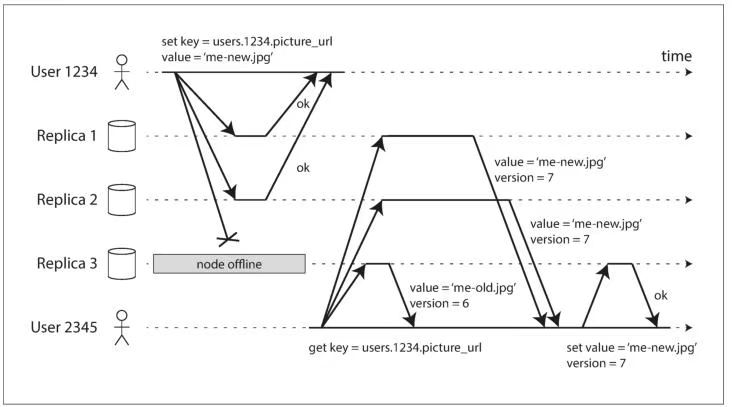
Now imagine that the unavailable node comes back online, and clients start readingfrom it. Any writes that happened while the node was down are missing from thatnode. Thus, if you read from that node, you may get stale (outdated) values asresponses.
现在设想那个不可用的节点重新上线,并且客户端开始从它读取数据。由于该节点宕机期间发生的写入都没有同步到它上面,因此这些写入在该节点上是缺失的。于是,如果你从这个节点读取数据,得到的可能是陈旧的(过期的)值。
To solve that problem, when a client reads from the database, it doesn’t just send itsrequest to one replica: read requests are also sent to several nodes in parallel. The cli‐ent may get different responses from different nodes; i.e., the up-to-date value fromone node and a stale value from another. Version numbers are used to determinewhich value is newer (see “Detecting Concurrent Writes” on page 184).
为了解决这个问题,当客户端从数据库读取数据时,并不会只向一个副本发送请求:读请求同样会并行发送给多个节点。客户端可能会从不同节点收到不同的响应,也就是说,可能从某个节点拿到最新值,而从另一个节点拿到旧值。此时可以通过版本号来判断哪个值更新(参见第 184 页“检测并发写入”)。
Read repair and anti-entropy.
读修复(Read repair)与反熵(Anti-entropy)
The replication scheme should ensure that eventually all the data is copied to everyreplica. After an unavailable node comes back online, how does it catch up on thewrites that it missed?
复制机制需要确保:最终所有数据都会被复制到每一个副本上。当一个曾经不可用的节点重新上线后,它是如何补齐在宕机期间错过的写入的呢?
Two mechanisms are often used in Dynamo-style datastores:
在 Dynamo 风格的数据存储系统中,通常会使用两种机制:
Read repair When a client makes a read from several nodes in parallel, it can detect any stale responses. For example, in Figure 5-10, user 2345 gets a version 6 value from rep‐ lica 3 and a version 7 value from replicas 1 and 2. The client sees that replica 3 has a stale value and writes the newer value back to that replica. This approach works well for values that are frequently read.
读修复(Read repair). 当客户端并行地从多个节点读取数据时,它可以检测到哪些响应是陈旧的。例如,在图 5-10 中,用户 2345 从副本 3 读到了版本 6 的值,而从副本 1 和副本 2 读到了版本 7 的值。客户端可以判断出副本 3 上的数据是过期的,于是将较新的值写回到该副本。这种方法对于被频繁读取的数据效果很好。
Anti-entropy process In addition, some datastores have a background process that constantly looks for differences in the data between replicas and copies any missing data from one replica to another. Unlike the replication log in leader-based replication, this anti-entropy process does not copy writes in any particular order, and there may be a significant delay before data is copied.
反熵过程(Anti-entropy process). 此外,一些数据存储系统还会运行一个后台进程,不断检查各个副本之间的数据差异,并将缺失的数据从一个副本复制到另一个副本。与基于主节点复制的复制日志不同,这种反熵过程不会按照特定的写入顺序复制数据,而且在数据被完全复制之前,可能会存在较长的延迟。
Detecting Concurrent Writes
检测并发写入
For defining concurrency, exact time doesn’t matter: we simply call two operationsconcurrent if they are both unaware of each other, regardless of the physical time at which they occurred.
在定义并发时,精确时间并不重要:只要两个操作彼此互不感知,无论它们实际发生的物理时间如何,我们就将这两个操作称为并发操作。
Note that the server can determine whether two operations are concurrent by looking at the version numbers—it does not need to interpret the value itself (so the valuecould be any data structure). The algorithm works as follows:
- The server maintains a version number for every key, increments the version number every time that key is written, and stores the new version number along with the value written.
- When a client reads a key, the server returns all values that have not been overwritten, as well as the latest version number. A client must read a key before writing.
- When a client writes a key, it must include the version number from the prior read, and it must merge together all values that it received in the prior read. (The response from a write request can be like a read, returning all current values, which allows us to chain several writes like in the shopping cart example.)
- When the server receives a write with a particular version number, it can overwrite all values with that version number or below (since it knows that they have been merged into the new value), but it must keep all values with a higher version number (because those values are concurrent with the incoming write).
- When a write includes the version number from a prior read, that tells us which previous state the write is based on. If you make a write without including a versionnumber, it is concurrent with all other writes, so it will not overwrite anything—itwill just be returned as one of the values on subsequent reads.
需要注意的是,服务器只需通过版本号就能判断两个操作是否并发,无需解析值本身的内容(因此值可以是任意数据结构)。该算法的工作流程如下:
- 服务器为每个键维护一个版本号,每当该键被写入时,版本号就会递增,同时将新版本号与写入的值一并存储。
- 当客户端读取某个键时,服务器会返回该键所有未被覆盖的值,以及当前的最新版本号。客户端在执行写入操作前,必须先读取对应键的数据。
- 客户端写入某个键时,必须附带之前读取操作获取的版本号,同时需要将之前读取到的所有值合并为一个新值。(写入请求的响应可以仿照读取操作,返回当前的所有值,这一设计支持像购物车场景那样,将多次写入操作串联执行。)
- 当服务器接收到携带特定版本号的写入请求时,可以覆盖所有版本号小于等于该值的数据(因为服务器明确这些数据已被合并到新值中);但必须保留所有版本号高于该值的数据(因为这些数据与本次写入请求属于并发关系)。
- 若写入请求中附带了之前读取操作的版本号,这就明确了本次写入基于的历史状态版本。如果写入时未附带版本号,则该操作会被判定为与所有其他写入操作并发,因此它不会覆盖任何已有数据 —— 只会在后续的读取操作中,作为其中一个值被返回。
Summary
In this chapter we looked at the issue of replication. Replication can serve severalpurposes:
- High availability Keeping the system running, even when one machine (or several machines, or an entire datacenter) goes down
- Disconnected operation Allowing an application to continue working when there is a network interruption
- Latency Placing data geographically close to users, so that users can interact with it faster
- Scalability Being able to handle a higher volume of reads than a single machine could handle, by performing reads on replicas
在本章中,我们讨论了复制(replication)的问题。复制可以服务于多个目的:
- 高可用性(High availability) 即使一台机器(或多台机器,甚至整个数据中心)发生故障,系统仍然能够继续运行。
- 离线/断连运行(Disconnected operation) 在网络中断的情况下,仍然允许应用继续工作。
- 低延迟(Latency) 将数据放置在地理位置上更接近用户的地方,使用户能够更快地与数据交互。
- 可扩展性(Scalability) 通过在副本上执行读操作,来处理单台机器无法承受的高读请求量。
Despite being a simple goal—keeping a copy of the same data on several machines—replication turns out to be a remarkably tricky problem. It requires carefully thinkingabout concurrency and about all the things that can go wrong, and dealing with theconsequences of those faults. At a minimum, we need to deal with unavailable nodesand network interruptions (and that’s not even considering the more insidious kindsof fault, such as silent data corruption due to software bugs).
尽管目标看起来很简单——在多台机器上保存同一份数据的副本——复制实际上是一个极其棘手的问题。它需要我们非常谨慎地思考并发问题,以及各种可能出错的情况,并处理这些故障所带来的后果。至少,我们必须应对节点不可用和网络中断(更不用说那些更加隐蔽的故障类型,例如由于软件缺陷导致的静默数据损坏)。
We discussed three main approaches to replication:
- Single-leader replication Clients send all writes to a single node (the leader), which sends a stream of data change events to the other replicas (followers). Reads can be performed on any replica, but reads from followers might be stale.
- Multi-leader replication Clients send each write to one of several leader nodes, any of which can accept writes. The leaders send streams of data change events to each other and to any follower nodes.
- Leaderless replication Clients send each write to several nodes, and read from several nodes in parallel in order to detect and correct nodes with stale data.
我们讨论了三种主要的复制方式:
- 单主复制(Single-leader replication) 客户端将所有写请求发送到单一节点(主节点),主节点再将数据变更事件流发送给其他副本(从节点)。读操作可以在任意副本上执行,但从节点上的读取可能是过期的。
- 多主复制(Multi-leader replication) 客户端将写请求发送到多个主节点中的任意一个,这些主节点都可以接受写入。各个主节点之间,以及主节点与其从节点之间,都会相互复制数据变更事件流。
- 无主复制(Leaderless replication) 客户端将每一次写入发送给多个节点,并在读取时并行地从多个节点读取,以检测并修复包含过期数据的节点。
Each approach has advantages and disadvantages. Single-leader replication is popularbecause it is fairly easy to understand and there is no conflict resolution to worryabout. Multi-leader and leaderless replication can be more robust in the presence offaulty nodes, network interruptions, and latency spikes—at the cost of being harderto reason about and providing only very weak consistency guarantees.
每种方式都有其优缺点。单主复制由于概念相对简单,而且不需要处理写冲突,因此非常流行。多主复制和无主复制在面对节点故障、网络中断以及延迟抖动时通常更加健壮,但代价是系统更难理解,只能提供较弱的一致性保证。
Replication can be synchronous or asynchronous, which has a profound effect on thesystem behavior when there is a fault. Although asynchronous replication can be fastwhen the system is running smoothly, it’s important to figure out what happenswhen replication lag increases and servers fail. If a leader fails and you promote anasynchronously updated follower to be the new leader, recently committed data maybe lost.
复制可以是同步的,也可以是异步的,而这在系统发生故障时会对行为产生深远影响。尽管异步复制在系统运行良好时速度很快,但当复制延迟增大、服务器发生故障时,必须认真考虑会发生什么。如果主节点发生故障,并将一个异步更新的从节点提升为新的主节点,那么最近已经提交的数据可能会丢失。
We looked at some strange effects that can be caused by replication lag, and we dis‐cussed a few consistency models which are helpful for deciding how an applicationshould behave under replication lag:
- Read-after-write consistency Users should always see data that they submitted themselves.
- Monotonic reads After users have seen the data at one point in time, they shouldn’t later see the data from some earlier point in time.
- Consistent prefix reads Users should see the data in a state that makes causal sense: for example, seeing a question and its reply in the correct order.
我们还探讨了复制延迟可能引发的一些特殊问题,并介绍了几种一致性模型,这些模型有助于我们定义应用程序在复制延迟场景下应有的行为表现:
- 写后读一致性:用户始终能够读取到自己提交的最新数据。
- 单调读一致性:用户一旦读取到某个时间点的数据状态,后续读取操作就不会返回更早时间点的数据。
- 一致前缀读一致性:用户读取的数据始终符合因果逻辑,比如能够按正确的先后顺序看到某条问题及其对应的回复。
Finally, we discussed the concurrency issues that are inherent in multi-leader andleaderless replication approaches: because they allow multiple writes to happen con‐currently, conflicts may occur. We examined an algorithm that a database might useto determine whether one operation happened before another, or whether they hap‐pened concurrently. We also touched on methods for resolving conflicts by mergingtogether concurrent updates.
最后,我们分析了多主复制和无主复制方案中固有的并发问题:由于这两种方案允许多个写入操作并行执行,因此很可能会引发冲突。我们介绍了一种数据库常用的算法,该算法能够判断一个操作是发生在另一个操作之前,还是与另一个操作属于并发关系。同时,我们也简要提及了通过合并并发更新来解决冲突的相关方法。
Chapter 6. Partitioning
Partitioning and Replication
分区与复制
Partitioning is usually combined with replication so that copies of each partition arestored on multiple nodes. This means that, even though each record belongs toexactly one partition, it may still be stored on several different nodes for fault tolerance.
分区通常会与复制结合使用,这样一来,每个分区的副本就会存储在多个节点上。这意味着,尽管每条记录只属于某一个分区,但为了实现容错性,该记录仍可能被存储在多个不同的节点上。
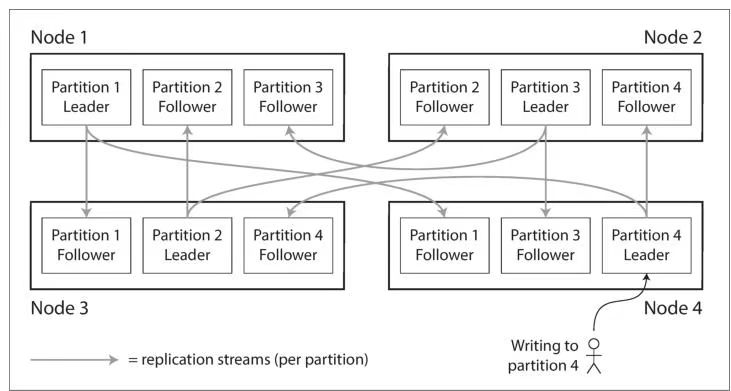
A node may store more than one partition. If a leader–follower replication model isused, the combination of partitioning and replication can look like Figure 6-1. Eachpartition’s leader is assigned to one node, and its followers are assigned to othernodes. Each node may be the leader for some partitions and a follower for other partitions.
一个节点可以存储多个分区。若采用主从复制模型,分区与复制的结合方式可参见图 6-1。每个分区的主节点会被分配至某一个节点,而该分区的从节点则分配至其他节点。每个节点既可以是某些分区的主节点,同时也可以是另一些分区的从节点。
Partitioning of Key-Value Data
If the partitioning is unfair, so that some partitions have more data or queries thanothers, we call it skewed. The presence of skew makes partitioning much less effective.In an extreme case, all the load could end up on one partition, so 9 out of 10 nodesare idle and your bottleneck is the single busy node. A partition with disproportionately high load is called a hot spot.
若分区策略设计得不够均衡,导致部分分区的数据量或查询量远超其他分区,这种情况就称为数据倾斜 。数据倾斜的存在会大幅削弱分区策略的效果。
在极端情况下,所有负载最终都集中在某一个分区上,导致十台节点中有九台处于闲置状态,而系统的性能瓶颈就变成了这台超负荷运转的节点。负载量异常偏高的分区,被称为热点分区。
Skewed Workloads and Relieving Hot Spots
倾斜的负载与热点缓解
Today, most data systems are not able to automatically compensate for such a highlyskewed workload, so it’s the responsibility of the application to reduce the skew. Forexample, if one key is known to be very hot, a simple technique is to add a randomnumber to the beginning or end of the key. Just a two-digit decimal random numberwould split the writes to the key evenly across 100 different keys, allowing those keysto be distributed to different partitions.
如今,大多数数据系统都无法自动应对这类高度倾斜的负载,因此减轻数据倾斜的责任需要由应用层来承担。例如,若已知某个键是高频热点键,一种简单的解决办法是在该键的开头或结尾添加一个随机数。仅一个两位十进制随机数,就能将对原键的写入请求均匀分散到 100 个不同的键上,进而让这些键被分配至不同的分区。
However, having split the writes across different keys, any reads now have to do addi‐tional work, as they have to read the data from all 100 keys and combine it. This tech‐nique also requires additional bookkeeping: it only makes sense to append therandom number for the small number of hot keys; for the vast majority of keys withlow write throughput this would be unnecessary overhead. Thus, you also need someway of keeping track of which keys are being split.
但这种做法会给读取操作带来额外的工作量 —— 因为读取时需要从这 100 个键中分别获取数据,再将结果合并。同时,该方案还需要额外的记录工作:只有对少数热点键添加随机数才有意义;对于绝大多数写入吞吐量较低的普通键来说,这种操作只会造成不必要的开销。因此,应用层还需要有相应的机制,记录哪些键是被拆分处理的热点键。
Request Routing
This is an instance of a more general problem called service discovery, which isn’tlimited to just databases. Any piece of software that is accessible over a network hasthis problem, especially if it is aiming for high availability (running in a redundan tconfiguration on multiple machines). Many companies have written their own in-house service discovery tools, and many of these have been released as open source[30].
这是一个更通用的问题 ——服务发现的具体体现,该问题并非数据库领域所独有。任何可通过网络访问的软件都会面临这个问题,尤其是那些追求高可用性(在多台机器上以冗余配置运行)的软件。许多企业都开发了自研的服务发现工具,其中不少已作为开源项目发布 [30]。
On a high level, there are a few different approaches to this problem (illustrated inFigure 6-7):
- Allow clients to contact any node (e.g., via a round-robin load balancer). If that node coincidentally owns the partition to which the request applies, it can handle the request directly; otherwise, it forwards the request to the appropriate node,receives the reply, and passes the reply along to the client.
- Send all requests from clients to a routing tier first, which determines the node that should handle each request and forwards it accordingly. This routing tier does not itself handle any requests; it only acts as a partition-aware load balancer.
- Require that clients be aware of the partitioning and the assignment of partitions to nodes. In this case, a client can connect directly to the appropriate node,without any intermediary.
从宏观层面来看,解决该问题有以下几种不同方案(如图 6-7 所示):
- 允许客户端访问任意节点(例如,通过轮询负载均衡器)。如果该节点恰好负责请求对应的分区,就可以直接处理这个请求;否则,该节点会将请求转发至对应的目标节点,待接收目标节点的回复后,再将结果反馈给客户端。
- 先将客户端的所有请求发送至路由层,由路由层确定每个请求应对应的处理节点,并完成请求转发。该路由层不处理任何业务请求,仅充当感知分区的负载均衡器。
- 要求客户端知晓分区情况以及分区与节点的对应关系。这种情况下,客户端无需任何中间层,即可直接连接到对应的处理节点。
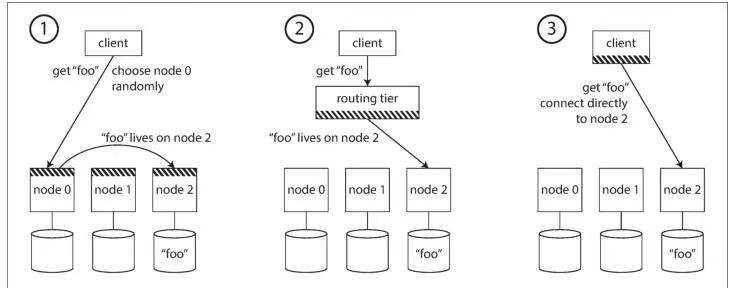
Figure 6-7: Three different ways of routing a request to right nodes
Many distributed data systems rely on a separate coordination service such as ZooKeeper to keep track of this cluster metadata, as illustrated in Figure 6-8. Each noderegisters itself in ZooKeeper, and ZooKeeper maintains the authoritative mapping ofpartitions to nodes. Other actors, such as the routing tier or the partitioning-awareclient, can subscribe to this information in ZooKeeper. Whenever a partition changesownership, or a node is added or removed, ZooKeeper notifies the routing tier so thatit can keep its routing information up to date.
许多分布式数据系统会依赖 ZooKeeper 这类独立的协调服务,来维护集群的元数据信息(如图 6-8 所示)。每个节点会在 ZooKeeper 中完成自身注册,ZooKeeper 则负责维护分区与节点之间的权威映射关系。路由层、感知分区的客户端等其他角色,可以在 ZooKeeper 中订阅这些信息。每当某个分区的归属权发生变更,或是有节点新增、移除时,ZooKeeper 都会及时通知路由层,使其能够实时更新自身的路由信息。
Chapter 7. Transactions
The Slippery Concept of a Transaction
事务的模糊概念
The Meaning of ACID
The safety guarantees provided by transactions are often described by the well-known acronym ACID, which stands for Atomicity, Consistency, Isolation, and Durability.
事务提供的安全保障通常用广为人知的缩写词 ACID 来描述,它分别代表原子性(Atomicity)、一致性(Consistency)、隔离性(Isolation)和持久性(Durability)。
(Systems that do not meet the ACID criteria are sometimes called BASE, whichstands for Basically Available, Soft state, and Eventual consistency [9]. This is evenmore vague than the definition of ACID. It seems that the only sensible definition ofBASE is “not ACID”; i.e., it can mean almost anything you want.)
(那些不符合 ACID 标准的系统有时被称为 BASE 系统,BASE 代表基本可用(Basically Available)、软状态(Soft state)和最终一致性(Eventual consistency)[9]。这个定义比 ACID 的定义还要模糊。似乎对 BASE 唯一合理的解读就是 “非 ACID 系统”—— 也就是说,它几乎可以指代任何你想要的系统类型。)
Atomicity, isolation, and durability are properties of the database, whereas consis‐tency (in the ACID sense) is a property of the application. The application may relyon the database’s atomicity and isolation properties in order to achieve consistency,but it’s not up to the database alone. Thus, the letter C doesn’t really belong in ACID.
原子性、隔离性和持久性是数据库自身的特性,而一致性(就 ACID 的语境而言)则是应用程序的特性。应用程序可能会依赖数据库的原子性与隔离性特性来实现一致性,但这并非仅靠数据库就能完成。因此,ACID 中的字母 C(即一致性)其实并不名副其实。
Single-Object and Multi-Object Operations
To recap, in ACID, atomicity and isolation describe what the database should do if aclient makes several writes within the same transaction:
- Atomicity If an error occurs halfway through a sequence of writes, the transaction should be aborted, and the writes made up to that point should be discarded. In other words, the database saves you from having to worry about partial failure, by giving an all-or-nothing guarantee.
- Isolation Concurrently running transactions shouldn’t interfere with each other. For example, if one transaction makes several writes, then another transaction should see either all or none of those writes, but not some subset.
总而言之,在 ACID 特性中,原子性与隔离性描述了当客户端在同一个事务中执行多次写入操作时,数据库应当采取的处理规则:
- 原子性:如果在一系列写入操作执行的过程中发生错误,事务应当被中止,且此前已完成的写入操作都应被撤销。换句话说,数据库通过提供 “要么全部完成,要么全部不做” 的保障机制,帮你规避了对部分失败情况的担忧。
- 隔离性:并发执行的事务之间不应相互干扰。例如,若某个事务执行了多次写入操作,那么其他事务要么能看到该事务所有写入操作的结果,要么完全看不到,而不会出现只看到其中一部分写入结果的情况。
Weak Isolation Levels
弱隔离级别
Read Committed
How do we prevent dirty reads? One option would be to use the same lock, and torequire any transaction that wants to read an object to briefly acquire the lock andthen release it again immediately after reading. This would ensure that a readcouldn’t happen while an object has a dirty, uncommitted value (because during thattime the lock would be held by the transaction that has made the write).
如何防止脏读的发生呢?一种方案是使用同一把锁,要求所有需要读取某一数据对象的事务先短暂获取该锁,读取完成后立即释放。这种方式可以确保,当数据对象存在未提交的脏数据时,其他事务无法读取该对象(因为这段时间内,锁会被执行写入操作的事务持有)。
However, the approach of requiring read locks does not work well in practice,because one long-running write transaction can force many read-only transactions towait until the long-running transaction has completed. This harms the response timeof read-only transactions and is bad for operability: a slowdown in one part of anapplication can have a knock-on effect in a completely different part of the applica‐tion, due to waiting for locks.
但在实际场景中,这种强制加读锁的方案并不可行。因为一个长时间运行的写入事务,会迫使大量只读事务一直等待,直到该写入事务执行完毕。这会降低只读事务的响应速度,还会影响系统的可操作性:应用程序某一部分的性能下降,会因为锁等待机制,对应用完全无关的其他部分产生连锁影响。
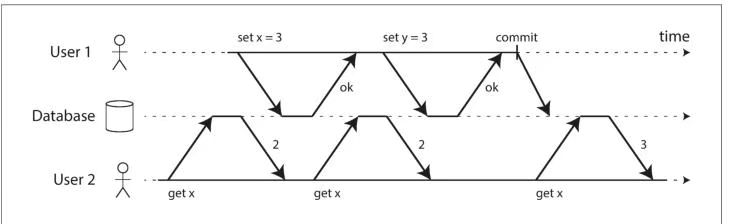
Figure 7-4. No dirty reads: user 2 sees the new value for x only after user 1’s transaction has committed.
For that reason, most databasesvi prevent dirty reads using the approach illustrated in Figure 7-4: for every object that is written, the database remembers both the old committed value and the new value set by the transaction that currently holds the writelock. While the transaction is ongoing, any other transactions that read the object aresimply given the old value. Only when the new value is committed do transactionsswitch over to reading the new value.
正因为如此,大多数数据库会采用图 7-4 所示的方案来防止脏读:对于每一个被写入的数据对象,数据库会同时记录该对象的旧版已提交值,以及当前持有写锁的事务所设置的新版值。在该写入事务的执行过程中,其他所有读取该数据对象的事务,都会直接获取旧版值。只有当新版值被成功提交后,后续事务才会切换为读取新版值。
Snapshot Isolation and Repeatable Read
快照隔离和可重复读
Snapshot isolation [28] is the most common solution to this problem. The idea is that each transaction reads from a consistent snapshot of the database—that is, the transaction sees all the data that was committed in the database at the start of the transac‐tion. Even if the data is subsequently changed by another transaction, eachtransaction sees only the old data from that particular point in time.
快照隔离(Snapshot Isolation) [28] 是解决这一问题最常见的方法。其核心思想是:每个事务都从数据库的一个一致性快照中读取数据——也就是说,事务只能看到在该事务开始时已经提交到数据库中的所有数据。即使之后有其他事务对数据进行了修改,每个事务仍然只会看到那个特定时间点上的旧数据。
To implement snapshot isolation, databases use a generalization of the mechanismwe saw for preventing dirty reads in Figure 7-4. The database must potentially keep several different committed versions of an object, because various in-progress transactions may need to see the state of the database at different points in time. Because itmaintains several versions of an object side by side, this technique is known as multi-version concurrency control (MVCC).
为了实现快照隔离(snapshot isolation),数据库会使用一种机制的泛化版本,这种机制我们在图 7-4 中已经见过,用来防止脏读(dirty reads)。数据库可能需要同时保留同一对象的多个已提交版本,因为不同的正在执行中的事务,可能需要看到数据库在不同时间点的状态。由于这种技术会并排维护同一对象的多个版本,因此被称为多版本并发控制(Multi-Version Concurrency Control,MVCC)。
Each row in a table has a created_by field, containing the ID of the transaction that inserted this row into the table. Moreover, each row has a deleted_by field, which is initially empty. If a transaction deletes a row, the row isn’t actually deleted from thedatabase, but it is marked for deletion by setting the deleted_by field to the ID of the transaction that requested the deletion. At some later time, when it is certain that notransaction can any longer access the deleted data, a garbage collection process in thedatabase removes any rows marked for deletion and frees their space.
表中的每一行都有一个 created_by 字段,用来记录插入该行的事务 ID。此外,每一行还有一个 deleted_by 字段,初始为空。如果某个事务删除了一行,这一行并不会立刻从数据库中真正删除,而是通过将 deleted_by 字段设置为发起删除操作的事务 ID,来标记该行已被删除。等到确认再也没有任何事务可能访问这条已删除的数据之后,数据库中的垃圾回收(garbage collection)进程才会真正移除这些被标记删除的行,并释放它们所占用的空间。
Visibility rules for observing a consistent snapshot
读取一致性快照的可见性规则
When a transaction reads from the database, transaction IDs are used to decidewhich objects it can see and which are invisible. By carefully defining visibility rules,the database can present a consistent snapshot of the database to the application. Thisworks as follows:
- At the start of each transaction, the database makes a list of all the other transac‐ tions that are in progress (not yet committed or aborted) at that time. Any writes that those transactions have made are ignored, even if the transactions subse‐ quently commit.
- Any writes made by aborted transactions are ignored.
- Any writes made by transactions with a later transaction ID (i.e., which started after the current transaction started) are ignored, regardless of whether those transactions have committed.
- All other writes are visible to the application’s queries.
当事务从数据库中读取数据时,数据库会借助事务 ID来判定哪些数据对象对当前事务可见、哪些不可见。通过严谨定义可见性规则,数据库能够为应用程序呈现出一份一致性的数据库快照。其工作机制如下:
- 每个事务启动时,数据库会生成一份清单,记录下此刻所有正在执行中(尚未提交或中止)的其他事务。无论这些事务后续是否提交,它们已执行的所有写入操作,对当前事务而言均视为不可见。
- 所有已中止事务执行的写入操作,均视为不可见。
- 所有事务 ID 更大的事务(即启动时间晚于当前事务的事务)执行的写入操作,无论是否提交,均视为不可见。
- 除上述情况外,其他所有写入操作产生的数据,均对当前应用程序的查询请求可见。
A long-running transaction may continue using a snapshot for a long time, continu‐ing to read values that (from other transactions’ point of view) have long been over‐written or deleted. By never updating values in place but instead creating a newversion every time a value is changed, the database can provide a consistent snapshotwhile incurring only a small overhead.
一个长时间运行的事务可以持续使用某一份快照很长时间,始终读取那些在其他事务看来早已被覆盖或删除的数据值。数据库通过从不原地更新数据值,而是在每次修改数据时都生成一个新版本的设计,仅需产生少量额外开销,就能为事务提供一致性快照。
Preventing Lost Updates
Many databases provide atomic update operations, which remove the need to imple‐ment read-modify-write cycles in application code. They are usually the best solutionif your code can be expressed in terms of those operations. For example, the follow‐ing instruction is concurrency-safe in most relational databases:
许多数据库都支持原子更新操作,这就无需在应用代码中自行实现读 - 改 - 写循环的逻辑。如果业务逻辑可以通过这类操作来表达,原子更新操作通常是最优解决方案。例如,以下操作指令在大多数关系型数据库中都是并发安全的:
1 | |
Atomic operations are usually implemented by taking an exclusive lock on the objectwhen it is read so that no other transaction can read it until the update has been.
原子操作的实现方式通常是:在读取目标数据对象时为其加排他锁,确保在更新操作完成前,其他事务无法读取该数据对象。
Explicit locking
显式锁定
Another option for preventing lost updates, if the database’s built-in atomic operations don’t provide the necessary functionality, is for the application to explicitly lock objects that are going to be updated. Then the application can perform a read-modify-write cycle, and if any other transaction tries to concurrently read the sameobject, it is forced to wait until the first read-modify-write cycle has completed.
若数据库内置的原子操作无法满足业务所需的功能,防止更新丢失的另一方案是由应用程序显式锁定即将被更新的数据对象。此时应用程序可执行读 - 改 - 写循环,而若有其他事务尝试并发读取同一数据对象,会被强制等待,直至第一个读 - 改 - 写循环执行完毕。
Automatically detecting lost updates
自动检测更新丢失
Atomic operations and locks are ways of preventing lost updates by forcing the read-modify-write cycles to happen sequentially. An alternative is to allow them to executein parallel and, if the transaction manager detects a lost update, abort the transactionand force it to retry its read-modify-write cycle.
原子操作与锁机制的核心逻辑是强制读 - 改 - 写循环串行执行,以此避免更新丢失。另一种思路则是允许这些循环并行执行:若事务管理器检测到更新丢失,便中止该事务,并强制其重新执行读 - 改 - 写循环。
An advantage of this approach is that databases can perform this check efficiently inconjunction with snapshot isolation. Indeed, PostgreSQL’s repeatable read, Oracle’sserializable, and SQL Server’s snapshot isolation levels automatically detect when alost update has occurred and abort the offending transaction. However, MySQL/InnoDB’s repeatable read does not detect lost updates [23]. Some authors [28, 30]argue that a database must prevent lost updates in order to qualify as providing snap‐shot isolation, so MySQL does not provide snapshot isolation under this definition.
这种方案的优势在于,数据库可结合快照隔离机制高效完成该检测。事实上,PostgreSQL 的可重复读隔离级别、Oracle 的串行化隔离级别,以及 SQL Server 的快照隔离级别,都会自动检测更新丢失的发生,并中止引发该问题的事务。但 MySQL/InnoDB 的可重复读隔离级别不具备更新丢失检测能力 [23]。有学者 [28,30] 提出,数据库若要被认定为提供 “快照隔离” 能力,必须具备防止更新丢失的特性 —— 按此定义,MySQL 并不满足快照隔离的要求。
Lost update detection is a great feature, because it doesn’t require application code touse any special database features—you may forget to use a lock or an atomic opera‐tion and thus introduce a bug, but lost update detection happens automatically and isthus less error-prone.
更新丢失检测是一项极具价值的特性:它无需应用代码调用任何特殊的数据库功能(你可能会因忘记使用锁或原子操作而引入漏洞),而更新丢失检测是自动触发的,因此出错概率更低。
Compare-and-set
比较并设置(Compare-and-set,CAS)
In databases that don’t provide transactions, you sometimes find an atomic compare-and-set operation (previously mentioned in “Single-object writes” on page 230). Thepurpose of this operation is to avoid lost updates by allowing an update to happenonly if the value has not changed since you last read it. If the current value does notmatch what you previously read, the update has no effect, and the read-modify-writecycle must be retried.
在不提供事务的数据库中,有时会提供一种原子性的比较并设置(compare-and-set)操作(此前已在第 230 页“单对象写入(Single-object writes)”中提到)。这种操作的目的是避免更新丢失:只有当某个值自上次读取以来没有发生变化时,更新才会生效。如果当前值与之前读取到的值不匹配,那么这次更新将不会产生任何效果,此时必须重新执行读–修改–写(read–modify–write)这一循环。
Write Skew and Phantoms
写偏斜与幻读
This anomaly is called write skew [28]. It is neither a dirty write nor a lost update,because the two transactions are updating two different objects (Alice’s and Bob’s on-call records, respectively). It is less obvious that a conflict occurred here, but it’s defi‐nitely a race condition: if the two transactions had run one after another, the seconddoctor would have been prevented from going off call. The anomalous behavior wasonly possible because the transactions ran concurrently.
这种异常被称为写偏斜[28]。它既不属于脏写,也不属于更新丢失,因为两个事务更新的是两个不同的数据对象(分别是爱丽丝和鲍勃的值班记录)。此处的冲突并不明显,但它无疑是一种竞态条件:若两个事务串行执行,第二个医生的离岗操作就会被阻止。这种异常行为的发生,完全是因为事务的并发执行。
You can think of write skew as a generalization of the lost update problem. Write skew can occur if two transactions read the same objects, and then update some ofthose objects (different transactions may update different objects). In the special casewhere different transactions update the same object, you get a dirty write or lostupdate anomaly (depending on the timing).
可以将写偏斜看作是更新丢失问题的广义形式。当两个事务读取了相同的数据对象,随后又更新了其中部分对象(不同事务可能更新不同的对象)时,就可能发生写偏斜。而在不同事务更新同一数据对象的特殊情况下,就会出现脏写或更新丢失异常(具体取决于操作的时序)。
If you can’t use a serializable isolation level, the second-best option in this case is probably to explicitly lock the rows that the transaction depends on. In the doc‐ tors example, you could write something like the following:
如果你无法使用可序列化的隔离级别,那么在这种情况下,次优的选择可能是明确地锁定那些该事务所依赖的行。在文档中的示例中,你可以编写类似以下的代码:
1 | |
Phantoms causing write skew
幻读引发的写偏斜
All of these examples follow a similar pattern:
- A SELECT query checks whether some requirement is satisfied by searching for rows that match some search condition (there are at least two doctors on call,there are no existing bookings for that room at that time, the position on the board doesn’t already have another figure on it, the username isn’t already taken,there is still money in the account).
- Depending on the result of the first query, the application code decides how to continue (perhaps to go ahead with the operation, or perhaps to report an error to the user and abort).
- If the application decides to go ahead, it makes a write (INSERT, UPDATE, or DELETE) to the database and commits the transaction.
所有这类场景都遵循相似的执行模式:
- 执行一条 SELECT 查询,通过检索匹配特定搜索条件的行,判断某项业务要求是否得到满足(例如:至少有两名医生在值班、该会议室在指定时段暂无预订、棋盘上的某位置尚未放置棋子、用户名未被占用、账户内仍有余额)。
- 应用程序代码根据第一步查询的结果,决定后续执行逻辑 —— 要么继续执行相关操作,要么向用户报错并中止事务。
- 若应用程序决定继续执行,则向数据库执行写入操作(INSERT、UPDATE 或 DELETE),并提交事务。
The effect of this write changes the precondition of the decision of step 2. Inother words, if you were to repeat the SELECT query from step 1 after commiting the write, you would get a different result, because the write changed the set ofrows matching the search condition (there is now one fewer doctor on call, themeeting room is now booked for that time, the position on the board is nowtaken by the figure that was moved, the username is now taken, there is now lessmoney in the account).
此次写入操作的结果,会改变第二步执行决策时依赖的前置条件。换句话说,若在写入操作提交后,重新执行第一步的 SELECT 查询,得到的结果会发生变化 —— 因为这次写入改变了匹配搜索条件的行集合(比如此时值班医生的人数减少了一名、会议室在该时段已有预订、棋盘上的目标位置已被占用、用户名变为已占用状态、账户余额相应减少)。
This effect, where a write in one transaction changes the result of a search query inanother transaction, is called a phantom [3]. Snapshot isolation avoids phantoms inread-only queries, but in read-write transactions like the examples we discussed,phantoms can lead to particularly tricky cases of write skew.
一个事务中的写入操作改变了另一个事务中搜索查询的结果,这种现象就称为幻读[3]。快照隔离机制能够避免只读查询出现幻读问题,但在我们讨论过的这类读写事务中,幻读则可能引发尤为棘手的写偏斜场景。
Materializing conflicts
物化冲突
If the problem of phantoms is that there is no object to which we can attach the locks,perhaps we can artificially introduce a lock object into the database?
幻读问题的症结在于没有可以附加锁的数据对象,那么或许我们可以主动在数据库中引入一个锁对象?
For example, in the meeting room booking case you could imagine creating a table oftime slots and rooms. Each row in this table corresponds to a particular room for aparticular time period (say, 15 minutes). You create rows for all possible combina‐tions of rooms and time periods ahead of time, e.g. for the next six months.
以会议室预订场景为例,你可以设想创建一张时段 - 会议室对照表。这张表中的每一行,对应某一间会议室在某一个特定时段(比如 15 分钟)的占用状态。你需要提前创建好未来一段时间内(例如半年)所有会议室与时段的组合记录。
Now a transaction that wants to create a booking can lock (SELECT FOR UPDATE) therows in the table that correspond to the desired room and time period. After it hasacquired the locks, it can check for overlapping bookings and insert a new booking asbefore. Note that the additional table isn’t used to store information about the book‐ing—it’s purely a collection of locks which is used to prevent bookings on the sameroom and time range from being modified concurrently.
如此一来,当某个事务想要创建一条预订记录时,就可以对目标会议室与目标时段对应的表行加锁(执行 SELECT FOR UPDATE 语句)。获取锁之后,事务就可以像之前一样检查是否存在重叠预订,再插入新的预订记录。需要注意的是,这张额外创建的表并非用于存储预订信息 —— 它仅作为锁的集合,用来防止同一间会议室在同一时段的预订请求被并发修改。
This approach is called materializing conflicts, because it takes a phantom and turns itinto a lock conflict on a concrete set of rows that exist in the database [11]. Unfortu‐nately, it can be hard and error-prone to figure out how to materialize conflicts, andit’s ugly to let a concurrency control mechanism leak into the application data model.For those reasons, materializing conflicts should be considered a last resort if noalternative is possible. A serializable isolation level is much preferable in most cases.
这种方案被称为物化冲突,其核心思路是将幻读问题转化为针对数据库中实际存在的一组行记录的锁冲突 [11]。但遗憾的是,设计和实现物化冲突的难度较大,且容易出错;同时,将并发控制机制侵入到应用数据模型中,这种做法也不够优雅。
Serializability
Most databases thatprovide serializability today use one of three techniques, which we will explore in therest of this chapter:
- Literally executing transactions in a serial order (see “Actual Serial Execution” on page 252)
- Two-phase locking (see “**Two-Phase Locking (2PL)**” on page 257), which for several decades was the only viable option
- Optimistic concurrency control techniques such as serializable snapshot isolation (see “**Serializable Snapshot Isolation (SSI)**” on page 261)
如今,大多数提供串行化能力的数据库会采用以下三种技术方案之一,本章后续内容将对其展开详细探讨:
- 严格按照串行顺序执行事务(参见第 252 页的实际串行执行)
- 两阶段锁(2PL)(参见第 257 页的两阶段锁(2PL))—— 该方案在数十年间都是实现串行化唯一可行的选择
- 乐观并发控制技术,例如可串行化快照隔离(SSI)(参见第 261 页的可串行化快照隔离(SSI))
Actual Serial Execution
实际串行执行
With stored procedures and in-memory data, executing all transactions on a singlethread becomes feasible. As they don’t need to wait for I/O and they avoid the over‐head of other concurrency control mechanisms, they can achieve quite goodthroughput on a single thread.
借助存储过程与内存数据技术,让所有事务在单线程上执行的方案具备了可行性。由于这类方案无需等待 I/O 操作,还能规避其他并发控制机制带来的额外开销,因此在单线程下也能实现相当可观的吞吐量。
Summary of serial execution
事务串行执行总结
Serial execution of transactions has become a viable way of achieving serializable isolation within certain constraints:
- Every transaction must be small and fast, because it takes only one slow transac‐ tion to stall all transaction processing.
- It is limited to use cases where the active dataset can fit in memory. Rarely accessed data could potentially be moved to disk, but if it needed to be accessed in a single-threaded transaction, the system would get very slow. x
- Write throughput must be low enough to be handled on a single CPU core, or else transactions need to be partitioned without requiring cross-partition coordination.
- Cross-partition transactions are possible, but there is a hard limit to the extent to which they can be used.
在特定约束条件下,事务的串行执行已成为实现可串行化隔离的一种可行方案:
- 所有事务必须短小且高效,因为仅需一个执行缓慢的事务,就会阻塞所有事务的处理流程。
- 该方案仅适用于活跃数据集可完全放入内存的场景。访问频率较低的数据可以酌情转移至磁盘存储,但如果单线程事务需要访问这些磁盘数据,系统性能会急剧下降。
- 写入吞吐量需低至单个 CPU 核心即可处理的水平;否则,就需要对事务进行分片,且分片后的事务无需跨分片协调。
- 跨分片事务可以执行,但其使用范围存在严格限制。
x. If a transaction needs to access data that’s not in memory, the best solution may be to abort the transac‐ tion, asynchronously fetch the data into memory while continuing to process other transactions, and then restart the transaction when the data has been loaded. This approach is known as anti-caching, as previouslymentioned in “Keeping everything in memory” on page 88.
补充说明:若某个事务需要访问不在内存中的数据,最优方案或许是先中止该事务;在持续处理其他事务的同时,异步将目标数据加载到内存;待数据加载完成后,再重启这个事务。这种方法被称为反缓存,前文第 88 页的 “全内存数据存储” 部分也曾提及。
Two-Phase Locking (2PL)
两阶段锁(2PL)
2PL is not 2PC
Note that while two-phase locking (2PL) sounds very similar to two-phase commit (2PC), they are completely different things. Wewill discuss 2PC in Chapter 9.
需要注意的是,尽管两阶段锁(2PL) 和两阶段提交(2PC) 名称听起来十分相似,但二者是完全不同的机制。关于两阶段提交的内容,我们将在第 9 章展开讨论。
We saw previously that locks are often used to prevent dirty writes (see “No dirtywrites” on page 235): if two transactions concurrently try to write to the same object,the lock ensures that the second writer must wait until the first one has finished itstransaction (aborted or committed) before it may continue.
前文我们提到,锁机制常被用于防止脏写(参见第 235 页 “禁止脏写”):若两个事务尝试并发写入同一数据对象,锁会强制第二个写入事务等待,直至第一个写入事务完成全部操作(提交或中止)后,才能继续执行。
Two-phase locking is similar, but makes the lock requirements much stronger. Sev‐eral transactions are allowed to concurrently read the same object as long as nobodyis writing to it. But as soon as anyone wants to write (modify or delete) an object,exclusive access is required:
If transaction A has read an object and transaction B wants to write to that object, B must wait until A commits or aborts before it can continue. (This ensures that B can’t change the object unexpectedly behind A’s back.)
If transaction A has written an object and transaction B wants to read that object,B must wait until A commits or aborts before it can continue. (Reading an old version of the object, like in Figure 7-1, is not acceptable under 2PL.)
两阶段锁的原理与之类似,但对加锁的要求更为严格。在没有事务对数据对象执行写入操作的前提下,多个事务可以并发读取该数据对象。而一旦有事务要对数据对象执行写入操作(修改或删除),就必须获取该对象的排他访问权,具体规则如下:
- 若事务 A 已读取某数据对象,此时事务 B 想要写入该对象,事务 B 必须等待,直至事务 A 提交或中止后,才能继续执行。(这一规则确保事务 B 不会在事务 A 不知情的情况下擅自修改该对象。)
- 若事务 A 已写入某数据对象,此时事务 B 想要读取该对象,事务 B 必须等待,直至事务 A 提交或中止后,才能继续执行。(在两阶段锁机制下,像图 7-1 那样读取数据对象的旧版本是不被允许的。)
In 2PL, writers don’t just block other writers; they also block readers and vice versa.Snapshot isolation has the mantra readers never block writers, and writers never blockreaders(see “Implementing snapshot isolation” on page 239), which captures this keydifference between snapshot isolation and two-phase locking. On the other hand,because 2PL provides serializability, it protects against all the race conditions dis‐cussed earlier, including lost updates and write skew.
在两阶段锁机制中,写入操作不仅会阻塞其他写入操作,还会阻塞读取操作,反之亦然。快照隔离则遵循 “读不阻塞写,写不阻塞读” 的准则(参见第 239 页 “快照隔离的实现”),这一点恰好体现了快照隔离与两阶段锁的核心差异。而另一方面,由于两阶段锁能够提供串行化隔离级别,因此它可以防范前文讨论过的所有竞态条件,包括更新丢失与写偏斜。
Implementation of two-phase locking
两阶段锁的实现
2PL is used by the serializable isolation level in MySQL (InnoDB) and SQL Server,and the repeatable read isolation level in DB2 [23, 36].
MySQL(InnoDB 引擎)和 SQL Server 的串行化隔离级别,以及 DB2 的可重复读隔离级别,均采用了两阶段锁机制 [23,36]。
The blocking of readers and writers is implemented by a having a lock on each objectin the database. The lock can either be in shared mode or in exclusive mode. The lockis used as follows:
- If a transaction wants to read an object, it must first acquire the lock in shared mode. Several transactions are allowed to hold the lock in shared mode simultaneously, but if another transaction already has an exclusive lock on the object,these transactions must wait.
- If a transaction wants to write to an object, it must first acquire the lock in exclusive mode. No other transaction may hold the lock at the same time (either in shared or in exclusive mode), so if there is any existing lock on the object, the transaction must wait.
- If a transaction first reads and then writes an object, it may upgrade its shared lock to an exclusive lock. The upgrade works the same as getting an exclusive lock directly.
- After a transaction has acquired the lock, it must continue to hold the lock until the end of the transaction (commit or abort). This is where the name “two- phase” comes from: the first phase (while the transaction is executing) is when the locks are acquired, and the second phase (at the end of the transaction) is when all the locks are released.
读写操作之间的阻塞逻辑,是通过为数据库中的每个数据对象配置一把锁来实现的。锁分为两种模式:共享锁模式与排他锁模式,其使用规则如下:
- 若事务需要读取某一数据对象,必须先获取该对象的共享锁。多个事务可以同时持有同一对象的共享锁;但如果该对象已被其他事务加了排他锁,这些事务就必须等待。
- 若事务需要写入某一数据对象,必须先获取该对象的排他锁。同一时间内,不允许其他任何事务持有该对象的锁(无论是共享锁还是排他锁),因此只要该对象上存在任何锁,当前事务就必须等待。
- 若事务先读取某一数据对象、随后又要写入该对象,可将持有的共享锁升级为排他锁。锁升级的执行逻辑与直接获取排他锁完全一致。
- 事务获取锁之后,必须持续持有该锁,直至事务结束(提交或中止)。这正是 “两阶段” 这一名称的由来:第一阶段(事务执行期间)为加锁阶段,第二阶段(事务结束时)为解锁阶段。
Performance of two-phase locking
两阶段锁的性能表现
The big downside of two-phase locking, and the reason why it hasn’t been used byeverybody since the 1970s, is performance: transaction throughput and responsetimes of queries are significantly worse under two-phase locking than under weakisolation.
两阶段锁的一大缺点,也是它自 20 世纪 70 年代起未能得到全面普及的原因,在于性能问题:在两阶段锁机制下,事务吞吐量与查询响应时间的表现,要显著劣于弱隔离级别下的表现。
This is partly due to the overhead of acquiring and releasing all those locks, but moreimportantly due to reduced concurrency. By design, if two concurrent transactionstry to do anything that may in any way result in a race condition, one has to wait forthe other to complete.
性能不佳的部分原因在于获取和释放大量锁所产生的开销,但更关键的因素是并发度的降低。从设计逻辑来看,只要两个并发事务执行的操作存在引发竞态条件的潜在可能,其中一个事务就必须等待另一个事务执行完毕后,才能继续推进。
Predicate locks
谓词锁
In the preceding description of locks, we glossed over a subtle but important detail.In “Phantoms causing write skew” on page 250we discussed the problem of phan‐toms—that is, one transaction changing the results of another transaction’s searchquery. A database with serializable isolation must prevent phantoms.
在之前对锁机制的描述中,我们略过了一个细微但至关重要的细节。在第 250 页 “幻读引发的写偏斜” 一节中,我们讨论了幻读问题 —— 即一个事务改变了另一个事务的搜索查询结果。提供串行化隔离级别的数据库必须防范幻读问题。
In the meeting room booking example this means that if one transaction hassearched for existing bookings for a room within a certain time window (seeExample 7-2), another transaction is not allowed to concurrently insert or updateanother booking for the same room and time range. (It’s okay to concurrently insertbookings for other rooms, or for the same room at a different time that doesn’t affectthe proposed booking.) How do we implement this? Conceptually, we need a predicate lock [3]. It works sim‐ilarly to the shared/exclusive lock described earlier, but rather than belonging to aparticular object (e.g., one row in a table), it belongs to all objects that match somesearch condition, such as:
以会议室预订场景为例,这意味着:若某个事务已查询了某间会议室在特定时间窗口内的现有预订记录(参见示例 7-2),则不允许其他事务并发插入或更新该会议室在同一时间范围内的另一笔预订记录。(而并发插入其他会议室的预订记录,或同一会议室在不影响当前待提交预订的其他时段的预订记录,是允许的。)该如何实现这一规则呢?从逻辑层面来说,我们需要一种谓词锁[3]。它的工作原理与前文所述的共享 / 排他锁类似,但核心区别在于:它并非归属某个特定的数据对象(例如表中的某一行),而是归属所有匹配某一搜索条件的对象,例如以下查询所覆盖的对象:
1 | |
A predicate lock restricts access as follows:
- If transaction A wants to read objects matching some condition, like in that SELECT query, it must acquire a shared-mode predicate lock on the conditions of the query. If another transaction B currently has an exclusive lock on any object matching those conditions, A must wait until B releases its lock before it is allowed to make its query.
- If transaction A wants to insert, update, or delete any object, it must first check whether either the old or the new value matches any existing predicate lock. If there is a matching predicate lock held by transaction B, then A must wait until B has committed or aborted before it can continue.
谓词锁的访问限制规则如下:
- 若事务 A 想要读取匹配某一条件的对象(如上述 SELECT 查询),则必须为该查询的条件获取一把共享模式的谓词锁。如果另一事务 B 当前持有任何匹配该条件的对象的排他锁,那么 A 必须等待 B 释放锁后,才能执行该查询。
- 若事务 A 想要插入、更新或删除任一对象,则必须先检查该对象的旧值或新值是否匹配任何已存在的谓词锁。如果存在事务 B 持有的匹配谓词锁,那么 A 必须等待 B 提交或中止后,才能继续执行。
The key idea here is that a predicate lock applies even to objects that do not yet existin the database, but which might be added in the future (phantoms). If two-phaselocking includes predicate locks, the database prevents all forms of write skew andother race conditions, and so its isolation becomes serializable.
这里的核心思路是:谓词锁的作用范围甚至包括尚未存在于数据库中、但未来可能被添加的对象(即幻行)。如果两阶段锁机制中包含谓词锁,数据库就能防范所有形式的写偏斜及其他竞态条件,从而使其隔离级别达到串行化。
Index-range locks
索引范围锁
Unfortunately, predicate locks do not perform well: if there are many locks by activetransactions, checking for matching locks becomes time-consuming. For that reason,most databases with 2PL actually implement index-range locking(also known as next-key locking), which is a simplified approximation of predicate locking [41, 50].
遗憾的是,谓词锁的性能表现不佳:如果存在大量由活跃事务持有的锁,那么检查是否存在匹配锁的操作会变得十分耗时。正因如此,大多数采用两阶段锁的数据库,实际实现的是索引范围锁(也称为临键锁)—— 它是谓词锁的一种简化近似方案 [41,50]。
Either way, an approximation of the search condition is attached to one of theindexes. Now, if another transaction wants to insert, update, or delete a booking forthe same room and/or an overlapping time period, it will have to update the samepart of the index. In the process of doing so, it will encounter the shared lock, and itwill be forced to wait until the lock is released.
无论采用哪种实现方式,查询条件的近似范围都会关联到某一个索引上。此时,若另一个事务想要插入、更新或删除同一间会议室、且 / 或时间存在重叠的预订记录,就必须更新索引的同一部分。在执行该操作的过程中,该事务会遇到对应的共享锁,进而被强制等待,直至这把锁被释放。
This provides effective protection against phantoms and write skew. Index-rangelocks are not as precise as predicate locks would be (they may lock a bigger range of objects than is strictly necessary to maintain serializability), but since they have muchlower overheads, they are a good compromise.
这种机制能够有效防范幻读与写偏斜问题。索引范围锁的精准度不及谓词锁(为了维持串行化,它锁定的对象范围可能比严格所需的范围更大),但由于其开销要低得多,因此是一种很好的折中方案。
If there is no suitable index where a range lock can be attached, the database can fallback to a shared lock on the entire table. This will not be good for performance, sinceit will stop all other transactions writing to the table, but it’s a safe fallback position.
如果不存在可关联范围锁的合适索引,数据库会退而求其次,对整个表加共享锁。这种做法的性能表现并不好,因为它会阻止所有其他事务向该表写入数据,但却是一种安全的兜底方案。
Serializable Snapshot Isolation (SSI)
可串行化快照隔离(SSI)
Decisions based on an outdated premise
基于过期前提的决策
When we previously discussed write skew in snapshot isolation (see “Write Skew andPhantoms” on page 246), we observed a recurring pattern: a transaction reads somedata from the database, examines the result of the query, and decides to take someaction (write to the database) based on the result that it saw. However, under snap‐shot isolation, the result from the original query may no longer be up-to-date by thetime the transaction commits, because the data may have been modified in the mean‐time.
前文讨论快照隔离下的写偏斜问题时(参见第 246 页 “写偏斜与幻读”),我们发现了一种重复出现的模式:事务先从数据库中读取部分数据,分析查询结果,再基于所见的结果决定执行某些操作(向数据库写入数据)。但在快照隔离机制下,当事务提交时,初始查询得到的结果可能已经失效 —— 因为在此期间,相关数据可能已被修改。
Put another way, the transaction is taking an action based on a premise (a fact thatwas true at the beginning of the transaction, e.g., “There are currently two doctors oncall”). Later, when the transaction wants to commit, the original data may havechanged—the premise may no longer be true.
换一种说法,事务的操作是基于某一前提执行的(该前提在事务启动时成立,例如 “目前有两名医生在值班”)。而当事务准备提交时,原始数据可能已经发生变化,这个前提也就不再成立。
When the application makes a query (e.g., “How many doctors are currently oncall?”), the database doesn’t know how the application logic uses the result of thatquery. To be safe, the database needs to assume that any change in the query result(the premise) means that writes in that transaction may be invalid. In other words,there may be a causal dependency between the queries and the writes in the transac‐tion. In order to provide serializable isolation, the database must detect situations inwhich a transaction may have acted on an outdated premise and abort the transac‐tion in that case.
当应用程序发起查询(例如 “当前有多少名医生在值班?”)时,数据库并不知道应用程序的业务逻辑会如何利用该查询结果。为了保证安全性,数据库需要做出这样的假设:查询结果(即前提)的任何变化,都可能导致该事务中的写入操作失效。换句话说,事务中的查询操作与写入操作之间,可能存在一种因果依赖关系。
How does the database know if a query result might have changed? There are twocases to consider:
- Detecting reads of a stale MVCC object version (uncommitted write occurred before the read)
- Detecting writes that affect prior reads (the write occurs after the read)
数据库如何判断查询结果是否可能发生变化?需要考虑以下两种情况:
- 检测对多版本并发控制(MVCC)过期数据版本的读取操作(即读取操作发生前,已有未提交的写入操作存在)
- 检测会影响历史读取结果的写入操作(即写入操作发生在读取操作之后)
Summary
Dirty reads One client reads another client’s writes before they have been committed. The read committed isolation level and stronger levels prevent dirty reads.
脏读 一个客户端读取了另一个客户端尚未提交的写入数据。读已提交及更高级别的隔离级别可以防止脏读。
Dirty writes One client overwrites data that another client has written, but not yet committed. Almost all transaction implementations prevent dirty writes.
脏写 一个客户端覆盖了另一个客户端已写入但未提交的数据。几乎所有事务实现都能防止脏写。
Read skew (nonrepeatable reads) A client sees different parts of the database at different points in time. This issue is most commonly prevented with snapshot isolation, which allows a transaction to read from a consistent snapshot at one point in time. It is usually implemented with multi-version concurrency control (MVCC).
读偏斜(不可重复读) 一个客户端在事务的不同时间点,读取到数据库中不一致的数据集。这个问题最常用快照隔离来解决,快照隔离允许事务读取某一时间点的一致性快照,通常基于多版本并发控制(MVCC) 实现。
Lost updates Two clients concurrently perform a read-modify-write cycle. One overwrites the other’s write without incorporating its changes, so data is lost. Some implemen‐ tations of snapshot isolation prevent this anomaly automatically, while others require a manual lock (SELECT FOR UPDATE).
更新丢失 两个客户端并发执行读 - 改 - 写循环,其中一个客户端的写入操作覆盖了另一个的写入结果,且未整合对方的修改,导致数据丢失。部分快照隔离的实现会自动防止这种异常,其他实现则需要手动加锁(如执行 SELECT FOR UPDATE 语句)。
Write skew A transaction reads something, makes a decision based on the value it saw, and writes the decision to the database. However, by the time the write is made, the premise of the decision is no longer true. Only serializable isolation prevents this anomaly.
写偏斜 一个事务读取某些数据后,基于所见的值做出决策,并将决策结果写入数据库。但当写入操作执行时,当初决策所依赖的前提条件已不再成立。只有串行化隔离级别能够防止这种异常。
Phantom reads A transaction reads objects that match some search condition. Another client makes a write that affects the results of that search. Snapshot isolation prevents straightforward phantom reads, but phantoms in the context of write skew require special treatment, such as index-range locks.
幻读 一个事务读取匹配某一搜索条件的对象,另一个客户端执行写入操作,改变了该搜索条件的结果集。快照隔离可以防止简单的幻读,但幻读引发的写偏斜问题需要特殊处理,例如使用索引范围锁。
Weak isolation levels protect against some of those anomalies but leave you, theapplication developer, to handle others manually (e.g., using explicit locking). Onlyserializable isolation protects against all of these issues. We discussed three differentapproaches to implementing serializable transactions:
弱隔离级别只能防范上述部分异常,其余异常需要应用开发者手动处理(例如使用显式锁)。只有串行化隔离级别能够防范所有这些问题。我们讨论过三种实现串行化事务的方案:
Literally executing transactions in a serial order If you can make each transaction very fast to execute, and the transaction throughput is low enough to process on a single CPU core, this is a simple and effective option.
严格按串行顺序执行事务 若能保证每个事务执行速度极快,且事务吞吐量低至单个 CPU 核心即可处理,这会是一种简单且高效的方案。
Two-phase locking For decades this has been the standard way of implementing serializability, but many applications avoid using it because of its performance characteristics.
两阶段锁 数十年来,这一直是实现串行化的标准方案,但由于其性能特性,许多应用会避免使用它。
Serializable snapshot isolation (SSI) A fairly new algorithm that avoids most of the downsides of the previous approaches. It uses an optimistic approach, allowing transactions to proceed without blocking. When a transaction wants to commit, it is checked, and it is aborted if the execution was not serializable.
可串行化快照隔离(SSI) 这是一种相对较新的算法,规避了前两种方案的大部分缺点。它采用乐观并发控制思路,允许事务无阻塞地执行;仅在事务提交阶段进行冲突检查,若检测到执行过程不满足串行化要求,则中止该事务并要求重试。
Chapter 8. The Trouble With Distributed Systems
Faults and Partial Failures
故障与部分失效
There is no fundamental reason why software on a single computer should be flaky:when the hardware is working correctly, the same operation always produces thesame result (it is deterministic). If there is a hardware problem (e.g., memory corrup‐tion or a loose connector), the consequence is usually a total system failure (e.g., ker‐nel panic, “blue screen of death,” failure to start up). An individual computer withgood software is usually either fully functional or entirely broken, but not somethingin between.
单台计算机上的软件本不该存在稳定性问题:在硬件正常运行的情况下,相同操作理应产生相同结果(即具备确定性)。若硬件出现故障(例如内存损坏或接口松动),后果通常是系统完全瘫痪(如内核崩溃、蓝屏死机、无法启动)。一台搭载优质软件的独立计算机,其状态通常只有完全可用和彻底故障两种,而非介于两者之间的中间状态。
This is a deliberate choice in the design of computers: if an internal fault occurs, weprefer a computer to crash completely rather than returning a wrong result, becausewrong results are difficult and confusing to deal with. Thus, computers hide the fuzzyphysical reality on which they are implemented and present an idealized systemmodel that operates with mathematical perfection. A CPU instruction always doesthe same thing; if you write some data to memory or disk, that data remains intactand doesn’t get randomly corrupted. This design goal of always-correct computationgoes all the way back to the very first digital computer [3].
这是计算机设计过程中一个刻意为之的选择:当内部故障发生时,我们更倾向于让计算机彻底崩溃,而非返回错误结果 —— 因为错误结果的处理难度大,且极易造成混乱。基于此,计算机屏蔽了底层硬件模糊的物理特性,对外呈现出一个理想化的系统模型,该模型能够以数学层面的完美状态运行。一条 CPU 指令的执行结果永远保持一致;向内存或磁盘写入的数据会完整留存,不会发生随机损坏。这种 “始终正确计算” 的设计目标,最早可以追溯到第一台数字计算机诞生的时代 [3]。
If we want to make distributed systems work, we must accept the possibility of partial failure and build fault-tolerance mechanisms into the software. In other words, we need to build a reliable system from unreliable components. (As discussed in “Relia‐bility” on page 6, there is no such thing as perfect reliability, so we’ll need to understand the limits of what we can realistically promise.) Even in smaller systems consisting of only a few nodes, it’s important to think aboutpartial failure. In a small system, it’s quite likely that most of the components areworking correctly most of the time. However, sooner or later, some part of the system will become faulty, and the software will have to somehow handle it. The fault han‐dling must be part of the software design, and you (as operator of the software) needto know what behavior to expect from the software in the case of a fault.
若要让分布式系统稳定运行,我们就必须接受部分失效的可能性,并在软件中内置容错机制。换句话说,我们需要用不可靠的组件构建可靠的系统。(正如第 6 页 “可靠性” 一节所讨论的,绝对可靠的系统并不存在,因此我们需要清楚自己实际能承诺的可靠性边界。)即便是由少数节点构成的小型系统,考量部分失效问题也同样重要。在小型系统中,大多数组件多数时候都能正常工作,这种情况是很常见的。但无论如何,系统的某个部分迟早会出现故障,软件必须以某种方式对此进行处理。故障处理逻辑必须作为软件设计的一部分,而你(作为软件运维人员)需要清楚,当故障发生时,软件会呈现出怎样的行为。
Building a Reliable System from Unreliable Components
You may wonder whether this makes any sense—intuitively it may seem like a systemcan only be as reliable as its least reliable component (its weakest link). This is not thecase: in fact, it is an old idea in computing to construct a more reliable system from aless reliable underlying base [11]. For example:
- Error-correcting codes allow digital data to be transmitted accurately across a communication channel that occasionally gets some bits wrong, for example due to radio interference on a wireless network [12].
- IP (the Internet Protocol) is unreliable: it may drop, delay, duplicate, or reorder packets. TCP (the Transmission Control Protocol) provides a more reliable transport layer on top of IP: it ensures that missing packets are retransmitted,duplicates are eliminated, and packets are reassembled into the order in which they were sent.
你可能会疑惑,这种思路是否成立 —— 直观来看,系统的可靠性似乎至多等同于其最不可靠组件的可靠性(也就是 “木桶效应”)。但事实并非如此:实际上,通过可靠性较低的底层基础构建更可靠的系统,是计算机领域的一个古老理念 [11]。例如:
- 纠错码技术能够让数字数据在存在偶发比特错误的通信信道上准确传输,比如无线网络中受无线电干扰影响的信道 [12]。
- 互联网协议(IP)本身是不可靠的:它可能会丢弃、延迟、重复或乱序发送数据包。而传输控制协议(TCP)在 IP 的基础上,提供了更可靠的传输层服务:它会确保丢失的数据包被重传、重复的数据包被剔除,并且数据包会按照发送顺序重新组装。
Although the system can be more reliable than its underlying parts, there is always alimit to how much more reliable it can be. For example, error-correcting codes candeal with a small number of single-bit errors, but if your signal is swamped by inter‐ference, there is a fundamental limit to how much data you can get through yourcommunication channel [13]. TCP can hide packet loss, duplication, and reorderingfrom you, but it cannot magically remove delays in the network.
尽管上层系统的可靠性可以高于底层组件,但这种可靠性的提升存在本质上限。例如,纠错码可以处理少量的单比特错误,但如果信号被干扰完全淹没,通信信道能够传输的数据量就会存在无法突破的极限 [13]。TCP 可以为你屏蔽丢包、重复和乱序的问题,却无法凭空消除网络延迟。
Although the more reliable higher-level system is not perfect, it’s still useful because ittakes care of some of the tricky low-level faults, and so the remaining faults are usu‐ally easier to reason about and deal with. We will explore this matter further in “Theend-to-end argument” on page 519.
虽然经过可靠性增强的上层系统并非尽善尽美,但它依然具备很高的实用价值:因为它已经处理了部分棘手的底层故障,剩下的故障通常更容易被分析和应对。关于这一点,我们将在第 519 页的 “端到端原则” 一节中展开进一步探讨。
Knowledge, Truth, and Lies
认知、真相与误判
The moral of these stories is that a node cannot necessarily trust its own judgment ofa situation. A distributed system cannot exclusively rely on a single node, because anode may fail at any time, potentially leaving the system stuck and unable to recover.Instead, many distributed algorithms rely on a quorum, that is, voting among thenodes (see “Quorums for reading and writing” on page 179): decisions require someminimum number of votes from several nodes in order to reduce the dependence onany one particular node.
这些案例揭示的核心启示是:节点未必能信任自身对当前状况的判断。分布式系统不能完全依赖单个节点 —— 因为任一节点都可能随时发生故障,这有可能导致整个系统陷入停滞且无法恢复。恰恰相反,许多分布式算法的设计都依赖于法定人数机制,即通过节点间的投票达成决策(参见第 179 页 “读写操作的法定人数机制”):决策的生效需要获取若干节点的最低票数支持,以此降低系统对单一节点的依赖。
That includes decisions about declaring nodes dead. If a quorum of nodes declaresanother node dead, then it must be considered dead, even if that node still very muchfeels alive. The individual node must abide by the quorum decision and step down.
这一机制同样适用于节点失效状态的判定决策。只要超过法定人数的节点判定某一节点已失效,无论该节点自身是否仍处于正常运行状态,都必须被认定为失效节点。该节点自身也必须遵从法定人数的决策结果,退出系统运行。
Most commonly, the quorum is an absolute majority of more than half the nodes(although other kinds of quorums are possible). A majority quorum allows the sys‐tem to continue working if individual nodes have failed (with three nodes, one failurecan be tolerated; with five nodes, two failures can be tolerated). However, it is stillsafe, because there can only be only one majority in the system—there cannot be twomajorities with conflicting decisions at the same time. We will discuss the use of quo‐rums in more detail when we get to consensus algorithmsin Chapter 9.
在实践中,法定人数通常指超过半数节点的绝对多数派(当然也存在其他类型的法定人数机制)。多数派法定人数机制允许系统在部分节点失效的情况下继续运行:3 个节点的集群可容忍 1 个节点失效,5 个节点的集群则可容忍 2 个节点失效。同时,这种机制具备安全性 —— 系统中同一时间只会存在一个多数派,不会出现两个持有冲突决策的多数派并存的情况。关于法定人数机制的具体应用,我们将在第 9 章探讨共识算法时展开详细论述。
Let’s assume that every time the lock server grants a lock or lease, it also returns afencing token, which is a number that increases every time a lock is granted (e.g.,incremented by the lock service). We can then require that every time a client sends awrite request to the storage service, it must include its current fencing token.
我们不妨做这样的设定:锁服务器每次授予锁或租约时,都会同时返回一个防护令牌。这个令牌是一个数字,每授予一次锁就会递增(例如由锁服务负责递增)。基于此,我们可以要求客户端每次向存储服务发送写入请求时,都必须附带其当前持有的防护令牌。
In Figure 8-5, client 1 acquires the lease with a token of 33, but then it goes into along pause and the lease expires. Client 2 acquires the lease with a token of 34 (thenumber always increases) and then sends its write request to the storage service,including the token of 34. Later, client 1 comes back to life and sends its write to thestorage service, including its token value 33. However, the storage server remembersthat it has already processed a write with a higher token number (34), and so it rejectsthe request with token 33.
在图 8-5 的场景中,客户端 1 获取了防护令牌为 33 的租约,但随后进入长时间停滞状态,租约也随之过期。客户端 2 紧接着获取了防护令牌为 34 的租约(令牌数值始终保持递增),并向存储服务发送写入请求,请求中附带了令牌 34。一段时间后,客户端 1 恢复正常运行,也向存储服务发送写入请求,附带的令牌数值为 33。但存储服务器会记录自己已经处理过令牌数值更高(34)的写入请求,因此会拒绝携带令牌 33 的这次请求。
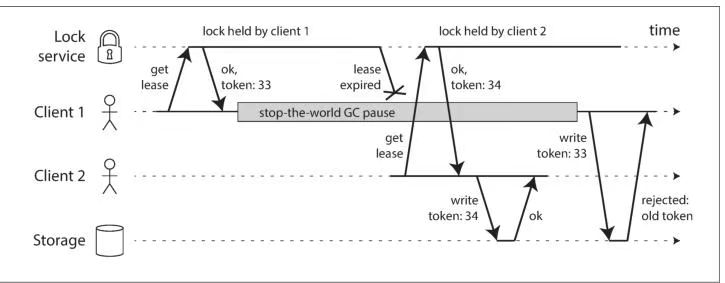
Figure 8-5. Making access to storage safe by allowing writes only in the order of increasing fencing tokens
Byzantine Faults
拜占庭故障
The Byzantine Generals Problem
拜占庭将军问题
The Byzantine Generals Problem is a generalization of the so-called Two Generals Problem[78], which imagines a situation in which two army generals need to agreeon a battle plan. As they have set up camp on two different sites, they can only com‐municate by messenger, and the messengers sometimes get delayed or lost (like pack‐ets in a network). We will discuss this problem of consensusin Chapter 9.
拜占庭将军问题是两军问题[78] 的泛化扩展,该问题构想了这样一种场景:两位军队将领需要就作战计划达成共识。由于他们分别扎营在两处不同的营地,只能通过信使传递消息,而信使可能会出现延误或失踪的情况(就像网络中的数据包丢失一样)。关于这个共识问题,我们将在第 9 章展开讨论。
In the Byzantine version of the problem, there are n generals who need to agree, andtheir endeavor is hampered by the fact that there are some traitors in their midst.Most of the generals are loyal, and thus send truthful messages, but the traitors maytry to deceive and confuse the others by sending fake or untrue messages (while try‐ing to remain undiscovered). It is not known in advance who the traitors are.
在拜占庭将军问题的设定中,共有n位将领需要达成共识,而他们的行动受制于一个情况 —— 队伍中存在叛徒。大多数将领是忠诚的,会传递真实的消息,但叛徒可能会发送伪造或虚假的消息,以此欺骗、混淆其他将领的判断,同时还会设法隐藏自己的身份。叛徒的身份在事前是未知的。
A system is Byzantine fault-tolerant if it continues to operate correctly even if someof the nodes are malfunctioning and not obeying the protocol, or if malicious attack‐ers are interfering with the network. This concern is relevant in certain specific circumstances
若一个系统即便在部分节点发生故障、不遵守协议,或遭遇恶意攻击者的网络干扰时,仍能保持正确运行,那么这个系统就具备拜占庭容错能力。这类问题仅在一些特定场景下才需要重点考量。
System Model and Reality
系统模型与现实
Correctness of an algorithm
To define what it means for an algorithm to be correct, we can describe its properties.For example, the output of a sorting algorithm has the property that for any two dis‐tinct elements of the output list, the element further to the left is smaller than the ele‐ment further to the right. That is simply a formal way of defining what it means for alist to be sorted.
要定义一个算法的正确性,我们可以描述它应具备的特性。例如,排序算法的输出具有这样的特性:对于输出列表中的任意两个不同元素,左侧的元素始终小于右侧的元素。这是对 “列表已排序” 这一概念的一种形式化定义方式。
Similarly, we can write down the properties we want of a distributed algorithm todefine what it means to be correct. For example, if we are generating fencing tokensfor a lock (see “Fencing tokens” on page 303), we may require the algorithm to havethe following properties:
- Uniqueness No two requests for a fencing token return the same value.
- Monotonic sequence If request xreturned token tx, and request yreturned token ty, and x completed before ybegan, then tx< ty.
- Availability A node that requests a fencing token and does not crash eventually receives a response.
同理,我们也可以通过列举期望的特性,来定义一个分布式算法的正确性。例如,在为锁生成防护令牌时(参见第 303 页 “防护令牌”),我们可能要求该算法具备以下特性:
- 唯一性:任意两次防护令牌的请求,都不会返回相同的数值。
- 单调性序列:若请求x返回的令牌为tx,请求y返回的令牌为ty,且请求x在请求y开始之前完成,则有 tx<ty。
- 可用性:发起防护令牌请求且未发生崩溃的节点,最终都会收到响应。
An algorithm is correct in some system model if it always satisfies its properties in allsituations that we assume may occur in that system model. But how does this makesense? If all nodes crash, or all network delays suddenly become infinitely long, thenno algorithm will be able to get anything done.
若一个算法在某个系统模型所假设的所有可能发生的场景中,均能始终满足其既定特性,那么该算法在这个系统模型中就是正确的。但这一说法如何才能成立呢?如果所有节点都发生崩溃,或者所有网络延迟突然变得无限长,那么任何算法都无法完成任务。
Safety and liveness
安全属性与活性属性
To clarify the situation, it is worth distinguishing between two different kinds ofproperties: safety and liveness properties. In the example just given, uniqueness and monotonic sequence are safety properties, but availability is a liveness property.
为了厘清这一情况,我们有必要区分两类不同的属性:安全属性与活性属性。在刚才的示例中,唯一性与单调性序列属于安全属性,而可用性则属于活性属性。
What distinguishes the two kinds of properties? A giveaway is that liveness propertiesoften include the word “eventually” in their definition. (And yes, you guessed it—eventual consistency is a liveness property [89].)
这两类属性的区别是什么?一个显著特征是,活性属性的定义中往往包含 “最终” 一词。(没错,你可以猜到 ——最终一致性就是一种活性属性 [89]。)
Safety is often informally defined as nothing bad happens, and liveness as something good eventually happens. However, it’s best to not read too much into those informaldefinitions, because the meaning of good and bad is subjective. The actual definitionsof safety and liveness are precise and mathematical [90]:
- If a safety property is violated, we can point at a particular point in time at which it was broken (for example, if the uniqueness property was violated, we can iden‐ tify the particular operation in which a duplicate fencing token was returned). After a safety property has been violated, the violation cannot be undone—the damage is already done.
- A liveness property works the other way round: it may not hold at some point in time (for example, a node may have sent a request but not yet received a response), but there is always hope that it may be satisfied in the future (namely by receiving a response).
安全属性的通俗定义通常是 “不会发生任何糟糕的情况”,而活性属性则是“好事最终总会发生”。不过,我们不宜过度解读这些通俗定义,因为 “好” 与 “坏” 的界定具有主观性。安全属性与活性属性的准确定义,是严谨且具备数学依据的 [90]:
- 若某一安全属性被违反,我们可以明确指出它被破坏的具体时间点(例如,若唯一性属性被违反,我们能够定位到返回重复防护令牌的那次具体操作)。安全属性一旦被违反,这种违规状态便无法逆转 —— 损害已经造成。
- 活性属性的逻辑则恰好相反:它可能在某个时间点不成立(例如,某个节点已发送请求但尚未收到响应),但我们始终有理由相信,它在未来某一时刻可以得到满足(也就是通过接收响应来达成)。
An advantage of distinguishing between safety and liveness properties is that it helpsus deal with difficult system models. For distributed algorithms, it is common torequire that safety properties always hold, in all possible situations of a system model[88]. That is, even if all nodes crash, or the entire network fails, the algorithm mustnevertheless ensure that it does not return a wrong result (i.e., that the safety proper‐ties remain satisfied).
区分安全属性与活性属性的一大好处,在于它能帮助我们应对复杂的系统模型。对于分布式算法而言,一个常见的要求是:安全属性必须在系统模型的所有可能场景下始终成立[88]。也就是说,即便所有节点崩溃、或整个网络瘫痪,算法也必须保证不会返回错误结果(即安全属性始终得到满足)。
Summary
In this chapter we also went on some tangents to explore whether the unreliability ofnetworks, clocks, and processes is an inevitable law of nature. We saw that it isn’t: it is possible to give hard realtime response guarantees and bounded delays in networks, but doing so is very expensive and results in lower utilization of hardwareresources. Most non-safety-critical systems choose cheap and unreliable over expensive and reliable.
在本章中,我们还穿插探讨了一些延伸话题,旨在弄清网络、时钟与进程的不可靠性是否属于不可规避的自然规律。而我们得到的结论是:并非如此。硬实时响应保证与网络有界延迟是可以实现的,但这种实现的成本极其高昂,并且会导致硬件资源利用率降低。对于大多数非安全关键系统而言,它们更倾向于选择廉价但不可靠的方案,而非昂贵但可靠的方案。
Chapter 9. Consistency and Consensus
第九章. 一致性和共识
The best way of building fault-tolerant systems is to find some general-purpose abstractions with useful guarantees, implement them once, and then let applicationsrely on those guarantees. This is the same approach as we used with transactions inChapter 7: by using a transaction, the application can pretend that there are nocrashes (atomicity), that nobody else is concurrently accessing the database (isola‐tion), and that storage devices are perfectly reliable (durability). Even though crashes,race conditions, and disk failures do occur, the transaction abstraction hides thoseproblems so that the application doesn’t need to worry about them.
构建容错系统的最佳方式,是提炼出若干具备实用保障机制的通用抽象,对其进行一次性实现,而后让上层应用直接依赖这些保障机制运行。这与我们在第 7 章中讨论事务时采用的思路如出一辙:通过使用事务,应用程序可以无需考虑崩溃问题(原子性)、无需考虑其他主体并发访问数据库的情况(隔离性),也无需考虑存储设备的可靠性问题(持久性)。尽管崩溃、竞态条件和磁盘故障实际都会发生,但事务抽象会将这些问题完全屏蔽,让应用程序无需再为其费心。
Linearizability
线性一致性
What Makes a System Linearizable?
什么样的系统具备线性一致性?
Linearizability Versus Serializability
线性一致性与可串行化的区别
Linearizability is easily confused with serializability (see “Serializability” on page 251),as both words seem to mean something like “can be arranged in a sequential order.”However, they are two quite different guarantees, and it is important to distinguishbetween them:
线性一致性很容易与可串行化混淆(参见第 251 页 “可串行化”),这两个术语的字面意思都近似于 “可按某种顺序排列”。但实际上,二者是两种截然不同的保障机制,厘清它们的区别至关重要:
Serializability Serializability is an isolation property of transactions, where every transaction may read and write multiple objects (rows, documents, records)—see “Single- Object and Multi-Object Operations” on page 228. It guarantees that transac‐ tions behave the same as if they had executed in some serial order (each transaction running to completion before the next transaction starts). It is okay for that serial order to be different from the order in which transactions were actually run [12].
可串行化 可串行化是事务的隔离属性,适用于包含多对象(行、文档、记录)读写操作的事务场景(参见第 228 页 “单对象与多对象操作”)。它能保证:事务的执行效果,等价于所有事务按照某一种串行顺序依次执行 —— 即每个事务都完整执行完毕后,下一个事务才开始执行。这种串行顺序,允许与事务实际的执行顺序不一致 [1
Linearizability Linearizability is a recency guarantee on reads and writes of a register (an indi‐ vidual object). It doesn’t group operations together into transactions, so it does not prevent problems such as write skew (see “Write Skew and Phantoms” on page 246), unless you take additional measures such as materializing conflicts (see “Materializing conflicts” on page 251).
线性一致性 线性一致性是寄存器(单个对象)读写操作的最新性保障。它不会将多个操作分组为事务,因此无法防范写偏斜这类问题(参见第 246 页 “写偏斜与幻读”),除非额外采取物化冲突等措施(参见第 251 页 “物化冲突”)。
A database may provide both serializability and linearizability, and this combinationis known as strict serializabilityor strong one-copy serializability(strong-1SR) [4, 13].Implementations of serializability based on two-phase locking (see “Two-Phase Lock‐ing (2PL)” on page 257) or actual serial execution (see “Actual Serial Execution” onpage 252) are typically linearizable.
一个数据库可以同时提供可串行化与线性一致性这两种保障,这种组合特性被称为严格可串行化或强单副本可串行化(strong-1SR)[4,13]。基于两阶段锁(参见第 257 页 “两阶段锁(2PL)”)或严格串行执行(参见第 252 页 “严格串行执行”)实现的可串行化,通常具备线性一致性。
However, serializable snapshot isolation (see “Serializable Snapshot Isolation (SSI)”on page 261) is not linearizable: by design, it makes reads from a consistent snapshot,to avoid lock contention between readers and writers. The whole point of a consistentsnapshot is that it does not include writes that are more recent than the snapshot, andthus reads from the snapshot are not linearizable.
但可串行化快照隔离(SSI)(参见第 261 页 “可串行化快照隔离(SSI)”)不具备线性一致性:其设计初衷是让事务读取一致性快照,以此避免读写操作之间的锁竞争。而一致性快照的核心特点,就是不包含快照生成之后的新写入操作 —— 因此,基于快照的读取不满足线性一致性要求。
Relying on Linearizability
Similar issues arise if you want to ensure that a bank account balance never goes neg‐ative, or that you don’t sell more items than you have in stock in the warehouse, orthat two people don’t concurrently book the same seat on a flight or in a theater.These constraints all require there to be a single up-to-date value (the account balance, the stock level, the seat occupancy) that all nodes agree on.
当你需要确保以下约束条件时,也会遇到类似的问题:银行账户余额绝不能为负、商品出库数量不超过仓库库存量、航班或剧院的同一个座位不会被两人同时预订。这些约束的实现,都需要一个所有节点均认可的单一最新有效值—— 即账户余额、库存数量、座位占用状态。
In real applications, it is sometimes acceptable to treat such constraints loosely (forexample, if a flight is overbooked, you can move customers to a different flight andoffer them compensation for the inconvenience). In such cases, linearizability maynot be needed, and we will discuss such loosely interpreted constraints in “Timelinessand Integrity” on page 524.
在实际业务场景中,这类约束有时可以宽松处理。例如,若航班出现超售情况,你可以为乘客改签至其他航班,并为其因此产生的不便提供补偿。在这类场景下,就不需要用到线性一致性;关于这类宽松约束的相关内容,我们将在第 524 页的 “时效性与完整性” 一节中展开讨论。
However, a hard uniqueness constraint, such as the one you typically find in rela‐tional databases, requires linearizability. Other kinds of constraints, such as foreignkey or attribute constraints, can be implemented without requiring linearizability[19].
但对于硬性唯一性约束(例如关系型数据库中常见的唯一性约束),则必须依赖线性一致性才能实现。而其他类型的约束(如外键约束或属性约束),即便不依赖线性一致性,同样可以实现 [19]。
The Cost of Linearizability
线性一致性的成本
The Unhelpful CAP Theorem
并无实际指导意义的 CAP 定理
CAP is sometimes presented as Consistency, Availability, Partition tolerance: pick 2out of 3. Unfortunately, putting it this way is misleading [32] because network parti‐tions are a kind of fault, so they aren’t something about which you have a choice: theywill happen whether you like it or not [38].
CAP 定理有时被阐释为一致性(Consistency)、可用性(Availability)、分区容错性(Partition tolerance)三者选其二。但遗憾的是,这种表述具有误导性 [32]—— 因为网络分区属于一种故障类型,它的发生并不以人的意志为转移,无论你是否愿意,它迟早都会出现 [38]。
At times when the network is working correctly, a system can provide both consistency (linearizability) and total availability. When a network fault occurs, you have tochoose between either linearizability or total availability. Thus, a better way of phras‐ing CAP would be either Consistent or Available when Partitioned[39]. A more relia‐ble network needs to make this choice less often, but at some point the choice isinevitable.
在网络正常运行时,系统可以同时提供一致性(线性一致性)**与**完全可用性**。而当网络故障导致分区发生时,你就必须在线性一致性与完全可用性之间做出取舍。因此,对 CAP 定理更准确的表述应当是:发生网络分区时,一致性与可用性二者择一**[39]。网络可靠性越高,需要做出这种取舍的频率就越低,但从根本上来说,这种选择是无法避免的。
In discussions of CAP there are several contradictory definitions of the term availa‐bility, and the formalization as a theorem [30] does not match its usual meaning [40].Many so-called “highly available” (fault-tolerant) systems actually do not meet CAP’sidiosyncratic definition of availability. All in all, there is a lot of misunderstandingand confusion around CAP, and it does not help us understand systems better, soCAP is best avoided.
在关于 CAP 定理的讨论中,“可用性” 这一术语存在多种相互矛盾的定义,该定理的形式化定义 [30] 与 “可用性” 的常规含义并不相符 [40]。许多所谓的 “高可用”(容错)系统,实际上并不符合 CAP 定理中对可用性的特殊定义。总而言之,围绕 CAP 定理存在大量的误解与混淆,它不仅无法帮助我们更深入地理解系统,反而可能造成困扰,因此最好尽量避免过度依赖这一理论。
The CAP theorem as formally defined [30] is of very narrow scope: it only considersone consistency model (namely linearizability) and one kind of fault (network parti‐tions,vi or nodes that are alive but disconnected from each other). It doesn’t say anything about network delays, dead nodes, or other trade-offs. Thus, although CAP hasbeen historically influential, it has little practical value for designing systems [9, 40].
从形式化定义来看 [30],CAP 定理的适用范围非常狭窄:它只考量了一种一致性模型(即线性一致性)和一种故障类型(网络分区,也就是节点存活但彼此断开连接的情况)。对于网络延迟、节点宕机,以及其他需要权衡的因素,该定理并未提及。因此,尽管 CAP 定理在历史上具有一定的影响力,但对于实际的系统设计而言,它的实用价值十分有限 [9,40]。
Can’t we maybe find a more efficient implementation of linearizable storage? Itseems the answer is no: Attiya and Welch [47] prove that if you want linearizability,the response time of read and write requests is at least proportional to the uncertainty of delays in the network. In a network with highly variable delays, like most com‐puter networks (see “Timeouts and Unbounded Delays” on page 281), the responsetime of linearizable reads and writes is inevitably going to be high. A faster algorithmfor linearizability does not exist, but weaker consistency models can be much faster,so this trade-off is important for latency-sensitive systems. In Chapter 12 we will dis‐cuss some approaches for avoiding linearizability without sacrificing correctness.
难道我们就不能找到一种更高效的线性一致性存储实现方案吗?答案似乎是否定的:阿提亚(Attiya)与韦尔奇(Welch)[47] 证明,若要实现线性一致性,读写请求的响应时间至少与网络延迟的不确定性成正比。对于延迟高度可变的网络(如多数计算机网络,参见第 281 页的《超时与无界延迟》一节)而言,线性一致性读写的响应时间必然会处于较高水平。目前并不存在更快速的线性一致性实现算法,但弱一致性模型的执行效率可以提升很多,因此这种权衡对延迟敏感型系统而言至关重要。在第 12 章中,我们将探讨一些无需牺牲正确性、同时又能规避线性一致性的实现方案。
Ordering Guarantees
顺序保障
Causality imposes an ordering on events: cause comes before effect; a message is sentbefore that message is received; the question comes before the answer. And, like inreal life, one thing leads to another: one node reads some data and then writes some‐thing as a result, another node reads the thing that was written and writes somethingelse in turn, and so on. These chains of causally dependent operations define thecausal order in the system—i.e., what happened before what.
因果关系会给事件施加一种先后顺序:因发生于果之前;消息的发送发生于该消息的接收之前;问题的提出发生于该问题的解答之前。与现实场景同理,事件的发生环环相扣:某个节点读取部分数据后,基于这些数据执行写入操作;另一个节点读取此次写入的结果,继而又执行新的写入操作,以此类推。这些存在因果依赖的操作链,定义了系统中的因果顺序—— 即哪些事件发生在哪些事件之前。
If a system obeys the ordering imposed by causality, we say that it is causally consistent. For example, snapshot isolation provides causal consistency: when you readfrom the database, and you see some piece of data, then you must also be able to seeany data that causally precedes it (assuming it has not been deleted in the meantime).
若一个系统遵循因果关系所施加的顺序规则,我们就称该系统具备因果一致性。例如,快照隔离就能够提供因果一致性:当你从数据库中读取数据时,若能看到某一份数据,那么你也一定能看到所有在因果关系上先于这份数据产生的数据(前提是这些前置数据在此期间未被删除)。
The Causal order is not a total order
因果顺序并非全序
The difference between a total order and a partial order is reflected in different data‐base consistency models:
全序与偏序的区别,体现在不同的数据库一致性模型中:
Linearizability In a linearizable system, we have a total order of operations: if the system behaves as if there is only a single copy of the data, and every operation is atomic, this means that for any two operations we can always say which one happened first. This total ordering is illustrated as a timeline in Figure 9-4.
线性一致性 在一个线性一致性系统中,所有操作遵循全序关系:如果系统的表现就如同只有一份数据副本,且每个操作都是原子性的,那么这意味着对于任意两个操作,我们始终能够判定二者的先后顺序。这种全序关系可以用图 9-4 中的时间线直观表示。
Causality We said that two operations are concurrent if neither happened before the other (see “The “happens-before” relationship and concurrency” on page 186). Put another way, two events are ordered if they are causally related (one happened before the other), but they are incomparable if they are concurrent. This means that causality defines a partial order, not a total order: some operations are ordered with respect to each other, but some are incomparable.
因果关系 我们曾定义:若两个操作之间不存在 “先发生” 关系,则称这两个操作是并发的(参见第 186 页 “‘先发生’关系与并发”)。换而言之,若两个事件存在因果关联(一个事件发生在另一个事件之前),则二者存在明确的先后顺序;若两个事件是并发的,则二者之间无法比较先后。这意味着因果关系定义的是一种偏序关系,而非全序关系:部分操作之间存在明确的先后顺序,但部分操作之间无法比较。
Therefore, according to this definition, there are no concurrent operations in a linearizable datastore: there must be a single timeline along which all operations aretotally ordered. There might be several requests waiting to be handled, but the data‐store ensures that every request is handled atomically at a single point in time, actingon a single copy of the data, along a single timeline, without any concurrency.
因此,根据这个定义,线性一致性数据存储中不存在并发操作:所有操作必须沿着一条单一的时间线构成全序关系。系统中可能存在多个等待处理的请求,但数据存储会确保每个请求都在某个时间点被原子性地处理,基于唯一的数据副本、遵循单一的时间线执行,不存在任何并发情况。
Concurrency would mean that the timeline branches and merges again—and in thiscase, operations on different branches are incomparable (i.e., concurrent). We sawthis phenomenon in Chapter 5: for example, Figure 5-14 is not a straight-line totalorder, but rather a jumble of different operations going on concurrently. The arrowsin the diagram indicate causal dependencies—the partial ordering of operations.
并发意味着时间线会产生分支,之后又会合并 —— 在这种情况下,不同分支上的操作之间无法比较先后(即处于并发状态)。我们在第 5 章中已经见过这种现象:例如,图 5-14 所展示的并非一条线性的全序关系,而是多个操作并发执行的混杂状态。图中的箭头代表了因果依赖关系,也就是操作之间的偏序关系。
If you are familiar with distributed version control systems such as Git, their versionhistories are very much like the graph of causal dependencies. Often one commithappens after another, in a straight line, but sometimes you get branches (when sev‐eral people concurrently work on a project), and merges are created when those con‐currently created commits are combined.
如果你熟悉 Git 这类分布式版本控制系统,就会发现它们的版本历史与因果依赖关系图非常相似。版本提交通常会沿着一条直线依次进行,但有时也会产生分支(比如多人并发协作同一个项目时);当这些并发创建的提交被整合到一起时,就会形成合并记录。
Linearizability is stronger than causal consistency
线性一致性强于因果一致性
So what is the relationship between the causal order and linearizability? The answer is that linearizability implies causality: any system that is linearizable will preserve causality correctly [7]. In particular, if there are multiple communication channels in asystem (such as the message queue and the file storage service in Figure 9-5), lineariz‐ability ensures that causality is automatically preserved without the system having todo anything special (such as passing around timestamps between different components).
那么,因果顺序与线性一致性之间存在怎样的关系?答案是线性一致性蕴含因果一致性:任何具备线性一致性的系统,都能正确地保持因果关系 [7]。具体来说,若系统中存在多条通信渠道(例如图 9-5 中的消息队列与文件存储服务),线性一致性可以确保因果关系被自动维持,无需系统采取任何特殊手段(比如在不同组件之间传递时间戳)。
The fact that linearizability ensures causality is what makes linearizable systems simple to understand and appealing. However, as discussed in “The Cost of Linearizability” on page 335, making a system linearizable can harm its performance andavailability, especially if the system has significant network delays (for example, if it’s geographically distributed). For this reason, some distributed data systems have abandoned linearizability, which allows them to achieve better performance but can make them difficult to work with.
线性一致性能够保障因果关系这一特性,让线性一致性系统易于理解且颇具吸引力。但正如第 335 页《线性一致性的成本》一节所讨论的,实现系统的线性一致性可能会损害其性能与可用性,在系统存在显著网络延迟的场景下(例如地理分布式系统),这种负面影响尤为突出。正因如此,部分分布式数据系统舍弃了线性一致性 —— 这一做法能换取更优的性能表现,但也会提升系统的使用难度。
The good news is that a middle ground is possible. Linearizability is not the only wayof preserving causality—there are other ways too. A system can be causally consistentwithout incurring the performance hit of making it linearizable (in particular, theCAP theorem does not apply). In fact, causal consistency is the strongest possibleconsistency model that does not slow down due to network delays, and remains available in the face of network failures [2, 42].
好消息是,我们可以找到一种折中方案。线性一致性并非保持因果关系的唯一方式,还存在其他替代方案。系统可以在不承担线性一致性带来的性能损耗的前提下,实现因果一致性(值得一提的是,这种情况下 CAP 定理不再适用)。实际上,因果一致性是这样一种一致性模型:它是不会因网络延迟而降低速度、且在网络故障发生时仍能保持可用的最强一致性模型[2,42]。
In many cases, systems that appear to require linearizability in fact only really require causal consistency, which can be implemented more efficiently. Based on this observation, researchers are exploring new kinds of databases that preserve causality, with performance and availability characteristics that are similar to those of eventually consistent systems [49, 50, 51].
在许多场景下,看似需要线性一致性的系统,实际上往往只需要因果一致性即可 —— 而因果一致性的实现效率更高。基于这一发现,研究人员正在探索具备因果一致性保障能力的新型数据库,这类数据库的性能与可用性表现,与最终一致性系统相近 [49,50,51]。
Sequence Number Ordering
序列编号排序
Although causality is an important theoretical concept, actually keeping track of allcausal dependencies can become impractical. In many applications, clients read lotsof data before writing something, and then it is not clear whether the write is causallydependent on all or only some of those prior reads. Explicitly tracking all the datathat has been read would mean a large overhead.
因果关系虽是一个重要的理论概念,但实际追踪所有因果依赖关系,往往不具备可行性。在诸多应用场景中,客户端会先读取大量数据,再执行写入操作,而此时我们很难界定,后续的写入操作是与此前所有的读取操作存在因果依赖,还是仅与其中部分读取操作有关。若要显式追踪所有已读取的数据,会产生极大的性能开销。
However, there is a better way: we can use sequence numbersor timestamps to orderevents. A timestamp need not come from a time-of-day clock (or physical clock,which have many problems, as discussed in “Unreliable Clocks” on page 287). It caninstead come from a logical clock, which is an algorithm to generate a sequence ofnumbers to identify operations, typically using counters that are incremented forevery operation.
不过,我们可以采用一种更优的方案:借助序列编号或时间戳来为事件排序。时间戳的来源不一定是日历时钟(即物理时钟,其存在诸多弊端,详见第 287 页的《不可靠时钟》),也可以来源于逻辑时钟。逻辑时钟是一种生成数字序列以标识操作的算法,通常会为每一次操作递增计数器,以此生成对应的编号。
Such sequence numbers or timestamps are compact (only a few bytes in size), andthey provide a total order: that is, every operation has a unique sequence number, andyou can always compare two sequence numbers to determine which is greater (i.e.,which operation happened later).
这类序列编号或时间戳具备简洁性(仅占用数个字节的存储空间),并且能够定义一种全序关系:也就是说,每一项操作都对应一个唯一的序列编号,通过对比任意两个序列编号的大小,我们就能判断出对应操作的先后顺序(编号更小的操作发生时间更早)。
In particular, we can create sequence numbers in a total order that is consistent withcausality:vii we promise that if operation A causally happened before B, then A occurs before B in the total order (A has a lower sequence number than B). Concurrentoperations may be ordered arbitrarily. Such a total order captures all the causalityinformation, but also imposes more ordering than strictly required by causality.
值得一提的是,我们可以生成一种与因果关系一致的全序序列编号:⁷ 我们保证,若操作 A 在因果关系上发生于操作 B 之前,那么在全序关系中,操作 A 也会排在操作 B 之前(即操作 A 的序列编号小于操作 B)。对于并发操作,则可按照任意顺序排列。这种全序关系既涵盖了所有因果信息,又施加了比因果关系严格得多的排序约束。
In a database with single-leader replication (see “Leaders and Followers” on page152), the replication log defines a total order of write operations that is consistentwith causality. The leader can simply increment a counter for each operation, andthus assign a monotonically increasing sequence number to each operation in thereplication log. If a follower applies the writes in the order they appear in the replica‐tion log, the state of the follower is always causally consistent (even if it is lagging behind the leader).
在采用单主复制的数据库中(详见第 152 页的《主节点与从节点》),复制日志定义了一套与因果关系一致的写入操作全序。主节点只需为每一次操作递增计数器,就能为复制日志中的每一项操作分配一个单调递增的序列编号。若从节点严格按照复制日志中的顺序执行写入操作,那么无论其同步进度是否落后于主节点,自身的数据状态都能始终保持因果一致性。
A Lamport timestamp bears no relationship to a physical time-of-day clock, but it provides total ordering: if you have two timestamps, the one with a greater countervalue is the greater timestamp; if the counter values are the same, the one with thegreater node ID is the greater timestamp.
兰波特时间戳与物理日历时钟毫无关联,但它能够实现全序关系排序:若存在两个时间戳,计数器数值更大的那个时间戳更大;若两个时间戳的计数器数值相同,则节点 ID 更大的那个时间戳更大。
So far this description is essentially the same as the even/odd counters described inthe last section. The key idea about Lamport timestamps, which makes them consis‐tent with causality, is the following: every node and every client keeps track of themaximum counter value it has seen so far, and includes that maximum on everyrequest. When a node receives a request or response with a maximum counter valuegreater than its own counter value, it immediately increases its own counter to thatmaximum.
截至目前,上述描述本质上与上一节提到的奇偶计数器机制完全一致。兰波特时间戳之所以能与因果关系保持一致,其核心设计思路如下:每个节点与每个客户端都会记录自身迄今为止见过的最大计数器值,并在每次请求中附带该最大值。当某个节点接收到的请求或响应中,携带的最大计数器值大于自身当前的计数器值时,该节点会立即将自身的计数器更新为这个最大值。
This is shown in Figure 9-8, where client A receives a counter value of 5 from node 2,and then sends that maximum of 5 to node 1. At that time, node 1’s counter was only1, but it was immediately moved forward to 5, so the next operation had an incre‐mented counter value of 6.
这一过程如图 9-8 所示:客户端 A 从节点 2 获取到计数器值 5,随后便将这个最大值 5 携带至发往节点 1 的请求中。此时,节点 1 自身的计数器值仅为 1,但它会立即将计数器更新为 5,因此其执行的下一次操作,对应的计数器值就会递增为 6。
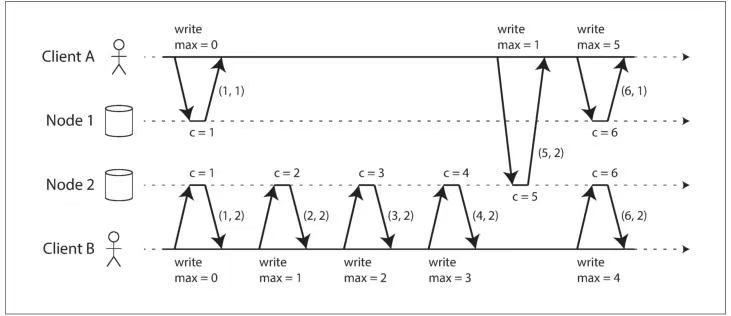
As long as the maximum counter value is carried along with every operation, thisscheme ensures that the ordering from the Lamport timestamps is consistent withcausality, because every causal dependency results in an increased timestamp.
只要每次操作都携带当前的最大计数器值,这套机制就能确保兰波特时间戳所定义的排序与因果关系一致 —— 因为每一个因果依赖关系,都会对应一个递增的时间戳。
Total Order Broadcast
全序广播
Total order broadcast is usually described as a protocol for exchanging messagesbetween nodes. Informally, it requires that two safety properties always be satisfied:
- Reliable delivery No messages are lost: if a message is delivered to one node, it is delivered to all nodes.
- Totally ordered delivery Messages are delivered to every node in the same order.
全序广播通常被定义为一种节点间的消息交换协议。通俗来讲,该协议要求始终满足以下两项安全属性:
- 可靠投递:无消息丢失。若一条消息被投递至某一节点,就必须被投递至所有节点。
- 全序投递:所有节点接收消息的顺序完全一致。
A correct algorithm for total order broadcast must ensure that the reliability and ordering properties are always satisfied, even if a node or the network is faulty. Of course, messages will not be delivered while the network is interrupted, but an algorithm can keep retrying so that the messages get through when the network is eventually repaired (and then they must still be delivered in the correct order).
一个正确的全序广播算法,必须确保上述可靠性与有序性属性始终成立,即便是在节点或网络发生故障的情况下。当然,网络中断期间消息无法完成投递,但算法可以持续重试,确保网络恢复后消息能够成功送达(且送达时仍需遵循既定的正确顺序)。
Using total order broadcast
全序广播的应用场景
Consensus services such as ZooKeeper and etcd actually implement total orderbroadcast. This fact is a hint that there is a strong connection between total orderbroadcast and consensus, which we will explore later in this chapter.
ZooKeeper、etcd 这类共识服务的底层,实际上都实现了全序广播机制。这一特性也暗示了全序广播与共识之间存在紧密的关联,我们将在本章后续内容中深入探讨这一点。
Total order broadcast is exactly what you need for database replication: if every mes‐sage represents a write to the database, and every replica processes the same writes inthe same order, then the replicas will remain consistent with each other (aside fromany temporary replication lag). This principle is known as state machine replication[60], and we will return to it in Chapter 11.
全序广播的特性,恰好满足数据库复制的核心需求:如果每条消息对应一次数据库写入操作,且所有副本都按照相同顺序处理这些写入请求,那么各副本之间的数据状态就能保持一致(暂不考虑暂时性的复制延迟)。这一实现原理被称为状态机复制[60],我们会在第 11 章中进一步展开讨论。
Similarly, total order broadcast can be used to implement serializable transactions: asdiscussed in “Actual Serial Execution” on page 252, if every message represents adeterministic transaction to be executed as a stored procedure, and if every node pro‐cesses those messages in the same order, then the partitions and replicas of the data‐base are kept consistent with each other [61].
同理,全序广播也可用于实现可串行化事务:正如第 252 页《实际串行执行》一节所述,若每条消息对应一个可作为存储过程执行的确定性事务,且所有节点都按同一顺序处理这些消息,那么数据库的各个分区与副本就能维持数据一致性 [61]。
An important aspect of total order broadcast is that the order is fixed at the time themessages are delivered: a node is not allowed to retroactively insert a message into anearlier position in the order if subsequent messages have already been delivered. Thisfact makes total order broadcast stronger than timestamp ordering.
全序广播的一个关键特性在于,消息的投递顺序在送达时即被固定:如果后续消息已经完成投递,节点就不能再将新消息回溯插入到顺序中的靠前位置。这一特性使得全序广播的排序能力,要强于基于时间戳的排序方式。
Another way of looking at total order broadcast is that it is a way of creating a log (asin a replication log, transaction log, or write-ahead log): delivering a message is likeappending to the log. Since all nodes must deliver the same messages in the sameorder, all nodes can read the log and see the same sequence of messages.
从另一个角度理解,全序广播相当于构建了一份日志(类似复制日志、事务日志或预写式日志):投递消息的过程,就等同于向日志中追加内容。由于所有节点接收消息的顺序完全一致,因此它们读取这份日志时,看到的消息序列也完全相同。
Total order broadcast is also useful for implementing a lock service that provides fencing tokens (see “Fencing tokens” on page 303). Every request to acquire the lockis appended as a message to the log, and all messages are sequentially numbered inthe order they appear in the log. The sequence number can then serve as a fencingtoken, because it is monotonically increasing. In ZooKeeper, this sequence number is called zxid [15].
全序广播还可用于实现支持围栏令牌的锁服务(详见第 303 页《围栏令牌》)。所有获取锁的请求都会作为消息追加到日志中,日志中的消息会按照顺序被分配一个连续的序列号。这个序列号即可作为围栏令牌,因为它具备单调递增的特性。在 ZooKeeper 中,该序列号被称为 zxid[15]。
Implementing linearizable storage using total order broadcast
基于全序广播实现线性化存储
Total order broadcast is asynchronous: messages are guaranteed to be delivered relia‐bly in a fixed order, but there is no guarantee about when a message will be delivered(so one recipient may lag behind the others). By contrast, linearizability is a recencyguarantee: a read is guaranteed to see the latest value written.
全序广播是异步的:它能确保消息以固定顺序实现可靠投递,但并不保证消息的投递时间(因此部分接收方可能会落后于其他节点)。相比之下,线性化是一种最新值保证:读取操作一定能获取到最新写入的数据值。
However, if you have total order broadcast, you can build linearizable storage on topof it. For example, you can ensure that usernames uniquely identify user accounts.
不过,基于全序广播机制,我们可以构建出线性化存储。例如,利用这一方式能够确保用户名可以唯一标识用户账户。
Imagine that for every possible username, you can have a linearizable register with anatomic compare-and-set operation. Every register initially has the value null (indi‐ cating that the username is not taken). When a user wants to create a username, youexecute a compare-and-set operation on the register for that username, setting it tothe user account ID, under the condition that the previous register value is null. Ifmultiple users try to concurrently grab the same username, only one of the compare-and-set operations will succeed, because the others will see a value other than null (due to linearizability).
我们可以这样设想:为每一个可能被使用的用户名配置一个线性化寄存器,该寄存器支持原子化比较并设置操作。所有寄存器的初始值均为 null(表示对应的用户名尚未被占用)。当用户想要注册某一用户名时,就对该用户名对应的寄存器执行比较并设置操作 —— 若寄存器当前值为 null,则将其更新为该用户的账户 ID。
You can implement such a linearizable compare-and-set operation as follows byusing total order broadcast as an append-only log [62, 63]:
- Append a message to the log, tentatively indicating the username you want to claim.
- Read the log, and wait for the message you appended to be delivered back to you.xi
- Check for any messages claiming the username that you want. If the first message for your desired username is your own message, then you are successful: you can commit the username claim (perhaps by appending another message to the log) and acknowledge it to the client. If the first message for your desired username is from another user, you abort the operation.
借助全序广播构建一个追加式日志,我们就能实现上述的线性化比较并设置操作,具体流程如下 [62, 63]:
- 向日志中追加一条消息,暂存声明要占用的用户名相关信息。
- 读取日志内容,并等待自己追加的这条消息被回传给自身。
- 检查日志中是否存在其他声明占用该用户名的消息。
- 若针对该用户名的第一条声明消息来自于自身,则操作成功:你可以提交用户名占用声明(方式之一是向日志中再追加一条确认消息),并向客户端返回操作成功的响应。
- 若针对该用户名的第一条声明消息来自其他用户,则终止本次操作。
Because log entries are delivered to all nodes in the same order, if there are severalconcurrent writes, all nodes will agree on which one came first. Choosing the first ofthe conflicting writes as the winner and aborting later ones ensures that all nodesagree on whether a write was committed or aborted. A similar approach can be usedto implement serializable multi-object transactions on top of a log [62].
由于日志条目会以相同的顺序投递至所有节点,因此即便存在多笔并发写入操作,所有节点也会对这些操作的先后顺序形成一致共识。我们可以将存在冲突的写入操作中,排在首位的那一笔判定为执行成功,其余后续操作则终止执行。这种处理方式能够确保所有节点对某笔写入操作最终是提交还是终止,达成完全一致的结论。基于类似的思路,我们还可以在日志之上实现支持可串行化的多对象事务[62]。
While this procedure ensures linearizable writes, it doesn’t guarantee linearizablereads—if you read from a store that is asynchronously updated from the log, it maybe stale. (To be precise, the procedure described here provides sequential consistency[47, 64], sometimes also known as timeline consistency [65, 66], a slightly weakerguarantee than linearizability.) To make reads linearizable, there are a few options:
- You can sequence reads through the log by appending a message, reading the log,and performing the actual read when the message is delivered back to you. The message’s position in the log thus defines the point in time at which the read happens. (Quorum reads in etcd work somewhat like this [16].)
- If the log allows you to fetch the position of the latest log message in a linearizable way, you can query that position, wait for all entries up to that position to be delivered to you, and then perform the read. (This is the idea behind Zoo‐ Keeper’s sync() operation [15].)
- You can make your read from a replica that is synchronously updated on writes,and is thus sure to be up to date. (This technique is used in chain replication [63]; see also “Research on Replication” on page 155.)
上述流程虽能保障写入操作的线性化,但无法确保读取操作的线性化 —— 如果读取操作的数据源是一个通过日志异步更新的存储副本,那么读取到的数据就可能是过期的。(准确来说,此处描述的流程提供的是顺序一致性[47, 64],该一致性模型有时也被称为时间线一致性[65, 66],其保障强度略低于线性化一致性。)若要实现线性化读取,可采用以下几种方案:
- 将读取操作也纳入日志的排序流程:先向日志中追加一条消息,随后读取日志内容,待这条消息被回传至自身时,再执行实际的读取操作。如此一来,该消息在日志中的位置,就定义了读取操作发生的时间点。(etcd 中的仲裁读机制,工作原理与此类似 [16]。)
- 如果日志支持以线性化的方式获取最新日志条目的位置,那么可以先查询该位置,等待所有序号不大于该位置的日志条目全部投递至本地后,再执行读取操作。(这正是 ZooKeeper 中
sync()操作的设计思路 [15]。) - 选择从一个写入同步更新的副本中读取数据,这类副本的数据状态可以确保是实时最新的。(该技术被应用于链式复制协议中 [63];相关内容亦可参考第 155 页的《复制技术研究》。)
Implementing total order broadcast using linearizable storage
基于线性化存储实现全序广播
The last section showed how to build a linearizable compare-and-set operation from total order broadcast. We can also turn it around, assume that we have linearizable storage, and show how to build total order broadcast from it.
上一节介绍了如何基于全序广播实现线性化比较并设置操作。我们也可以反过来,假设已经具备线性化存储能力,再基于它来构建全序广播机制。
The easiest way is to assume you have a linearizable register that stores an integer andthat has an atomic increment-and-get operation [28]. Alternatively, an atomic compare-and-set operation would also do the job.
实现这一目标的最简方式,是假定存在一个存储整数的线性化寄存器,且该寄存器支持原子化自增获取操作[28]。当然,使用原子化比较并设置操作也能达成同样的效果。
The algorithm is simple: for every message you want to send through total orderbroadcast, you increment-and-get the linearizable integer, and then attach the valueyou got from the register as a sequence number to the message. You can then sendthe message to all nodes (resending any lost messages), and the recipients will deliverthe messages consecutively by sequence number.
对应的算法十分简洁:对于每一条需要通过全序广播发送的消息,先对这个线性化整数执行原子化自增获取操作,再将从寄存器中获取的数值作为序列号附加到消息上。随后,将这条消息发送至所有节点(并重发所有丢失的消息),接收方则按照序列号的顺序依次投递消息。
Note that unlike Lamport timestamps, the numbers you get from incrementing the linearizable register form a sequence with no gaps. Thus, if a node has delivered mes‐sage 4 and receives an incoming message with a sequence number of 6, it knows thatit must wait for message 5 before it can deliver message 6. The same is not the case with Lamport timestamps—in fact, this is the key difference between total order broadcast and timestamp ordering.
需要注意的是,与兰波特时间戳不同,通过线性化寄存器自增得到的数值,生成的是一个无间隙的连续序列。因此,若某个节点已经投递了序列号为 4 的消息,此时收到一条序列号为 6 的消息,就知道必须先等待消息 5 投递完成,再处理消息 6。而兰波特时间戳则不具备这一特性 —— 实际上,这正是全序广播与时间戳排序的核心区别。
How hard could it be to make a linearizable integer with an atomic increment-and-get operation? As usual, if things never failed, it would be easy: you could just keep itin a variable on one node. The problem lies in handling the situation when networkconnections to that node are interrupted, and restoring the value when that node fails[59]. In general, if you think hard enough about linearizable sequence number gener‐ators, you inevitably end up with a consensus algorithm.
实现一个支持原子化自增获取操作的线性化整数寄存器,难度究竟有多大?和大多数分布式问题一样,如果系统永远不会发生故障,这件事会非常简单:只需在单个节点上用一个变量存储该整数即可。真正的难点在于,如何处理与该节点的网络连接中断的情况,以及节点故障后如何恢复该数值 [59]。通常来说,只要深入研究线性化序列号生成器的实现方案,最终都会不可避免地触及共识算法。
This is no coincidence: it can be proved that a linearizable compare-and-set (orincrement-and-get) register and total order broadcast are both equivalent to consensus [28, 67]. That is, if you can solve one of these problems, you can transform it intoa solution for the others. This is quite a profound and surprising insight!
这并非偶然现象:已有相关证明表明,支持原子化比较并设置(或自增获取)操作的线性化寄存器、全序广播,这两者在本质上都与共识问题等价[28, 67]。也就是说,只要能解决其中任意一个问题,就能将其转化为解决另外两个问题的方案。这是一个深刻且出人意料的结论!
Distributed Transactions and Consensus
分布式事务与共识
In this section we will first examine the atomic commit problem in more detail. Inparticular, we will discuss the two-phase commit (2PC) algorithm, which is the mostcommon way of solving atomic commit and which is implemented in various data‐bases, messaging systems, and application servers. It turns out that 2PC is a kind ofconsensus algorithm—but not a very good one [70, 71].
在本节中,我们将首先深入探讨原子提交问题。具体而言,我们会介绍两阶段提交(2PC)算法—— 这是解决原子提交问题最常用的方案,已在各类数据库、消息系统及应用服务器中落地实现。事实证明,2PC 本质上属于一种共识算法,只是其性能与可靠性表现并不算出色 [70, 71]。
By learning from 2PC we will then work our way toward better consensus algorithms,such as those used in ZooKeeper (Zab) and etcd (Raft).
我们将从 2PC 的设计思路与局限性中汲取经验,进而介绍性能更优的共识算法,例如 ZooKeeper 所采用的 Zab 算法与 etcd 所采用的 Raft 算法。
Atomic Commit and Two-Phase Commit (2PC)
原子提交与两阶段提交(2PC)
In Chapter 7 we learned that the purpose of transaction atomicity is to provide sim‐ple semantics in the case where something goes wrong in the middle of making several writes. The outcome of a transaction is either a successful commit, in which caseall of the transaction’s writes are made durable, or an abort, in which case all of thetransaction’s writes are rolled back (i.e., undone or discarded).
在第 7 章中我们已经了解到,事务原子性的设计目标,是在多笔写入操作执行过程中发生异常时,为系统提供简洁清晰的执行语义。事务的最终结果只有两种可能:要么成功提交,此时事务内的所有写入操作都会被持久化;要么执行回滚,此时事务内的所有写入操作都会被撤销(即取消或丢弃已执行的修改)。
Atomicity prevents failed transactions from littering the database with half-finished results and half-updated state. This is especially important for multi-object transactions (see “Single-Object and Multi-Object Operations” on page 228) and databasesthat maintain secondary indexes. Each secondary index is a separate data structurefrom the primary data—thus, if you modify some data, the corresponding changeneeds to also be made in the secondary index. Atomicity ensures that the secondaryindex stays consistent with the primary data (if the index became inconsistent withthe primary data, it would not be very useful).
原子性能够避免未完成的操作结果和半更新状态充斥数据库,这一点对于多对象事务(详见第 228 页《单对象与多对象操作》)以及维护二级索引的数据库而言,尤为关键。每一个二级索引都是独立于主数据的单独数据结构 —— 因此,当主数据被修改时,对应的二级索引也必须同步更新。原子性保障了二级索引与主数据的一致性(若索引与主数据出现不一致,其本身的价值就会大打折扣)。
From single-node to distributed atomic commit
从单节点原子提交到分布式原子提交
For transactions that execute at a single database node, atomicity is commonly imple‐mented by the storage engine. When the client asks the database node to commit thetransaction, the database makes the transaction’s writes durable (typically in a write-ahead log; see “Making B-trees reliable” on page 82) and then appends a commit record to the log on disk. If the database crashes in the middle of this process, thetransaction is recovered from the log when the node restarts: if the commit recordwas successfully written to disk before the crash, the transaction is considered com‐mitted; if not, any writes from that transaction are rolled back.
对于仅在单个数据库节点上执行的事务,原子性通常由存储引擎直接实现。当客户端向数据库节点发起事务提交请求时,数据库会先将事务的写入操作持久化(通常是写入预写式日志,详见第 82 页《保障 B 树的可靠性》),随后在磁盘日志中追加一条提交记录。若数据库在这一过程中发生崩溃,节点重启时会从日志中恢复事务状态:如果崩溃发生前,提交记录已成功写入磁盘,则判定该事务已提交;反之,则回滚该事务的所有写入操作。
Thus, on a single node, transaction commitment crucially depends on the order inwhich data is durably written to disk: first the data, then the commit record [72]. Thekey deciding moment for whether the transaction commits or aborts is the momentat which the disk finishes writing the commit record: before that moment, it is stillpossible to abort (due to a crash), but after that moment, the transaction is commit‐ted (even if the database crashes). Thus, it is a single device (the controller of one par‐ticular disk drive, attached to one particular node) that makes the commit atomic.
由此可见,在单节点场景下,事务能否成功提交,关键取决于数据持久化到磁盘的顺序:必须先写入业务数据,再写入提交记录 [72]。事务提交或回滚的核心判定节点,是磁盘完成提交记录写入的那一刻:在此之前,事务仍有因系统崩溃而被回滚的可能;而在此之后,无论数据库是否崩溃,该事务都已被判定为提交状态。因此,单节点事务的原子提交,实际上是由单个设备(即与该节点相连的某一磁盘驱动器的控制器)来保证的。
However, what if multiple nodes are involved in a transaction? For example, perhapsyou have a multi-object transaction in a partitioned database, or a term-partitionedsecondary index (in which the index entry may be on a different node from the pri‐mary data; see “Partitioning and Secondary Indexes” on page 206). Most “NoSQL”distributed datastores do not support such distributed transactions, but various clus‐tered relational systems do (see “Distributed Transactions in Practice” on page 360).
但如果事务涉及多个节点,情况又会如何?例如,在分区数据库中执行多对象事务,或是操作按词条分区的二级索引(索引条目与主数据可能存储在不同节点上,详见第 206 页《分区与二级索引》)。大多数 “非关系型” 分布式数据存储系统不支持此类分布式事务,但许多集群式关系型数据库系统对此提供了支持(详见第 360 页《实践中的分布式事务》)。
In these cases, it is not sufficient to simply send a commit request to all of the nodesand independently commit the transaction on each one. In doing so, it could easilyhappen that the commit succeeds on some nodes and fails on other nodes, whichwould violate the atomicity guarantee:
- Some nodes may detect a constraint violation or conflict, making an abort necessary, while other nodes are successfully able to commit.
- Some of the commit requests might be lost in the network, eventually aborting due to a timeout, while other commit requests get through.
- Some nodes may crash before the commit record is fully written and roll back on recovery, while others successfully commit.
在分布式场景中,简单地向所有节点发送提交请求、并让各节点独立提交事务的做法是行不通的。这种方式极易导致部分节点提交成功、部分节点提交失败,从而违背原子性保障,具体原因如下:
- 部分节点可能检测到约束违规或数据冲突,必须执行回滚操作,而其他节点却能够成功提交事务。
- 部分提交请求可能在网络传输中丢失,最终因超时而触发回滚,而其他提交请求则成功送达并执行。
- 部分节点可能在提交记录完全写入磁盘前发生崩溃,重启后会回滚事务,而其他节点则成功完成提交。
If some nodes commit the transaction but others abort it, the nodes become inconsis‐tent with each other (like in Figure 7-3). And once a transaction has been committedon one node, it cannot be retracted again if it later turns out that it was aborted onanother node. For this reason, a node must only commit once it is certain that allother nodes in the transaction are also going to commit.
若部分节点提交了事务,而另一些节点执行了回滚,节点之间的状态就会出现不一致(如图 7-3 所示)。而且,事务一旦在某一节点提交,即便后续发现其他节点执行了回滚,也无法撤销该节点的提交操作。正因如此,任一节点都必须在确认事务涉及的所有其他节点均会提交后,才能执行自身的提交操作。
A transaction commit must be irrevocable—you are not allowed to change yourmind and retroactively abort a transaction after it has been committed. The reasonfor this rule is that once data has been committed, it becomes visible to other transac‐tions, and thus other clients may start relying on that data; this principle forms thebasis of read committedisolation, discussed in “Read Committed” on page 234. If atransaction was allowed to abort after committing, any transactions that read thecommitted data would be based on data that was retroactively declared not to haveexisted—so they would have to be reverted as well.
事务的提交操作必须是不可撤销的 —— 事务提交后,不允许再改变决策,对其进行回溯性回滚。制定这条规则的原因在于:事务提交后,其修改的数据会对其他事务可见,其他客户端可能会基于这些数据执行新的操作;这一原则正是读已提交隔离级别的设计基础(详见第 234 页《读已提交》)。若允许事务提交后再执行回滚,所有读取过该事务提交数据的其他事务,就会基于 “事后被宣告为不存在” 的数据进行操作 —— 这些事务同样需要被回滚,这会造成连锁反应。
(It is possible for the effects of a committed transaction to later be undone byanother, compensating transaction [73, 74]. However, from the database’s point ofview this is a separate transaction, and thus any cross-transaction correctnessrequirements are the application’s problem.)
(当然,已提交事务产生的影响,后续可通过另一个独立的补偿事务来抵消 [73,74]。但从数据库的角度来看,补偿事务属于全新的独立事务,因此,跨事务的一致性保障需求,需要由业务应用层自行处理。)
Coordinator failure
协调者故障
We have discussed what happens if one of the participants or the network fails during2PC: if any of the prepare requests fail or time out, the coordinator aborts the trans‐action; if any of the commit or abort requests fail, the coordinator retries them indefinitely. However, it is less clear what happens if the coordinator crashes.
我们已经讨论过,在两阶段提交(2PC)过程中,若某个参与者或网络发生故障会出现何种情况:若任一预提交请求失败或超时,协调者则会中止该事务;若任一提交或中止请求失败,协调者会无限重试这些请求。但协调者若发生崩溃,后续的处理逻辑则相对复杂。
If the coordinator fails before sending the prepare requests, a participant can safelyabort the transaction. But once the participant has received a prepare request andvoted “yes,” it can no longer abort unilaterally—it must wait to hear back from thecoordinator whether the transaction was committed or aborted. If the coordinatorcrashes or the network fails at this point, the participant can do nothing but wait. Aparticipant’s transaction in this state is called in doubtor uncertain.
如果协调者在发送预提交请求之前崩溃,参与者可以安全地中止该事务。但一旦参与者收到预提交请求并投票同意,它就不能再单方面中止事务 —— 必须等待协调者反馈,确认该事务最终是提交还是中止。若此时协调者崩溃或网络发生故障,参与者除了等待外别无选择。处于这种状态的参与者事务,被称为疑态事务或未决事务。
The situation is illustrated in Figure 9-10. In this particular example, the coordinatoractually decided to commit, and database 2 received the commit request. However,the coordinator crashed before it could send the commit request to database 1, and sodatabase 1 does not know whether to commit or abort. Even a timeout does not helphere: if database 1 unilaterally aborts after a timeout, it will end up inconsistent withdatabase 2, which has committed. Similarly, it is not safe to unilaterally commit,because another participant may have aborted.
这种情况可通过图 9-10 来阐释。在这个具体示例中,协调者实际上已经决定提交事务,且数据库 2 也已收到提交请求。但协调者在向数据库 1 发送提交请求前发生崩溃,导致数据库 1 无法确定应该提交还是中止事务。此时,即使等待超时也无济于事:如果数据库 1 在超时后单方面中止事务,会与已执行提交操作的数据库 2 产生数据不一致;同理,单方面提交也存在风险,因为其他参与者有可能已经中止了事务。
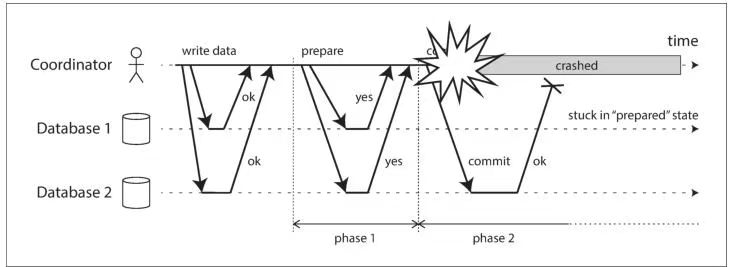
Without hearing from the coordinator, the participant has no way of knowingwhether to commit or abort. In principle, the participants could communicate amongthemselves to find out how each participant voted and come to some agreement, butthat is not part of the 2PC protocol.
在未收到协调者反馈的情况下,参与者无法判断应该执行提交还是中止操作。理论上,参与者之间可以互相通信,确认彼此的投票结果并达成一致决议,但这并不属于两阶段提交协议的范畴。
The only way 2PC can complete is by waiting for the coordinator to recover. This iswhy the coordinator must write its commit or abort decision to a transaction log ondisk before sending commit or abort requests to participants: when the coordinatorrecovers, it determines the status of all in-doubt transactions by reading its transac‐tion log. Any transactions that don’t have a commit record in the coordinator’s logare aborted. Thus, the commit point of 2PC comes down to a regular single-nodeatomic commit on the coordinator.
两阶段提交协议能够完成事务处理的唯一方式,就是等待协调者恢复。这也是为什么协调者必须在向参与者发送提交或中止请求之前,将自身的提交 / 中止决策写入磁盘上的事务日志:当协调者恢复后,会通过读取事务日志来确定所有疑态事务的状态。凡是在协调者日志中没有提交记录的事务,一律视为中止。由此可见,两阶段提交的提交点,最终取决于协调者节点上一次常规的单节点原子提交操作。
Fault-Tolerant Consensus
容错共识
Informally, consensus means getting several nodes to agree on something. For exam‐ple, if several people concurrently try to book the last seat on an airplane, or the same seat in a theater, or try to register an account with the same username, then a consensus algorithm could be used to determine which one of these mutually incompatible operations should be the winner.
通俗来讲,共识的含义是让多个节点就某一事项达成一致意见。例如,当多个人同时尝试预订某架飞机的最后一个座位、某剧院的同一个座位,或是注册同一个用户名时,就可以借助共识算法来判定,在这些互斥的操作中哪一个能够最终生效。
The consensus problem is normally formalized as follows: one or more nodes mayproposevalues, and the consensus algorithm decides on one of those values. In theseat-booking example, when several customers are concurrently trying to buy the lastseat, each node handling a customer request may propose the ID of the customer it isserving, and the decision indicates which one of those customers got the seat.
共识问题的形式化定义通常如下:一个或多个节点可以提议某个值,共识算法则从这些提议的值中选定一个作为最终决议。以座位预订的场景为例,当多名客户同时抢购最后一个座位时,每个处理客户请求的节点都可以提议自己所服务客户的 ID,而算法的最终决议则会明确哪一位客户成功订到该座位。
In this formalism, a consensus algorithm must satisfy the following properties [25]:
- Uniform agreement No two nodes decide differently.
- Integrity No node decides twice.
- Validity If a node decides value v, then v was proposed by some node.
- Termination Every node that does not crash eventually decides some value.
在这一形式化定义下,一个共识算法必须满足以下四个特性 [25]:
- 统一一致性:所有节点的最终决议结果完全一致,不存在分歧。
- 完整性:任何节点都不会做出两次及以上的决议。
- 有效性:若某节点决议的值为
v,则v必定是由某个节点提出的提议值。 - 终止性:所有未发生崩溃的节点,最终都会得出一个确定的决议。
The uniform agreement and integrity properties define the core idea of consensus:everyone decides on the same outcome, and once you have decided, you cannotchange your mind. The validity property exists mostly to rule out trivial solutions: forexample, you could have an algorithm that always decides null, no matter what wasproposed; this algorithm would satisfy the agreement and integrity properties, butnot the validity property.
统一一致性与完整性定义了共识的核心内涵:所有参与者的决议结果保持一致,且一旦做出决议,便不可更改。有效性这一特性的存在,主要是为了排除无意义的方案。例如,存在这样一种算法,无论节点提出何种提议值,它始终将null作为决议结果 —— 该算法虽然满足一致性和完整性,但并不满足有效性。
The termination property formalizes the idea of fault tolerance. It essentially says thata consensus algorithm cannot simply sit around and do nothing forever—in otherwords, it must make progress. Even if some nodes fail, the other nodes must stillreach a decision. (Termination is a liveness property, whereas the other three aresafety properties—see “Safety and liveness” on page 308.)
终止性则是对容错性的形式化描述。其核心要义是,共识算法不能无限期地处于停滞状态,换句话说,它必须能够持续推进流程。即使部分节点发生故障,其余正常节点仍需达成最终决议。(终止性属于活性属性,而另外三个特性则属于安全性属性—— 参见第 308 页的 “安全性与活性”)。
The system model of consensus assumes that when a node “crashes,” it suddenly dis‐appears and never comes back. (Instead of a software crash, imagine that there is anearthquake, and the datacenter containing your node is destroyed by a landslide. Youmust assume that your node is buried under 30 feet of mud and is never going tocome back online.) In this system model, any algorithm that has to wait for a node torecover is not going to be able to satisfy the termination property. In particular, 2PCdoes not meet the requirements for termination.
共识算法的系统模型假定,当一个节点发生 “崩溃” 时,会直接停止运行且永不恢复。(这里可以抛开软件崩溃的场景想象一下:假如发生地震,承载节点的机房因山体滑坡被摧毁,你必须认定这个节点被埋在 30 英尺深的淤泥下,再也无法上线运行)。在该系统模型中,任何需要等待故障节点恢复后才能继续推进的算法,都无法满足终止性要求。两阶段提交(2PC) 正是如此,它不符合终止性的相关要求。
Of course, if all nodes crash and none of them are running, then it is not possible forany algorithm to decide anything. There is a limit to the number of failures that analgorithm can tolerate: in fact, it can be proved that any consensus algorithm requiresat least a majority of nodes to be functioning correctly in order to assure termination[67]. That majority can safely form a quorum (see “Quorums for reading and writ‐ing” on page 179).
当然,如果所有节点全部崩溃且无一正常运行,那么任何算法都无法做出任何决议。算法的容错能力存在上限:事实上,经证明,任何共识算法要想保证终止性,都需要至少超过半数的节点保持正常运行[67]。这部分占多数的节点能够可靠地构成一个法定人数(参见第 179 页的 “读写操作的法定人数机制”)。
Thus, the termination property is subject to the assumption that fewer than half ofthe nodes are crashed or unreachable. However, most implementations of consensusensure that the safety properties—agreement, integrity, and validity—are always met,even if a majority of nodes fail or there is a severe network problem [92]. Thus, alarge-scale outage can stop the system from being able to process requests, but it can‐not corrupt the consensus system by causing it to make invalid decisions.
因此,终止性的成立,是以发生崩溃或无法连通的节点数量不超过总数的一半为前提的。不过,绝大多数共识算法的实现都能确保,即便超过半数节点发生故障或出现严重的网络问题,安全性属性(一致性、完整性、有效性)也始终能够得到满足 [92]。也就是说,大规模故障可能会导致系统无法处理请求,但绝不会使共识系统做出无效决议,进而破坏系统的一致性。
Consensus algorithms and total order broadcast
共识算法与全序广播
The best-known fault-tolerant consensus algorithms are Viewstamped Replication(VSR) [94, 95], Paxos [96, 97, 98, 99], Raft [22, 100, 101], and Zab [15, 21, 102]. Thereare quite a few similarities between these algorithms, but they are not the same [103].In this book we won’t go into full details of the different algorithms: it’s sufficient tobe aware of some of the high-level ideas that they have in common, unless you’reimplementing a consensus system yourself (which is probably not advisable—it’shard [98, 104]).
最知名的容错共识算法包括Viewstamped Replication,VSR[94, 95]、Paxos[96, 97, 98, 99]、Raft[22, 100, 101] 以及 **Zab **[15, 21, 102]。这些算法之间存在诸多相似之处,但并非完全相同 [103]。本书不会深入探讨各类算法的完整细节 —— 只要了解它们共通的核心设计思路就足够了,除非你需要亲自实现一个共识系统(通常并不推荐,因为这项工作的难度极高 [98, 104])。
Most of these algorithms actually don’t directly use the formal model described here(proposing and deciding on a single value, while satisfying the agreement, integrity,validity, and termination properties). Instead, they decide on a sequence of values,which makes them total order broadcast algorithms, as discussed previously in thischapter (see “Total Order Broadcast” on page 348).
事实上,这些算法大多并未直接采用前文所述的形式化模型(即对单一值进行提议与决议,同时满足一致性、完整性、有效性和终止性这四项特性)。相反,它们会对一系列值进行决议,这就使它们具备了全序广播算法的属性,相关内容已在本章前文提及(参见本书第 348 页的 “全序广播” 一节)。
Remember that total order broadcast requires messages to be delivered exactly once,in the same order, to all nodes. If you think about it, this is equivalent to performingseveral rounds of consensus: in each round, nodes propose the message that theywant to send next, and then decide on the next message to be delivered in the totalorder [67].
回顾一下,全序广播的核心要求是:每条消息均仅投递一次,且所有节点收到的消息顺序完全一致。细究起来,这一要求等价于执行多轮共识过程:在每一轮共识中,各节点提议自己接下来要发送的消息,然后共同决议出下一条要按全序投递的消息 [67]。
So, total order broadcast is equivalent to repeated rounds of consensus (each consen‐sus decision corresponding to one message delivery):
- Due to the agreement property of consensus, all nodes decide to deliver the same messages in the same order.
- Due to the integrity property, messages are not duplicated.
- Due to the validity property, messages are not corrupted and not fabricated out of thin air.
- Due to the termination property, messages are not lost.
由此可见,全序广播等价于重复执行多轮共识(每一次共识决议对应一条消息的投递),具体对应关系如下:
- 得益于共识算法的一致性特性,所有节点会按照完全相同的顺序投递相同的消息。
- 得益于共识算法的完整性特性,消息不会被重复投递。
- 得益于共识算法的有效性特性,消息不会被篡改,也不会凭空生成无中生有的消息。
- 得益于共识算法的终止性特性,消息不会丢失。
Viewstamped Replication, Raft, and Zab implement total order broadcast directly,because that is more efficient than doing repeated rounds of one-value-at-a-timeconsensus. In the case of Paxos, this optimization is known as Multi-Paxos.
Viewstamped Replication、Raft 与 Zab 均直接实现了全序广播功能,相比重复执行单值共识的方式,这种设计的效率更高。而在 Paxos 算法中,此类优化被称为Multi-Paxos。
Single-leader replication and consensus
单主复制与共识
In Chapter 5 we discussed single-leader replication (see “Leaders and Followers” onpage 152), which takes all the writes to the leader and applies them to the followers inthe same order, thus keeping replicas up to date. Isn’t this essentially total orderbroadcast? How come we didn’t have to worry about consensus in Chapter 5?
在本书第 5 章中,我们探讨过单主复制机制(参见第 152 页的 “主节点与从节点” 一节)。该机制会将所有写操作都路由至主节点,再按相同顺序同步至所有从节点,从而保证所有副本数据一致。这本质上不就是全序广播吗?那为什么在第 5 章中,我们完全不需要考虑共识相关的问题呢?
The answer comes down to how the leader is chosen. If the leader is manually chosenand configured by the humans in your operations team, you essentially have a “con‐sensus algorithm” of the dictatorial variety: only one node is allowed to accept writes(i.e., make decisions about the order of writes in the replication log), and if that nodegoes down, the system becomes unavailable for writes until the operators manuallyconfigure a different node to be the leader. Such a system can work well in practice,but it does not satisfy the termination property of consensus because it requireshuman intervention in order to make progress.
答案的核心在于主节点的选举方式。如果主节点是由运维人员手动选定并配置的,那么这种模式本质上就是一种集权式 “共识算法”:仅允许单个节点接收写操作(即由该节点决定复制日志中写操作的执行顺序);一旦该主节点发生故障,系统的写服务就会陷入不可用状态,直到运维人员手动将另一个节点配置为主节点为止。这类系统在实际场景中可以稳定运行,但它并不满足共识算法的终止性要求 —— 因为系统的持续运转需要人工介入。
Epoch numbering and quorums
纪元编号与法定人数
All of the consensus protocols discussed so far internally use a leader in some form oranother, but they don’t guarantee that the leader is unique. Instead, they can make aweaker guarantee: the protocols define an epoch number(called the ballot number in Paxos, view number in Viewstamped Replication, and term number in Raft) and guarantee that within each epoch, the leader is unique.
前文讨论的所有共识协议,在内部都会以某种形式引入主节点,但这些协议并不保证主节点的唯一性。相反,它们只能做出一个较弱的保证:协议会定义一个纪元编号(在Paxos中被称为表决编号,在Viewstamped Replication中被称为视图编号,在Raft中被称为任期编号),并保证在同一个纪元内,主节点是唯一的。
Every time the current leader is thought to be dead, a vote is started among the nodesto elect a new leader. This election is given an incremented epoch number, and thus epoch numbers are totally ordered and monotonically increasing. If there is a conflictbetween two different leaders in two different epochs (perhaps because the previousleader actually wasn’t dead after all), then the leader with the higher epoch number prevails.
每当集群认为当前主节点已失效时,节点之间会启动一轮投票,选举新的主节点。这轮选举会被赋予一个递增的纪元编号,因此纪元编号是全序且单调递增的。如果两个不同纪元的主节点之间出现冲突(可能是因为前一任主节点实际上并未失效),那么纪元编号更大的主节点拥有优先权。
Before a leader is allowed to decide anything, it must first check that there isn’t someother leader with a higher epoch number which might take a conflicting decision.How does a leader know that it hasn’t been ousted by another node? Recall “TheTruth Is Defined by the Majority” on page 300: a node cannot necessarily trust itsown judgment—just because a node thinks that it is the leader, that does not neces‐sarily mean the other nodes accept it as their leader.
主节点在获准做出任何决议之前,必须首先确认不存在纪元编号更大的其他主节点 —— 毕竟这些节点可能会做出与之冲突的决议。那么,主节点如何确认自己没有被其他节点取代呢?回顾本书第 300 页的 “真理由多数派定义” 一节:一个节点不能仅凭自身判断下定论 —— 仅仅因为某个节点自认为是主节点,并不代表其他节点也承认它的主节点身份。
Instead, it must collect votes from a quorumof nodes (see “Quorums for reading andwriting” on page 179). For every decision that a leader wants to make, it must sendthe proposed value to the other nodes and wait for a quorum of nodes to respond infavor of the proposal. The quorum typically, but not always, consists of a majority ofnodes [105]. A node votes in favor of a proposal only if it is not aware of any otherleader with a higher epoch.
相反,主节点必须收集法定人数节点的投票(参见本书第 179 页的 “读写操作的法定人数机制”)。对于主节点想要做出的每一项决议,它都必须将提议值发送给其他节点,并等待法定人数的节点对该提案投出赞成票。通常(但并非绝对),法定人数由多数节点构成 [105]。只有当节点不知道存在纪元编号更大的其他主节点时,才会对该提案投赞成票。
Thus, we have two rounds of voting: once to choose a leader, and a second time tovote on a leader’s proposal. The key insight is that the quorums for those two votesmust overlap: if a vote on a proposal succeeds, at least one of the nodes that voted forit must have also participated in the most recent leader election [105]. Thus, if thevote on a proposal does not reveal any higher-numbered epoch, the current leadercan conclude that no leader election with a higher epoch number has happened, andtherefore be sure that it still holds the leadership. It can then safely decide the pro‐posed value.
由此可见,整个过程包含两轮投票:第一轮用于选举主节点,第二轮用于对主节点提出的提案进行表决。核心要点在于,这两轮投票的法定人数集合必须存在交集:如果一项提案的投票获得通过,那么投赞成票的节点中,至少有一个节点同时参与了最近一次的主节点选举 [105]。如此一来,若提案投票未发现任何更高编号的纪元,当前主节点即可断定,尚未出现更高纪元的主节点选举,进而确认自己的主节点身份仍然有效。此时,主节点就可以安全地敲定该提案的决议值。
This voting process looks superficially similar to two-phase commit. The biggest dif‐ferences are that in 2PC the coordinator is not elected, and that fault-tolerant consen‐sus algorithms only require votes from a majority of nodes, whereas 2PC requires a“yes” vote from every participant. Moreover, consensus algorithms define a recoveryprocess by which nodes can get into a consistent state after a new leader is elected,ensuring that the safety properties are always met. These differences are key to thecorrectness and fault tolerance of a consensus algorithm.
这一投票流程表面上与两阶段提交颇为相似。二者最大的区别在于:两阶段提交中的协调者无需选举产生;且容错共识算法仅需获得多数节点的投票即可,而两阶段提交则要求所有参与者都投赞成票。此外,共识算法还定义了一套恢复流程,当新主节点当选后,各节点可通过该流程恢复至一致状态,从而确保安全性属性始终得到满足。这些差异,正是共识算法具备正确性与容错能力的关键所在。
Limitations of consensus
共识算法的局限性
Consensus algorithms are a huge breakthrough for distributed systems: they bringconcrete safety properties (agreement, integrity, and validity) to systems where every‐thing else is uncertain, and they nevertheless remain fault-tolerant (able to make pro‐gress as long as a majority of nodes are working and reachable). They provide totalorder broadcast, and therefore they can also implement linearizable atomic opera‐tions in a fault-tolerant way (see “Implementing linearizable storage using total orderbroadcast” on page 350).
共识算法堪称分布式系统领域的一项重大突破:在一个处处充满不确定性的系统中,它能够提供明确的安全性属性(一致性、完整性与有效性),同时还能保持容错能力 —— 只要多数节点处于正常工作且可连通的状态,系统就能持续推进业务流程。共识算法可实现全序广播,因此也能以容错的方式实现线性化原子操作(参见本书第 350 页的 “基于全序广播实现线性化存储” 一节)。
Nevertheless, they are not used everywhere, because the benefits come at a cost.
尽管优势显著,共识算法却并未在所有场景中得到应用,这是因为其收益的背后需要付出相应的代价。
The process by which nodes vote on proposals before they are decided is a kind ofsynchronous replication. As discussed in “Synchronous Versus Asynchronous Repli‐cation” on page 153, databases are often configured to use asynchronous replication.In this configuration, some committed data can potentially be lost on failover—butmany people choose to accept this risk for the sake of better performance.
节点在对提案做出决议之前,需要先通过投票达成共识,这一过程本质上属于同步复制。正如本书第 153 页 “同步复制与异步复制” 一节所述,数据库通常会被配置为异步复制模式。在这种配置下,发生故障转移时可能会丢失部分已提交的数据 —— 但为了换取更优的性能,许多人选择接受这种风险。
Consensus systems always require a strict majority to operate. This means you need aminimum of three nodes in order to tolerate one failure (the remaining two out ofthree form a majority), or a minimum of five nodes to tolerate two failures (theremaining three out of five form a majority). If a network failure cuts off some nodesfrom the rest, only the majority portion of the network can make progress, and therest is blocked (see also “The Cost of Linearizability” on page 335).
共识系统的运行始终需要严格多数的节点支持。这意味着,若要容忍 1 个节点故障,集群至少需要部署 3 个节点(3 个节点中剩余 2 个即可构成多数派);若要容忍 2 个节点故障,则集群至少需要部署 5 个节点(5 个节点中剩余 3 个即可构成多数派)。一旦发生网络故障,导致部分节点与集群失联,那么只有处于多数派分区的节点能够继续推进业务,其余节点则会陷入阻塞状态(另可参见本书第 335 页的 “线性化的代价” 一节)。
Most consensus algorithms assume a fixed set of nodes that participate in voting,which means that you can’t just add or remove nodes in the cluster. Dynamic mem‐bership extensions to consensus algorithms allow the set of nodes in the cluster tochange over time, but they are much less well understood than static membershipalgorithms.
多数共识算法会假定参与投票的节点集合是固定的,这意味着无法随意向集群中添加或移除节点。针对共识算法的动态节点成员机制扩展方案,允许集群的节点集合随时间变化,但这类方案的成熟度远不及静态节点成员机制。
Consensus systems generally rely on timeouts to detect failed nodes. In environmentswith highly variable network delays, especially geographically distributed systems, itoften happens that a node falsely believes the leader to have failed due to a transientnetwork issue. Although this error does not harm the safety properties, frequentleader elections result in terrible performance because the system can end up spend‐ing more time choosing a leader than doing any useful work.
共识系统通常依靠超时机制来检测故障节点。在网络延迟波动极大的环境中,尤其是在地理分布式系统里,常常会出现这样的情况:某个节点会因临时性网络故障,错误地判定主节点已经失效。虽然这类误判不会损害系统的安全性属性,但过于频繁的主节点选举会导致系统性能急剧下降 —— 因为系统可能会将更多时间耗费在选举主节点上,而非执行实际的业务工作。
Sometimes, consensus algorithms are particularly sensitive to network problems. Forexample, Raft has been shown to have unpleasant edge cases [106]: if the entire net‐work is working correctly except for one particular network link that is consistentlyunreliable, Raft can get into situations where leadership continually bounces betweentwo nodes, or the current leader is continually forced to resign, so the system effec‐tively never makes progress. Other consensus algorithms have similar problems, anddesigning algorithms that are more robust to unreliable networks is still an openresearch problem.
在某些场景下,共识算法对网络问题的敏感度会尤为突出。例如,有研究表明 Raft 算法存在一些棘手的边界情况[106]:即便整个网络的大部分链路都正常工作,只要有某一条特定的网络链路持续不稳定,Raft 集群就可能陷入这样的困境 —— 主节点身份在两个节点之间频繁切换,或者现任主节点被迫频繁退位,最终导致系统实际上完全无法推进业务。其他共识算法也存在类似问题,因此,设计对不稳定网络环境鲁棒性更强的共识算法,至今仍是一个开放的研究课题。
Membership and Coordination Services
成员管理与协调服务
ZooKeeper and etcd are designed to hold small amounts of data that can fit entirely in memory (although they still write to disk for durability)—so you wouldn’t want tostore all of your application’s data here. That small amount of data is replicatedacross all the nodes using a fault-tolerant total order broadcast algorithm. As dis‐cussed previously, total order broadcast is just what you need for database replica‐tion: if each message represents a write to the database, applying the same writes inthe same order keeps replicas consistent with each other.
ZooKeeper 与 etcd 的设计定位是存储少量可完全载入内存的数据(尽管为了保证持久性,它们仍会将数据写入磁盘)—— 因此,你不会希望将应用的全部数据都存储在这里。这些少量数据会通过容错全序广播算法在所有节点间实现复制。正如前文所述,全序广播恰好满足数据库复制的需求:如果每条消息都代表一次数据库写操作,那么所有节点按相同顺序执行这些写操作,就能保证各副本之间的数据一致性。
ZooKeeper is modeled after Google’s Chubby lock service [14, 98], implementing notonly total order broadcast (and hence consensus), but also an interesting set of otherfeatures that turn out to be particularly useful when building distributed systems:
ZooKeeper 的设计借鉴了谷歌的 Chubby 锁服务 [14, 98],它不仅实现了全序广播(进而实现了共识机制),还提供了一系列其他实用特性,这些特性在构建分布式系统的过程中被证明价值极高:
Linearizable atomic operations Using an atomic compare-and-set operation, you can implement a lock: if several nodes concurrently try to perform the same operation, only one of them will suc‐ ceed. The consensus protocol guarantees that the operation will be atomic and linearizable, even if a node fails or the network is interrupted at any point. A dis‐ tributed lock is usually implemented as a lease, which has an expiry time so that it is eventually released in case the client fails (see “Process Pauses” on page 295).
线性化原子操作 借助原子比较并设置(CAS)操作,你可以实现分布式锁:当多个节点并发执行同一操作时,仅有一个节点能够成功。共识协议可以保证,即便操作过程中发生节点故障或网络中断,该操作依然具备原子性与线性化特性。分布式锁通常会以租约的形式实现,并设置过期时间 —— 这样一来,即便客户端发生故障,锁最终也会被自动释放(参见本书第 295 页的 “进程暂停” 一节)。
Total ordering of operations As discussed in “The leader and the lock” on page 301, when some resource is protected by a lock or lease, you need a fencing token to prevent clients from con‐ flicting with each other in the case of a process pause. The fencing token is some number that monotonically increases every time the lock is acquired. ZooKeeper provides this by totally ordering all operations and giving each operation a monotonically increasing transaction ID (zxid) and version number (cversion) [15].
操作全序性 正如本书第 301 页 “主节点与锁” 一节所述,当某一资源被锁或租约保护时,需要引入围栏令牌来避免进程暂停场景下的客户端冲突问题。围栏令牌是一个递增数值,每一次获取锁操作都会生成一个比之前更大的令牌。ZooKeeper 通过对所有操作进行全序排序来实现这一机制,它会为每一项操作分配一个单调递增的事务 ID(zxid) 与版本号(cversion)[15]。
Failure detection Clients maintain a long-lived session on ZooKeeper servers, and the client and server periodically exchange heartbeats to check that the other node is still alive. Even if the connection is temporarily interrupted, or a ZooKeeper node fails, the session remains active. However, if the heartbeats cease for a duration that is longer than the session timeout, ZooKeeper declares the session to be dead. Any locks held by a session can be configured to be automatically released when the session times out (ZooKeeper calls these ephemeral nodes).
故障检测 客户端会与 ZooKeeper 服务器建立长连接会话,客户端与服务器之间会定期交换心跳包,以确认对方是否处于存活状态。即便连接发生临时中断,或是某一 ZooKeeper 节点发生故障,会话依然会保持有效。但如果心跳包的中断时长超过会话超时阈值,ZooKeeper 就会判定该会话已失效。会话持有的所有锁都可以被配置为会话超时时自动释放(ZooKeeper 将这类锁对应的节点称为临时节点)。
Change notifications Not only can one client read locks and values that were created by another client,but it can also watch them for changes. Thus, a client can find out when another client joins the cluster (based on the value it writes to ZooKeeper), or if another client fails (because its session times out and its ephemeral nodes disappear). By subscribing to notifications, a client avoids having to frequently poll to find out about changes.
变更通知 客户端不仅可以读取其他客户端创建的锁与数据,还能为这些数据注册变更监听。这样一来,当有新客户端加入集群时(可通过其写入 ZooKeeper 的数据判断),或是某一客户端发生故障时(因会话超时导致临时节点消失),监听客户端都能及时感知。通过订阅变更通知,客户端无需通过频繁轮询来获取数据变化。
Of these features, only the linearizable atomic operations really require consensus. However, it is the combination of these features that makes systems like ZooKeeperso useful for distributed coordination.
在上述特性中,只有线性化原子操作真正依赖共识机制实现。但正是这些特性的组合,才让 ZooKeeper 这类系统在分布式协调场景中具备了不可替代的价值。
Summary
We saw that achieving consensus means deciding something in such a way that allnodes agree on what was decided, and such that the decision is irrevocable. Withsome digging, it turns out that a wide range of problems are actually reducible toconsensus and are equivalent to each other (in the sense that if you have a solutionfor one of them, you can easily transform it into a solution for one of the others).Such equivalent problems include:
Linearizable compare-and-set registers The register needs to atomically decide whether to set its value, based on whether its current value equals the parameter given in the operation.
Atomic transaction commit A database must decide whether to commit or abort a distributed transaction.
Total order broadcast The messaging system must decide on the order in which to deliver messages.
Locks and leases When several clients are racing to grab a lock or lease, the lock decides which one successfully acquired it.
Membership/coordination service Given a failure detector (e.g., timeouts), the system must decide which nodes are alive, and which should be considered dead because their sessions timed out.
Uniqueness constraint When several transactions concurrently try to create conflicting records with the same key, the constraint must decide which one to allow and which should fail with a constraint violation.
我们已经明确,达成共识的内涵是:以一种能让所有节点对决议结果形成一致认可的方式做出决策,且该决策一旦确定便不可撤销。深入探究后不难发现,分布式领域内的诸多问题,实际上都可归结为共识问题,且这些问题彼此等价 —— 也就是说,只要能解决其中一个问题,就能轻松将解决方案转化为其他问题的解决思路。这类等价问题包括:
- 线性化比较并设置寄存器:寄存器需要基于自身当前值是否与操作传入的参数值相等,来原子性地决定是否更新其值。
- 原子事务提交:数据库必须决定是提交还是中止一个分布式事务。
- 全序广播:消息系统必须决定消息的投递顺序。
- 锁与租约:当多个客户端竞争获取同一把锁或租约时,由锁来决定哪一个客户端能够成功获取。
- 成员管理 / 协调服务:基于故障检测器(如超时机制),系统必须判定哪些节点处于存活状态,哪些节点因会话超时应被标记为失效。
- 唯一性约束:当多个事务并发尝试创建具有相同主键的冲突记录时,由约束机制决定允许其中哪一个事务执行,哪一个事务因违反约束而失败。
All of these are straightforward if you only have a single node, or if you are willing toassign the decision-making capability to a single node. This is what happens in asingle-leader database: all the power to make decisions is vested in the leader, whichis why such databases are able to provide linearizable operations, uniqueness con‐straints, a totally ordered replication log, and more.
如果系统只有单个节点,或者你愿意将决策能力完全赋予单个节点,那么解决上述所有问题都会变得十分简单。单主数据库正是采用了这种模式:所有决策权限都集中在主节点手中,这也是此类数据库能够提供线性化操作、唯一性约束、全序复制日志等功能的原因所在。
However, if that single leader fails, or if a network interruption makes the leaderunreachable, such a system becomes unable to make any progress. There are threeways of handling that situation:
- Wait for the leader to recover, and accept that the system will be blocked in the meantime. Many XA/JTA transaction coordinators choose this option. This approach does not fully solve consensus because it does not satisfy the termina‐ tion property: if the leader does not recover, the system can be blocked forever.
- Manually fail over by getting humans to choose a new leader node and reconfig‐ ure the system to use it. Many relational databases take this approach. It is a kind of consensus by “act of God”—the human operator, outside of the computer sys‐ tem, makes the decision. The speed of failover is limited by the speed at which humans can act, which is generally slower than computers.
- Use an algorithm to automatically choose a new leader. This approach requires a consensus algorithm, and it is advisable to use a proven algorithm that correctly handles adverse network conditions [107].
然而,一旦这个唯一的主节点发生故障,或是网络中断导致主节点无法被访问,这类系统就会陷入无法推进业务的停滞状态。针对这种情况,有三种应对方案:
- 等待主节点恢复,同时接受系统在此期间处于阻塞状态的现实。许多 XA/JTA 事务协调器都会选择这种方案。但该方案并未彻底解决共识问题,因为它不满足共识的终止性要求 —— 如果主节点永远无法恢复,系统就会被永久阻塞。
- 手动执行故障转移,由运维人员选定一个新的主节点,并重新配置系统使其成为新的主节点。许多关系型数据库采用的就是这种方案。这相当于一种人为干预式共识—— 决策由计算机系统之外的运维人员做出。故障转移的速度受制于人工操作的效率,通常要慢于计算机自动处理的速度。
- 使用算法自动选举新主节点。这种方案需要依赖共识算法,且建议选用经过实践验证的算法,以确保其能正确应对各类恶劣网络状况 [107]。
Part III. Derived Data
On a high level, systems that store and process data can be grouped into two broadcategories:
- Systems of record A system of record, also known as source of truth, holds the authoritative version of your data. When new data comes in, e.g., as user input, it is first written here. Each fact is represented exactly once (the representation is typically normalized). If there is any discrepancy between another system and the system of record,then the value in the system of record is (by definition) the correct one.
- Derived data systems Data in a derived system is the result of taking some existing data from another system and transforming or processing it in some way. If you lose derived data,you can recreate it from the original source. A classic example is a cache: data can be served from the cache if present, but if the cache doesn’t contain what you need, you can fall back to the underlying database. Denormalized values, indexes,and materialized views also fall into this category. In recommendation systems,predictive summary data is often derived from usage logs.
从宏观层面划分,存储与处理数据的系统可分为两大类
- 记录系统 记录系统也被称为权威数据源,存储的是数据的权威版本。当有新数据产生时(例如用户输入的数据),会优先写入该系统。系统内的每项数据事实仅需唯一表征(其数据结构通常为范式化形式)。若其他系统与记录系统的数据存在不一致,根据定义,记录系统中的数据值即为正确值。
- 衍生数据系统 衍生数据系统中的数据,是通过对其他系统的已有数据执行某种转换或处理操作后得到的结果。即便衍生数据丢失,也可从原始数据源重新生成。 一个典型示例是缓存:若缓存中存在目标数据,则直接从中读取;若缓存未存储所需数据,则可以回源至底层数据库查询。此外,反范式化数据、索引以及物化视图也都属于衍生数据的范畴。在推荐系统中,用于预测分析的汇总数据,通常也是从用户行为日志这类原始数据中衍生而来。
Most databases, storage engines, and query languages are not inherently either a sys‐tem of record or a derived system. A database is just a tool: how you use it is up toyou. The distinction between system of record and derived data system depends noton the tool, but on how you use it in your application.
大多数数据库、存储引擎和查询语言,本质上既不属于记录系统,也不属于衍生数据系统。数据库本身只是一种工具,具体如何使用完全取决于你。记录系统与衍生数据系统的区别,并不取决于工具本身,而在于你在应用程序中对它的使用方式。
By being clear about which data is derived from which other data, you can bringclarity to an otherwise confusing system architecture. This point will be a runningtheme throughout this part of the book.
明确哪些数据是从其他哪些数据衍生而来,你就能理清原本可能混乱不堪的系统架构。这一点,将作为贯穿本书本部分内容的核心主题。
Chapter 10. Batch Processing
Services (online systems) A service waits for a request or instruction from a client to arrive. When one is received, the service tries to handle it as quickly as possible and sends a response back. Response time is usually the primary measure of performance of a service,and availability is often very important (if the client can’t reach the service, the user will probably get an error message).
服务型系统(在线系统) 服务型系统会等待客户端的请求或指令抵达。一旦接收到请求,系统会以最快速度处理并返回响应。响应时间通常是衡量服务性能的核心指标,而可用性也至关重要 —— 如果客户端无法连接到服务,用户很可能会收到错误提示。
Batch processing systems (offline systems) A batch processing system takes a large amount of input data, runs a job to pro‐ cess it, and produces some output data. Jobs often take a while (from a few minutes to several days), so there normally isn’t a user waiting for the job to fin‐ ish. Instead, batch jobs are often scheduled to run periodically (for example, once a day). The primary performance measure of a batch job is usually throughput (the time it takes to crunch through an input dataset of a certain size). We dis‐ cuss batch processing in this chapter.
批处理系统(离线系统) 批处理系统接收大量输入数据,运行任务对其进行处理,最终生成输出数据。这类任务的执行往往需要一定时间(从数分钟到数天不等),因此通常不会有用户等待任务完成。相反,批处理任务一般会被设置为周期性运行(例如每天一次)。衡量批处理任务性能的核心指标通常是吞吐量,即处理完指定规模输入数据集所需的时间。本章将围绕批处理展开讨论。
Stream processing systems (near-real-time systems) Stream processing is somewhere between online and offline/batch processing (so it is sometimes called near-real-timeor nearline processing). Like a batch pro‐ cessing system, a stream processor consumes inputs and produces outputs (rather than responding to requests). However, a stream job operates on events shortly after they happen, whereas a batch job operates on a fixed set of input data. This difference allows stream processing systems to have lower latency than the equivalent batch systems. As stream processing builds upon batch process‐ ing, we discuss it in Chapter 11.
流处理系统(准实时系统) 流处理介于在线系统与离线 / 批处理系统之间(因此有时也被称为准实时处理或准在线处理)。与批处理系统类似,流处理器会消费输入数据并生成输出数据(而非响应请求)。但两者的区别在于,流处理任务会在事件发生后极短时间内对其进行处理,而批处理任务则针对固定的输入数据集进行操作。这一差异让流处理系统的延迟低于同等场景下的批处理系统。由于流处理是基于批处理发展而来,相关内容将在本书第 11 章中探讨。
Batch Processing with Unix Tools
The Unix Philosophy
Doug McIlroy, the inventor of Unix pipes, first described them like this in 1964 [11]:“We should have some ways of connecting programs like [a] garden hose—screw inanother segment when it becomes necessary to massage data in another way. This isthe way of I/O also.”
Unix 管道的发明者道格・麦克罗伊(Doug McIlroy)早在 1964 年就对其做出了这样的描述 [11]:
我们应当找到一种方式,像连接花园水管一样拼接程序 —— 当需要以新的方式处理数据时,直接接入一段新的程序即可。这同样也是输入输出(I/O)的运作之道。
The plumbing analogy stuck, and the idea of connecting programs with pipes became part of what is now known as the Unix philosophy—a set ofdesign principles that became popular among the developers and users of Unix. Thephilosophy was described in 1978 as follows [12, 13]:
- Make each program do one thing well. To do a new job, build afresh rather than complicate old programs by adding new “features”.
- Expect the output of every program to become the input to another, as yet unknown, program. Don’t clutter output with extraneous information. Avoid stringently columnar or binary input formats. Don’t insist on interactive input.
- Design and build software, even operating systems, to be tried early, ideally within weeks. Don’t hesitate to throw away the clumsy parts and rebuild them.
- Use tools in preference to unskilled help to lighten a programming task, even if you have to detour to build the tools and expect to throw some of them out after you’ve finished using them.
这个 “管道” 的比喻沿用至今,而用管道连接程序的理念,也成为了如今广为人知的 Unix 哲学的核心组成部分。这套设计原则在 Unix 的开发者与用户群体中备受推崇,并在 1978 年被归纳为以下四条 [12,13]:
- 让每个程序只做好一件事。若要完成新任务,应重新开发一个全新的程序,而非为旧程序添加新功能使其变得臃肿。
- 假定每个程序的输出,都将成为另一个未知程序的输入。不要用无关信息污染输出内容,避免使用严格的列格式或二进制输入格式,同时不强制要求交互式输入。
- 软件(甚至操作系统)的设计与开发应追求尽早试用,理想情况下几周内就能产出原型。对于设计拙劣的部分,要果断舍弃并重新构建。
- 优先使用工具来减轻编程任务的负担,哪怕为此需要先绕道开发工具,且预计部分工具在使用完毕后就会被弃用。
This approach—automation, rapid prototyping, incremental iteration, being friendly to experimentation, and breaking down large projects into manageable chunks—sounds remarkably like the Agile and DevOps movements of today. Surprisingly littlehas changed in four decades.
这种强调自动化、快速原型设计、增量迭代、鼓励实验,以及将大型项目拆解为可管理的小模块的方法论,听起来与如今的敏捷开发(Agile)和 DevOps 运动惊人地相似。时隔四十年,软件开发的核心思路竟几乎没有改变。
A Unix shell like bashlets us easily compose these small programs into surprisinglypowerful data processing jobs. Even though many of these programs are written bydifferent groups of people, they can be joined together in flexible ways. What doesUnix do to enable this composability?
像 bash 这样的 Unix Shell,能让我们轻松地将这些小巧的程序组合成功能强大的数据处理任务。尽管许多程序由不同团队开发,但它们仍能以灵活的方式协同工作。那么,Unix 究竟是通过哪些设计,实现了这种可组合性的呢?
A uniform interface
统一接口
If you expect the output of one program to become the input to another program,that means those programs must use the same data format—in other words, a com‐patible interface. If you want to be able to connect anyprogram’s output to any pro‐gram’s input, that means that all programs must use the same input/output interface.
若你希望将一个程序的输出,直接作为另一个程序的输入,就意味着这两个程序必须采用相同的数据格式 —— 换句话说,它们需要具备兼容的接口。而若要实现任意程序的输出与任意程序的输入相互对接,就意味着所有程序都必须遵循统一的输入输出接口规范。
In Unix, that interface is a file (or, more precisely, a file descriptor). A file is just an ordered sequence of bytes. Because that is such a simple interface, many differentthings can be represented using the same interface: an actual file on the filesystem, acommunication channel to another process (Unix socket, stdin, stdout), a devicedriver (say /dev/audioor /dev/lp0), a socket representing a TCP connection, and soon. It’s easy to take this for granted, but it’s actually quite remarkable that these verydifferent things can share a uniform interface, so they can easily be plugged together.ii
在 Unix 系统中,这套接口的载体是文件(更准确地说,是文件描述符)。文件的本质就是一个有序的字节流。正因为这一接口足够简单,大量截然不同的实体都能通过这套统一接口来表示:既可以是文件系统中的实际文件,也可以是与其他进程通信的信道(如 Unix 套接字、标准输入、标准输出),还可以是设备驱动程序(例如 /dev/audio 音频设备或 /dev/lp0 打印机设备),或是表示 TCP 连接的套接字,等等。我们很容易对此习以为常,但实际上,这些功能截然不同的实体能够共用一套统一接口,从而实现便捷的互联互通,这一点是非常了不起的。
MapReduce and Distributed Filesystems
The Output of Batch Workflows
Philosophy of batch process outputs
批处理输出的设计理念
The Unix philosophy that we discussed earlier in this chapter (“The Unix Philoso‐phy” on page 394) encourages experimentation by being very explicit about dataflow:a program reads its input and writes its output. In the process, the input is leftunchanged, any previous output is completely replaced with the new output, andthere are no other side effects. This means that you can rerun a command as often asyou like, tweaking or debugging it, without messing up the state of your system.
本章前文探讨的 Unix 设计理念(详见本书第 394 页的《Unix 设计哲学》一节),通过明确数据流走向的方式鼓励开发者大胆尝试:程序读取输入数据,经处理后生成输出结果。在此过程中,输入数据保持不可变,原有输出会被全新输出完全覆盖,且不会产生任何其他副作用。这意味着你可以反复执行某条命令,不断调试、优化参数,而不必担心破坏系统状态。
The handling of output from MapReduce jobs follows the same philosophy. By treat‐ing inputs as immutable and avoiding side effects (such as writing to external data‐bases), batch jobs not only achieve good performance but also become much easier tomaintain:
- If you introduce a bug into the code and the output is wrong or corrupted, you can simply roll back to a previous version of the code and rerun the job, and the output will be correct again. Or, even simpler, you can keep the old output in a different directory and simply switch back to it. Databases with read-write trans‐ actions do not have this property: if you deploy buggy code that writes bad data to the database, then rolling back the code will do nothing to fix the data in the database. (The idea of being able to recover from buggy code has been called human fault tolerance [50].)
- As a consequence of this ease of rolling back, feature development can proceed more quickly than in an environment where mistakes could mean irreversible damage. This principle of minimizing irreversibility is beneficial for Agile soft‐ ware development [51].
- If a map or reduce task fails, the MapReduce framework automatically re- schedules it and runs it again on the same input. If the failure is due to a bug in the code, it will keep crashing and eventually cause the job to fail after a few attempts; but if the failure is due to a transient issue, the fault is tolerated. This automatic retry is only safe because inputs are immutable and outputs from failed tasks are discarded by the MapReduce framework.
- The same set of files can be used as input for various different jobs, including monitoring jobs that calculate metrics and evaluate whether a job’s output has the expected characteristics (for example, by comparing it to the output from the previous run and measuring discrepancies).
- Like Unix tools, MapReduce jobs separate logic from wiring (configuring the input and output directories), which provides a separation of concerns and ena‐ bles potential reuse of code: one team can focus on implementing a job that does one thing well, while other teams can decide where and when to run that job.
MapReduce 任务对输出结果的处理方式,同样遵循这一设计理念。通过将输入视为不可变数据、避免产生副作用(例如向外部数据库写入数据),批处理任务不仅能获得出色的性能表现,还能大幅降低运维成本,具体体现在以下几点:
- 若代码引入缺陷导致输出结果错误或损坏,你只需回滚到代码的历史版本并重新执行任务,即可生成正确的输出。更简单的做法是,将旧版输出文件保留在独立目录中,直接切换回旧版本即可。而支持读写事务的数据库则不具备这一特性:如果部署的缺陷代码向数据库写入了错误数据,仅回滚代码并不能修复数据库中的错误数据。(这种能够从缺陷代码引发的问题中恢复的设计思路,被称为人为故障容错能力[50])。
- 正因为回滚操作如此便捷,功能开发的迭代速度可以远超那些一次失误就可能造成不可逆损害的系统。这种最小化不可逆操作的原则,对敏捷软件开发 [51] 的实践大有裨益。
- 若某个 Map 或 Reduce 任务执行失败,MapReduce 框架会自动重新调度该任务,并基于相同的输入数据再次运行。如果失败是由代码缺陷导致的,任务会持续崩溃,在多次重试后最终导致整个作业失败;但如果失败源于临时性故障(如网络抖动、节点短暂不可用),故障即可被容忍。这种自动重试机制之所以安全可靠,是因为输入数据是不可变的,且失败任务产生的输出会被 MapReduce 框架自动丢弃。
- 同一组输入文件可被多个不同的任务复用,其中包括监控任务 —— 这类任务会计算相关指标,校验作业输出是否符合预期(例如将本次输出与上一次执行的输出对比,计算两者的差异值)。
- 与 Unix 工具类似,MapReduce 任务将业务逻辑与配置(即输入输出目录的设置)解耦,实现了关注点分离,同时提升了代码的潜在复用性:一个团队可以专注于开发单一功能的任务,其他团队则可以自主决定该任务的运行时机与运行位置。
Comparing Hadoop to Distributed Databases
对比 Hadoop 与分布式数据库
Indiscriminate data dumping shifts the burden of interpreting the data: instead offorcing the producer of a dataset to bring it into a standardized format, the interpretation of the data becomes the consumer’s problem (the schema-on-read approach[56]; see “Schema flexibility in the document model” on page 39). This can be anadvantage if the producer and consumers are different teams with different priorities.There may not even be one ideal data model, but rather different views onto the datathat are suitable for different purposes. Simply dumping data in its raw form allowsfor several such transformations. This approach has been dubbed the sushi principle:“raw data is better” [57].
无差别地转储原始数据,相当于将数据解读的负担转嫁出去:它不再强制数据集的生产者将数据整理为标准化格式,而是把数据解读的工作交由数据消费者来完成(这一方式即读时模式[56],详见本书第 39 页的 “文档模型中的模式灵活性” 一节)。如果数据的生产者与消费者分属不同团队,且各自的工作优先级不同,这种方式会显现出优势。面对同一批数据,或许并不存在唯一的理想数据模型,反而是不同的数据视图更适合不同的业务场景。直接以原始格式转储数据,就为多种数据转换需求提供了实现空间。这种理念也被戏称为寿司原则:“原始数据更有价值”[57]。
To understand the reasons for MapReduce’s sparing use of memory and task-levelrecovery, it is helpful to look at the environment for which MapReduce was originallydesigned. Google has mixed-use datacenters, in which online production services andoffline batch jobs run on the same machines. Every task has a resource allocation(CPU cores, RAM, disk space, etc.) that is enforced using containers. Every task alsohas a priority, and if a higher-priority task needs more resources, lower-priority taskson the same machine can be terminated (preempted) in order to free up resources.Priority also determines pricing of the computing resources: teams must pay for theresources they use, and higher-priority processes cost more [59].
想要理解 MapReduce 为何如此节省内存,又为何要设计任务级恢复机制,我们不妨先了解 MapReduce 的原生设计环境。谷歌采用的是混合用途数据中心,在线生产服务与离线批处理任务会运行在同一批物理机器上。每个任务都会被分配固定的资源配额(包括 CPU 核心数、内存、磁盘空间等),并通过容器技术强制执行资源限制。同时,每个任务都被赋予相应的优先级:当高优先级任务需要更多资源时,运行在同一台机器上的低优先级任务会被终止(即抢占),以释放资源。任务优先级还会与计算资源的计费挂钩:团队需要为其使用的资源付费,且高优先级进程的计费标准更高 [59]。
This architecture allows non-production (low-priority) computing resources to beovercommitted, because the system knows that it can reclaim the resources if neces‐sary. Overcommitting resources in turn allows better utilization of machines andgreater efficiency compared to systems that segregate production and non-production tasks. However, as MapReduce jobs run at low priority, they run the riskof being preempted at any time because a higher-priority process requires theirresources. Batch jobs effectively “pick up the scraps under the table,” using any com‐puting resources that remain after the high-priority processes have taken what theyneed.
这种架构允许对非生产环境(低优先级)的计算资源进行超配,因为系统明确知道,必要时可以回收这些资源。相比那些将生产任务与非生产任务严格隔离的系统,资源超配能够提升机器利用率,实现更高的运行效率。但问题在于,MapReduce 任务通常以低优先级运行,因此随时可能因高优先级进程需要资源而被抢占终止。从本质上讲,批处理任务就是在 “捡漏式” 利用资源 —— 它们只会占用高优先级进程分配剩余的计算资源。
At Google, a MapReduce task that runs for an hour has an approximately 5% risk ofbeing terminated to make space for a higher-priority process. This rate is more thanan order of magnitude higher than the rate of failures due to hardware issues,machine reboot, or other reasons [59]. At this rate of preemptions, if a job has 100tasks that each run for 10 minutes, there is a risk greater than 50% that at least onetask will be terminated before it is finished.
在谷歌的环境中,一个运行时长为 1 小时的 MapReduce 任务,因需要为高优先级进程腾出空间而被终止的概率约为 5%。这一概率,比因硬件故障、机器重启或其他原因导致的任务失败率高出一个数量级 [59]。按照这个抢占概率计算,如果一个作业包含 100 个任务,每个任务运行 10 分钟,那么至少有一个任务会在完成前被终止的概率将超过 50%。
And this is why MapReduce is designed to tolerate frequent unexpected task termina‐tion: it’s not because the hardware is particularly unreliable, it’s because the freedomto arbitrarily terminate processes enables better resource utilization in a computing cluster.
这也正是 MapReduce 被设计为能够容忍频繁的意外任务终止的原因所在:这并非因为硬件本身特别不可靠,而是因为允许系统任意终止进程,才能在计算集群中实现更优的资源利用率。
Beyound MapReduce
Dataflow engines
数据流引擎
In order to fix these problems with MapReduce, several new execution engines fordistributed batch computations were developed, the most well known of which areSpark [61, 62], Tez [63, 64], and Flink [65, 66]. There are various differences in theway they are designed, but they have one thing in common: they handle an entireworkflow as one job, rather than breaking it up into independent subjobs.
为解决 MapReduce 存在的诸多问题,多款新一代分布式批处理执行引擎应运而生,其中最具代表性的有 Spark [61,62]、Tez [63,64] 以及 Flink [65,66]。这些引擎的设计细节虽各有不同,但存在一个核心共性:它们会将整个数据处理工作流作为单个作业来处理,而非拆分为多个相互独立的子作业。
Since they explicitly model the flow of data through several processing stages, thesesystems are known as dataflow engines. Like MapReduce, they work by repeatedlycalling a user-defined function to process one record at a time on a single thread.They parallelize work by partitioning inputs, and they copy the output of one func‐tion over the network to become the input to another function.
由于这类系统会显式地对多处理阶段间的数据流进行建模,因此被称为数据流引擎。与 MapReduce 类似,数据流引擎的工作原理也是通过反复调用用户自定义函数,在单线程上逐条处理数据记录。它们通过对输入数据进行分区来实现并行计算,并将一个函数的输出结果通过网络传输,作为另一个函数的输入。
Unlike in MapReduce, these functions need not take the strict roles of alternatingmap and reduce, but instead can be assembled in more flexible ways. We call these functions operators, and the dataflow engine provides several different options forconnecting one operator’s output to another’s input:
- One option is to repartition and sort records by key, like in the shuffle stage of MapReduce (see “Distributed execution of MapReduce” on page 400). This fea‐ ture enables sort-merge joins and grouping in the same way as in MapReduce.
- Another possibility is to take several inputs and to partition them in the same way, but skip the sorting. This saves effort on partitioned hash joins, where the partitioning of records is important but the order is irrelevant because building the hash table randomizes the order anyway.
- For broadcast hash joins, the same output from one operator can be sent to all partitions of the join operator.
但与 MapReduce 不同的是,这些函数无需严格扮演交替出现的 Map 与 Reduce 角色,而是可以通过更灵活的方式组合。我们将这些函数称为operators,数据流引擎提供了多种方式,用于实现算子输出与另一operator输入的对接:
- 第一种方式是按照 key 对记录进行重分区与排序,与 MapReduce 的混洗阶段逻辑一致(详见本书第 400 页的 “MapReduce 的分布式执行” 一节)。该特性能够像 MapReduce 一样,支持排序合并连接与分组聚合操作。
- 第二种方式是对多个输入数据集采用相同的分区策略,但跳过排序步骤。这种方式能为分区哈希连接节省大量开销 —— 在这类场景中,记录的分区方式至关重要,但顺序无关紧要,因为构建哈希表的过程本身就会打乱数据原有的顺序。
- 针对广播哈希连接场景,可将某一个operator的输出结果,发送至连接operator的所有分区。
This style of processing engine is based on research systems like Dryad [67] andNephele [68], and it offers several advantages compared to the MapReduce model:
- Expensive work such as sorting need only be performed in places where it is actually required, rather than always happening by default between every map and reduce stage.
- There are no unnecessary map tasks, since the work done by a mapper can often be incorporated into the preceding reduce operator (because a mapper does not change the partitioning of a dataset).
- Because all joins and data dependencies in a workflow are explicitly declared, the scheduler has an overview of what data is required where, so it can make locality optimizations. For example, it can try to place the task that consumes some data on the same machine as the task that produces it, so that the data can be exchanged through a shared memory buffer rather than having to copy it overthe network.
- It is usually sufficient for intermediate state between operators to be kept in memory or written to local disk, which requires less I/O than writing it to HDFS (where it must be replicated to several machines and written to disk on each rep‐ lica). MapReduce already uses this optimization for mapper output, but dataflow engines generalize the idea to all intermediate state.
- Operators can start executing as soon as their input is ready; there is no need to wait for the entire preceding stage to finish before the next one starts.
- Existing Java Virtual Machine (JVM) processes can be reused to run new operators, reducing startup overheads compared to MapReduce (which launches a new JVM for each task).
这类处理引擎的设计理念源于 Dryad [67]、Nephele [68] 等学术研究系统,相比 MapReduce 模型,它具备多项显著优势:
- 排序等开销高昂的操作仅在真正需要时执行,而非像 MapReduce 那样,默认在每一个 Map 与 Reduce 阶段之间都执行排序。
- 不存在多余的 Map 任务—— 因为 mapper的处理逻辑通常可以并入前序的 Reduce operator中(这是由于 mapper 不会改变数据集的分区方式)。
- 由于工作流中的所有连接操作与数据依赖关系都被显式声明,调度器能够全局掌握数据的需求分布,进而实现本地化优化。例如,调度器可以尝试将数据消费任务与数据生产任务部署在同一台机器上,这样数据就可以通过共享内存缓冲区进行交换,而无需通过网络传输。
- operators之间的中间状态通常只需保存在内存中,或写入本地磁盘 —— 这种方式的 I/O 开销远低于写入 HDFS(HDFS 要求数据在多台机器上创建副本,且每个副本都需写入磁盘)。MapReduce 仅对 mapper的输出采用了这种优化,而数据流引擎则将这一思路推广到了所有中间状态。
- Operators一旦输入数据就绪即可开始执行,无需等待前一处理阶段的所有任务全部完成。
- 可以复用已有的 Java 虚拟机(JVM)进程来运行新的operators,相比 MapReduce(为每个任务都启动一个全新的 JVM 进程),大幅降低了进程启动开销。
You can use dataflow engines to implement the same computations as MapReduceworkflows, and they usually execute significantly faster due to the optimizationsdescribed here. Since operators are a generalization of map and reduce, the same processing code can run on either execution engine: workflows implemented in Pig,Hive, or Cascading can be switched from MapReduce to Tez or Spark with a simpleconfiguration change, without modifying code [64].
数据流引擎可以实现 MapReduce 工作流支持的所有计算任务,并且借助上述优化手段,执行速度通常会显著提升。由于operators是 Map 和 Reduce 功能的泛化形式,相同的处理代码可以在任意一种执行引擎上运行:例如,基于 Pig、Hive 或 Cascading 开发的工作流,只需简单修改配置,无需改动任何代码,就能从 MapReduce 引擎切换到 Tez 或 Spark 引擎 [64]。
Chapter 11. Stream Processing
However, one big assumption remained throughout Chapter 10: namely, that theinput is bounded—i.e., of a known and finite size—so the batch process knows whenit has finished reading its input. For example, the sorting operation that is central toMapReduce must read its entire input before it can start producing output: it couldhappen that the very last input record is the one with the lowest key, and thus needsto be the very first output record, so starting the output early is not an option.
然而,第 10 章的内容始终基于一个重要假设:输入数据是有界的—— 即数据量已知且有限,因此批处理程序能够明确感知输入数据的读取终点。例如,MapReduce 核心的排序操作,必须读取全部输入数据后才能开始生成输出 —— 因为有可能最后一条输入记录的键值最小,需要作为第一条输出记录,因此提前输出是不可行的。
In reality, a lot of data is unbounded because it arrives gradually over time: your usersproduced data yesterday and today, and they will continue to produce more datatomorrow. Unless you go out of business, this process never ends, and so the datasetis never “complete” in any meaningful way [1]. Thus, batch processors must artifi‐cially divide the data into chunks of fixed duration: for example, processing a day’sworth of data at the end of every day, or processing an hour’s worth of data at the endof every hour.
但在实际场景中,大量数据都是无界的:数据会随时间推移持续产生 —— 用户在昨天、今天不断生成数据,明天也会继续产生新数据。除非业务终止,否则这个数据生成的过程永不停歇,因此从实际意义来讲,这类数据集永远不会 “完整”[1]。正因如此,批处理程序不得不将数据人为切分为固定时长的块来处理:例如每天结束时处理当日产生的数据,或每小时结束时处理该小时内的数据。
The problem with daily batch processes is that changes in the input are only reflectedin the output a day later, which is too slow for many impatient users. To reduce thedelay, we can run the processing more frequently—say, processing a second’s worthof data at the end of every second—or even continuously, abandoning the fixed time slices entirely and simply processing every event as it happens. That is the idea behind stream processing.
按日执行批处理的问题在于,输入数据的变化要等到一天后才能体现在输出结果中,这对于许多对延迟敏感的用户来说实在太慢。为了降低延迟,我们可以提高处理的频率 —— 比如每秒结束时处理该秒内的数据;甚至可以完全摒弃固定时间切片的模式,转而持续处理,在每个事件产生的瞬间就对其进行处理。这正是流处理的设计理念。
In principle, a file or database is sufficient to connect producers and consumers: aproducer writes every event that it generates to the datastore, and each consumerperiodically polls the datastore to check for events that have appeared since it last ran.This is essentially what a batch process does when it processes a day’s worth of data atthe end of every day.
理论上,仅依靠文件或数据库就足以衔接数据生产者与消费者:生产者将生成的所有事件写入数据存储系统,消费者则定期轮询该系统,以获取自上次轮询以来新增的事件。每日结束时处理当日数据的批处理程序,本质上就是这样工作的。
However, when moving toward continual processing with low delays, pollingbecomes expensive if the datastore is not designed for this kind of usage. The moreoften you poll, the lower the percentage of requests that return new events, and thusthe higher the overheads become. Instead, it is better for consumers to be notifiedwhen new events appear.
但在向低延迟的持续处理模式演进时,如果数据存储系统并非为这类场景设计,轮询的方式会产生极高的开销。轮询频率越高,返回新事件的请求占比就越低,由此引发的性能损耗也就越大。相比之下,在有新事件产生时主动通知消费者,才是更优的方案。
Databases have traditionally not supported this kind of notification mechanism verywell: relational databases commonly have triggers, which can react to a change (e.g., arow being inserted into a table), but they are very limited in what they can do andhave been somewhat of an afterthought in database design [4, 5]. Instead, specializedtools have been developed for the purpose of delivering event notifications.
传统数据库对这类通知机制的支持一直不够完善:关系型数据库虽然普遍提供触发器功能,能够对数据变更(例如向表中插入一行数据)做出响应,但触发器的功能十分受限,在数据库的整体设计中也更像是一个 “附加功能”[4,5]。正因如此,业界专门开发了一类工具,用于实现事件通知的功能。
Transmitting Event Streams
事件流的传输
Messaging Systems
消息系统
Within this publish/subscribe model, different systems take a wide range ofapproaches, and there is no one right answer for all purposes. To differentiate thesystems, it is particularly helpful to ask the following two questions:
What happens if the producers send messages faster than the consumers can process them? Broadly speaking, there are three options: the system can drop messages, buffer messages in a queue, or apply backpressure(also known as flow control; i.e., blocking the producer from sending more messages). For example,Unix pipes and TCP use backpressure: they have a small fixed-size buffer, and if it fills up, the sender is blocked until the recipient takes data out of the buffer (see“Network congestion and queueing” on page 282).
If messages are buffered in a queue, it is important to understand what happensas that queue grows. Does the system crash if the queue no longer fits in mem‐ory, or does it write messages to disk? If so, how does the disk access affect theperformance of the messaging system [6]?
What happens if nodes crash or temporarily go offline—are any messages lost? As with databases, durability may require some combination of writing to disk and/or replication (see the sidebar “Replication and Durability” on page 227),which has a cost. If you can afford to sometimes lose messages, you can probably get higher throughput and lower latency on the same hardware.
在发布 / 订阅模型的范畴内,不同系统采用的实现方案差异很大,不存在一种能适配所有场景的 “最优解”。想要区分各类系统的特性,提出以下两个问题会非常有帮助:
若生产者发送消息的速度超过消费者的处理能力,系统会如何处理? 总体而言,有三种应对方案:系统可以直接丢弃消息、将消息缓冲在队列中,或是启用背压机制(也称为流量控制,即阻塞生产者,使其无法继续发送更多消息)。例如,Unix 管道与 TCP 协议均采用了背压机制:它们会设置一个容量固定的小型缓冲区,一旦缓冲区被填满,发送方会被阻塞,直到接收方从缓冲区中取出数据(详见本书第 282 页的 “网络拥塞与排队” 一节)。
若消息被缓冲在队列中,就必须明确队列持续增长时的系统行为:若队列无法再容纳于内存,系统是否会崩溃?还是会将消息写入磁盘?如果是后者,磁盘读写会对消息系统的性能造成何种影响 [6]?
若节点崩溃或临时下线,是否会有消息丢失?与数据库的设计逻辑类似,消息的持久性通常需要结合写入磁盘和 / 或副本复制两种手段来实现(详见本书第 227 页的 “副本复制与持久性” 侧边栏),而这两种手段都会产生一定的性能开销。如果业务场景可以容忍偶尔的消息丢失,那么在相同硬件条件下,系统往往能实现更高的吞吐量和更低的延迟。
Whether message loss is acceptable depends very much on the application. For exam‐ple, with sensor readings and metrics that are transmitted periodically, an occasionalmissing data point is perhaps not important, since an updated value will be sent ashort time later anyway. However, beware that if a large number of messages aredropped, it may not be immediately apparent that the metrics are incorrect [7]. If youare counting events, it is more important that they are delivered reliably, since everylost message means incorrect counters.
消息丢失是否可以接受,很大程度上取决于具体的业务场景。例如,对于周期性传输的传感器读数和监控指标而言,偶尔丢失一个数据点或许无关紧要 —— 因为不久之后就会有更新的值发送过来。但需要注意的是,若大量消息丢失,监控指标出现异常这一问题可能无法被立即察觉 [7]。而如果是在统计事件的场景下,消息的可靠投递就尤为重要了,因为每丢失一条消息,都会导致最终的统计结果出现偏差。
Message brokers
消息代理
A widely used alternative is to send messages via a message broker (also known as a message queue), which is essentially a kind of database that is optimized for handlingmessage streams [13]. It runs as a server, with producers and consumers connectingto it as clients. Producers write messages to the broker, and consumers receive themby reading them from the broker.
一种被广泛采用的替代方案是通过消息代理(也称为消息队列)来发送消息。消息代理本质上是一种专为处理消息流而优化的数据库 [13]。它以服务端模式运行,生产者与消费者则作为客户端与其建立连接:生产者向代理写入消息,消费者则从代理读取消息以获取数据。
By centralizing the data in the broker, these systems can more easily tolerate clientsthat come and go (connect, disconnect, and crash), and the question of durability ismoved to the broker instead. Some message brokers only keep messages in memory,while others (depending on configuration) write them to disk so that they are not lostin case of a broker crash. Faced with slow consumers, they generally allow unbounded queueing (as opposed to dropping messages or backpressure), although thischoice may also depend on the configuration.
通过将数据集中存储在代理端,这类系统能够更轻松地应对客户端的频繁上下线(连接、断开、崩溃)情况,同时消息持久性的保障责任也随之转移到了代理端。部分消息代理仅将消息存储在内存中;而另一些代理(根据配置不同)会将消息写入磁盘,从而避免在代理崩溃时丢失消息。面对消费速度较慢的消费者,消息代理通常允许无限制排队(而非丢弃消息或启用背压机制),不过这一策略也可能取决于具体的配置。
A consequence of queueing is also that consumers are generally asynchronous: when a producer sends a message, it normally only waits for the broker to confirm that ithas buffered the message and does not wait for the message to be processed by con‐sumers. The delivery to consumers will happen at some undetermined future point intime—often within a fraction of a second, but sometimes significantly later if there isa queue backlog.
消息排队机制带来的一个结果是,消费者通常为异步工作模式:当生产者发送一条消息时,它一般只需等待代理确认消息已存入缓冲区即可,无需等待消费者完成对消息的处理。消息的投递会在未来某个不确定的时间点完成 —— 通常在几分之一秒内,但如果出现队列积压,投递延迟有时会显著增加。
Message brokers compared to databases
消息代理与数据库的对比
Some message brokers can even participate in two-phase commit protocols using XA or JTA (see “Distributed Transactions in Practice” on page 360). This feature makesthem quite similar in nature to databases, although there are still important practicaldifferences between message brokers and databases:
- Databases usually keep data until it is explicitly deleted, where as most message brokers automatically delete a message when it has been successfully delivered to its consumers. Such message brokers are not suitable for long-term data storage.
- Since they quickly delete messages, most message brokers assume that their working set is fairly small—i.e., the queues are short. If the broker needs to buffer a lot of messages because the consumers are slow (perhaps spilling messages to disk if they no longer fit in memory), each individual message takes longer to process, and the overall throughput may degrade [6].
- Databases often support secondary indexes and various ways of searching for data, while message brokers often support some way of subscribing to a subset of topics matching some pattern. The mechanisms are different, but both are essen‐ tially ways for a client to select the portion of the data that it wants to know about.
- When querying a database, the result is typically based on a point-in-time snap‐ shot of the data; if another client subsequently writes something to the database that changes the query result, the first client does not find out that its prior result is now outdated (unless it repeats the query, or polls for changes). By contrast,message brokers do not support arbitrary queries, but they do notify clients when data changes (i.e., when new messages become available).
部分消息代理甚至可以通过XA或JTA协议参与两阶段提交(详见本书第 360 页的《分布式事务实战》一节)。这一特性使得消息代理在本质上与数据库颇为相似,但二者在实际应用中仍存在显著差异:
- 数据库通常会留存数据,直至数据被显式删除;而大多数消息代理会在消息成功投递至消费者后,自动将其删除。因此,这类消息代理并不适用于长期数据存储。
- 由于消息会被快速删除,大多数消息代理默认其工作集规模较小 —— 也就是说,消息队列的长度通常很短。如果因消费者处理速度过慢,导致代理需要缓冲大量消息(消息无法存入内存时,可能会写入磁盘),那么单条消息的处理耗时会相应增加,系统整体吞吐量也可能随之下降 [6]。
- 数据库通常支持二级索引和多种数据查询方式;而消息代理则一般支持按特定模式订阅主题子集。二者的实现机制虽不相同,但本质上都是为了让客户端能够筛选出自己需要关注的数据。
- 查询数据库时,返回的结果通常基于数据的某一时间点快照。如果后续有其他客户端写入数据,导致该查询结果失效,最初发起查询的客户端并不会收到通知(除非重新执行查询或轮询数据变更)。相比之下,消息代理不支持任意查询,但它会在数据发生变化时(即有新消息可用时)主动通知客户端。
This is the traditional view of message brokers, which is encapsulated in standardslike JMS [14] and AMQP [15] and implemented in software like RabbitMQ,ActiveMQ, HornetQ, Qpid, TIBCO Enterprise Message Service, IBM MQ, Azure Ser‐vice Bus, and Google Cloud Pub/Sub [16].
以上是对消息代理的传统定位,这一定位被纳入了 JMS [14]、AMQP [15] 等标准中,并在 RabbitMQ、ActiveMQ、HornetQ、Qpid、TIBCO 企业消息服务、IBM MQ、Azure 服务总线以及 Google Cloud Pub/Sub [16] 等软件中得以实现。
Multiple consumers
多消费者模式
When multiple consumers read messages in the same topic, two main patterns ofmessaging are used, as illustrated in Figure 11-1:
当多个消费者读取同一主题下的消息时,主要采用两种消息传递模式(如图 11-1 所示):
Load balancing Each message is delivered to one of the consumers, so the consumers can share the work of processing the messages in the topic. The broker may assign messages to consumers arbitrarily. This pattern is useful when the messages are expensive to process, and so you want to be able to add consumers to parallelize the processing. (In AMQP, you can implement load balancing by having multi‐ ple clients consuming from the same queue, and in JMS it is called a shared subscription.)
负载均衡模式 每条消息只会投递至其中一个消费者,因此消费者可共同分担该主题下消息的处理工作。消息代理可将消息随机分配给任意消费者。当消息处理成本较高时,这种模式尤为适用 —— 你可以通过增加消费者数量来实现处理流程的并行化。(在 AMQP 中,可通过让多个客户端从同一个队列消费消息来实现负载均衡;在 JMS 中,该模式被称为 “共享订阅”。)
Fan-out Each message is delivered to all of the consumers. Fan-out allows several inde‐ pendent consumers to each “tune in” to the same broadcast of messages, without affecting each other—the streaming equivalent of having several different batch jobs that read the same input file. (This feature is provided by topic subscriptions in JMS, and exchange bindings in AMQP.)
扇出模式 每条消息会投递至所有消费者。扇出模式允许多个独立的消费者各自 “订阅” 同一消息广播流,且彼此互不影响 —— 这相当于流处理场景中,多个不同的批处理任务读取同一个输入文件的实现方式。(JMS 中通过主题订阅实现该功能,而 AMQP 中则通过交换器绑定来实现。)
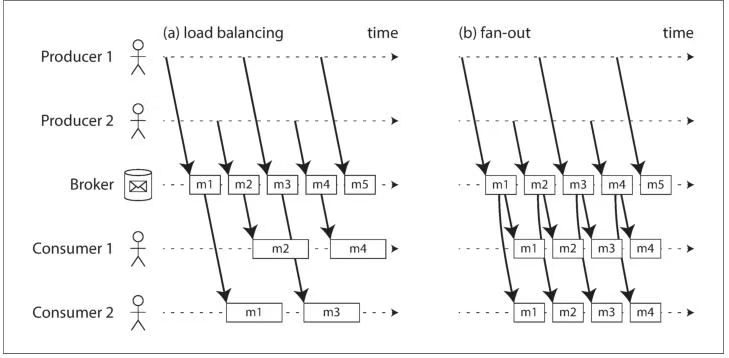
Figure 11-1. (a) Load balancing: sharing the work of consuming a topic amoing consumers; (b) fan-out: delivering each message to multiple consumers.
The two patterns can be combined: for example, two separate groups of consumers may each subscribe to a topic, such that each group collectively receives all messages,but within each group only one of the nodes receives each message.
这两种模式可以结合使用:例如,两个独立的消费者组可以分别订阅同一个主题,这样每个消费者组整体都会接收到该主题的所有消息,而在每个组内部,每条消息只会被其中一个节点接收。
Acknowledgments and redelivery
消息确认与重投递
Consumers may crash at any time, so it could happen that a broker delivers a message to a consumer but the consumer never processes it, or only partially processes it before crashing. In order to ensure that the message is not lost, message brokers use acknowledgments: a client must explicitly tell the broker when it has finished process‐ing a message so that the broker can remove it from the queue.
消费者随时可能发生崩溃,因此可能出现这样的情况:消息代理已将消息投递至某消费者,但该消费者完全未处理消息,或在处理过程中发生崩溃,仅完成了部分处理工作。 为避免消息丢失,消息代理会采用确认机制:客户端在完成消息处理后,必须向代理发送显式确认,代理收到确认后,才会将该消息从队列中移除。
If the connection to a client is closed or times out without the broker receiving anacknowledgment, it assumes that the message was not processed, and therefore itdelivers the message again to another consumer. (Note that it could happen that themessage actually was fully processed, but the acknowledgment was lost in the net‐work. Handling this case requires an atomic commit protocol, as discussed in “Dis‐tributed Transactions in Practice” on page 360.)
如果客户端的连接断开或超时,且代理始终未收到确认信息,就会判定这条消息未被成功处理,进而将其重新投递至其他消费者。(需注意的是,实际场景中可能存在消息已被完整处理,但确认信息在网络传输中丢失的情况。要处理这类场景,需要借助原子提交协议,详见本书第 360 页的《分布式事务实战》一节。)
When combined with load balancing, this redelivery behavior has an interestingeffect on the ordering of messages. In Figure 11-2, the consumers generally processmessages in the order they were sent by producers. However, consumer 2 crasheswhile processing message m3, at the same time as consumer 1 is processing messagem4. The unacknowledged message m3 is subsequently redelivered to consumer 1,with the result that consumer 1 processes messages in the order m4, m3, m5. Thus,m3and m4 are not delivered in the same order as they were sent by producer 1.
当确认重投机制与负载均衡模式结合使用时,会对消息的投递顺序产生一个值得关注的影响。如图 11-2 所示,正常情况下,消费者会按照生产者发送消息的顺序来处理消息。但如果消费者 2 在处理消息 m3 时发生崩溃,而同一时间消费者 1 正在处理消息 m4,那么未被确认的消息 m3 会被重新投递至消费者 1。最终消费者 1 处理消息的顺序就会变成 m4、m3、m5,导致 m3 和 m4 的投递顺序与生产者 1 的发送顺序不一致。
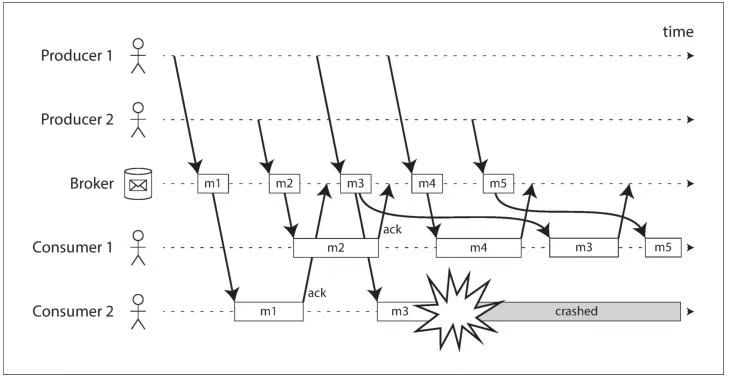
Figure 11-2. Consumer 2 crashes while processing m3, so it is redelivered to consumer 1 at a later time.
Even if the message broker otherwise tries to preserve the order of messages (asrequired by both the JMS and AMQP standards), the combination of load balancingwith redelivery inevitably leads to messages being reordered. To avoid this issue, youcan use a separate queue per consumer (i.e., not use the load balancing feature). Mes‐sage reordering is not a problem if messages are completely independent of eachother, but it can be important if there are causal dependencies between messages, aswe shall see later in the chapter.
即便消息代理会尽可能保证消息顺序(这也是 JMS 和 AMQP 两项标准的要求),负载均衡与重投递机制的组合,仍必然会导致消息乱序。若要避免这一问题,可以为每个消费者分配独立的队列(即不启用负载均衡功能)。如果消息之间彼此完全独立,乱序问题通常不会造成影响;但正如本章后续内容所述,若消息之间存在因果依赖关系,那么顺序错乱就可能引发严重问题。
Partitioned Logs
分区日志
Why can we not have a hybrid, combining the durable storage approach of databaseswith the low-latency notification facilities of messaging? This is the idea behind log-based message brokers.
我们为何不能设计一种混合方案,将数据库的持久化存储特性与消息系统的低延迟通知能力相结合?这正是基于日志的消息代理的设计理念。
Using logs for message storage
利用日志存储消息
A log is simply an append-only sequence of records on disk. We previously discussedlogs in the context of log-structured storage engines and write-ahead logs in Chap‐ter 3, and in the context of replication in Chapter 5.
日志本质上是磁盘上的仅追加记录序列。本书第 3 章在介绍日志结构存储引擎与预写式日志时,以及第 5 章在讨论副本复制机制时,都曾提及日志这一概念。
The same structure can be used to implement a message broker: a producer sends a message by appending it to the end of the log, and a consumer receives messages by reading the log sequentially. If a consumer reaches the end of the log, it waits for anotification that a new message has been appended. The Unix tool tail -f, whichwatches a file for data being appended, essentially works like this.
这种数据结构同样可用于实现消息代理:生产者通过将消息追加到日志末尾的方式发送消息,消费者则通过顺序读取日志的方式接收消息。如果消费者读取到了日志末尾,就会等待新消息追加的通知。Unix 工具 tail -f 就是基于此原理工作的 —— 它会持续监控文件,等待新数据被追加写入。
In order to scale to higher throughput than a single disk can offer, the log can be partitioned(in the sense of Chapter 6). Different partitions can then be hosted on dif‐ferent machines, making each partition a separate log that can be read and writtenindependently from other partitions. A topic can then be defined as a group of parti‐tions that all carry messages of the same type. This approach is illustrated inFigure 11-3.
为了突破单块磁盘的吞吐量限制,日志可以进行分区处理(此处的分区与第 6 章讨论的概念一致)。不同的分区可部署在不同的机器上,每个分区都是一个独立的日志,能够与其他分区并行读写。在此基础上,主题可被定义为一组存储同类消息的分区集合。图 11-3 展示了这种架构的工作原理。
Within each partition, the broker assigns a monotonically increasing sequence number, or offset, to every message (in Figure 11-3, the numbers in boxes are message off‐sets). Such a sequence number makes sense because a partition is append-only, so themessages within a partition are totally ordered. There is no ordering guarantee acrossdifferent partitions.
在每个分区内部,消息代理会为每条消息分配一个单调递增的序列号(或称偏移量)。图 11-3 中,方框内的数字即为消息偏移量。由于分区是仅追加写入的,分区内的消息具备完全有序性,因此这种序列号的设计是合理的。不过,不同分区之间的消息不提供任何顺序保证。
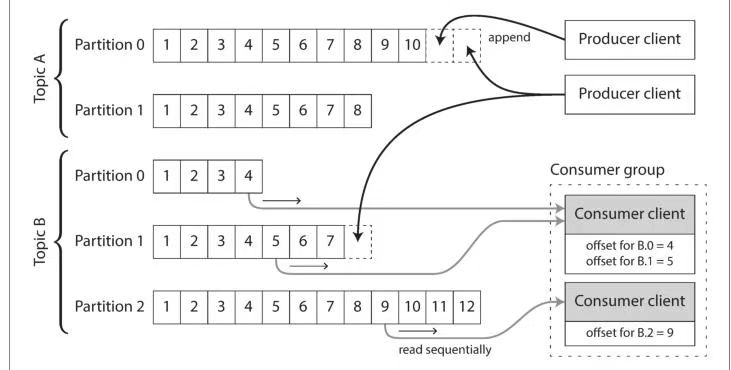
Figure 11-3. Producers send messages by appending them to a topic-partition file, andconsumers read these files sequentially.
Apache Kafka [17, 18], Amazon Kinesis Streams [19], and Twitter’s DistributedLog[20, 21] are log-based message brokers that work like this. Google Cloud Pub/Sub isarchitecturally similar but exposes a JMS-style API rather than a log abstraction [16].Even though these message brokers write all messages to disk, they are able to achievethroughput of millions of messages per second by partitioning across multiplemachines, and fault tolerance by replicating messages [22, 23].
Apache Kafka [17,18]、Amazon Kinesis Streams [19] 以及 Twitter 的 DistributedLog [20,21],均是采用这种架构的基于日志的消息代理。Google Cloud Pub/Sub 的架构与之类似,但对外提供的是 JMS 风格的 API,而非日志抽象接口 [16]。尽管这类消息代理会将所有消息写入磁盘,但通过多机分区部署,它们能够实现每秒数百万条消息的吞吐量;同时借助消息副本复制机制,可保障系统的容错性 [22,23]。
Consumer offsets
消费者偏移量
Consuming a partition sequentially makes it easy to tell which messages have beenprocessed: all messages with an offset less than a consumer’s current offset havealready been processed, and all messages with a greater offset have not yet been seen.Thus, the broker does not need to track acknowledgments for every single message—it only needs to periodically record the consumer offsets. The reduced bookkeeping overhead and the opportunities for batching and pipelining in this approach helpincrease the throughput of log-based systems.
按顺序消费分区的设计,能够很方便地判断哪些消息已被处理:所有偏移量小于消费者当前偏移量的消息均已处理完毕,所有偏移量大于当前偏移量的消息则尚未被读取。因此,消息代理无需追踪每条消息的确认状态 —— 只需定期记录消费者的偏移量即可。这种设计减少了簿记开销,同时为批处理与流水线处理创造了条件,有助于提升基于日志的消息系统的吞吐量。
This offset is in fact very similar to the log sequence number that is commonly foundin single-leader database replication, and which we discussed in “Setting Up NewFollowers” on page 155. In database replication, the log sequence number allows afollower to reconnect to a leader after it has become disconnected, and resume repli‐cation without skipping any writes. Exactly the same principle is used here: the mes‐sage broker behaves like a leader database, and the consumer like a follower.
实际上,这种偏移量与单主库数据库复制中常见的日志序列号非常相似,本书第 155 页的《新从库的搭建》一节曾对此展开讨论。在数据库复制流程中,日志序列号支持从库在断开连接后重新连接主库,并在不遗漏任何写入操作的前提下恢复复制。这里采用的是完全相同的原理:消息代理扮演主库的角色,而消费者则相当于从库。
If a consumer node fails, another node in the consumer group is assigned the failedconsumer’s partitions, and it starts consuming messages at the last recorded offset. Ifthe consumer had processed subsequent messages but not yet recorded their offset,those messages will be processed a second time upon restart. We will discuss ways ofdealing with this issue later in the chapter.
如果某个消费者节点发生故障,消费者组中的其他节点会接管故障节点负责的分区,并从最近一次记录的偏移量开始继续消费消息。若该消费者在处理后续消息后,尚未及时记录新的偏移量,那么这些已处理的消息会在节点重启后被重复处理。本章后续内容将探讨应对这一问题的解决方案。
Disk space usage
磁盘空间占用
If you only ever append to the log, you will eventually run out of disk space. Toreclaim disk space, the log is actually divided into segments, and from time to timeold segments are deleted or moved to archive storage. (We’ll discuss a more sophisti‐cated way of freeing disk space later.) This means that if a slow consumer cannot keep up with the rate of messages, and itfalls so far behind that its consumer offset points to a deleted segment, it will misssome of the messages. Effectively, the log implements a bounded-size buffer that discards old messages when it gets full, also known as a circular buffer or ring buffer.However, since that buffer is on disk, it can be quite large.
如果日志始终只执行追加操作,磁盘空间终将耗尽。为回收磁盘空间,日志实际上会被划分成多个段,系统会定期删除旧日志段或将其转移至归档存储中。(后文会介绍一种更精细的磁盘空间释放方案。)这就意味着,若某个消费者消费速度过慢,无法跟上消息的产生速率,导致其消费偏移量指向了已被删除的日志段,那么该消费者就会丢失部分消息。从效果上看,这种日志结构相当于一个有界缓冲区—— 缓冲区存满时会丢弃旧消息,它也被称为循环缓冲区或环形缓冲区。不过,由于该缓冲区基于磁盘存储,其容量可以配置得相当大。
Databass and Streams
数据库与流数据
Change Data Capture
变更数据捕获
Log compaction
日志压缩
If you can only keep a limited amount of log history, you need to go through thesnapshot process every time you want to add a new derived data system. However,log compaction provides a good alternative.
如果仅能保留有限的日志历史,那么每次新增衍生数据系统时,都需要执行一次快照流程。不过,日志压缩提供了一种更优的替代方案。
We discussed log compaction previously in “Hash Indexes” on page 72, in the con‐text of log-structured storage engines (see Figure 3-2 for an example). The principleis simple: the storage engine periodically looks for log records with the same key,throws away any duplicates, and keeps only the most recent update for each key. This compaction and merging process runs in the background.
本书第 72 页的《哈希索引》一节中,在介绍日志结构存储引擎时曾提及日志压缩机制(示例见图 3-2)。其原理十分简单:存储引擎会定期扫描具有相同键的日志记录,剔除重复记录,只为每个键保留最新的更新记录。这套压缩合并过程在后台自动运行。
In a log-structured storage engine, an update with a special null value (a tombstone)indicates that a key was deleted, and causes it to be removed during log compaction.But as long as a key is not overwritten or deleted, it stays in the log forever. The diskspace required for such a compacted log depends only on the current contents of thedatabase, not the number of writes that have ever occurred in the database. If thesame key is frequently overwritten, previous values will eventually be garbage-collected, and only the latest value will be retained.
在日志结构存储引擎中,一条带有特殊空值(即墓碑标记)的更新记录,表示某个键已被删除,该键会在日志压缩过程中被清除。但只要某个键未被覆盖或删除,就会永久保留在日志中。压缩日志所需的磁盘空间,仅取决于数据库的当前数据内容,与数据库历史上的写入操作总量无关。如果同一键被频繁覆盖,其历史值最终会被垃圾回收,日志中只会留存最新值。
The same idea works in the context of log-based message brokers and change data capture. If the CDC system is set up such that every change has a primary key, andevery update for a key replaces the previous value for that key, then it’s sufficient tokeep just the most recent write for a particular key.
这一理念同样适用于基于日志的消息代理与 ** 变更数据捕获(CDC)** 场景。若 CDC 系统被配置为每条变更记录都带有主键,且对同一键的每次更新都会覆盖该键之前的值,此时只需保留每个特定键的最新写入记录即可。
Now, whenever you want to rebuild a derived data system such as a search index, youcan start a new consumer from offset 0 of the log-compacted topic, and sequentiallyscan over all messages in the log. The log is guaranteed to contain the most recentvalue for every key in the database (and maybe some older values)—in other words,you can use it to obtain a full copy of the database contents without having to takeanother snapshot of the CDC source database.
如此一来,当你需要重建搜索索引这类衍生数据系统时,就可以从日志压缩主题的偏移量 0 处启动一个新的消费者,顺序扫描日志中的所有消息。该日志确保包含数据库中每个键的最新值(可能还会包含部分旧值)—— 也就是说,你无需再对 CDC 的源数据库创建新的快照,就能通过这份日志获取数据库的完整数据副本。
This log compaction feature is supported by Apache Kafka. As we shall see later inthis chapter, it allows the message broker to be used for durable storage, not just for transient messaging.
Apache Kafka 支持这一日志压缩功能。正如本章后续内容将介绍的,这一功能使得消息代理不仅可用于临时消息传递,还能作为持久化存储来使用。
Event Sourcing
事件溯源
There are some parallels between the ideas we’ve discussed here and event sourcing, a technique that was developed in the domain-driven design (DDD) community [42,43, 44]. We will discuss event sourcing briefly, because it incorporates some usefuland relevant ideas for streaming systems.
我们前文探讨的理念,与领域驱动设计(DDD)社区提出的一种名为事件溯源的技术存在诸多相通之处 [42,43,44]。在此我们对事件溯源做简要介绍,因为它包含了一些适用于流处理系统的实用理念。
Similarly to change data capture, event sourcing involves storing all changes to theapplication state as a log of change events. The biggest difference is that event sourcing applies the idea at a different level of abstraction:
- In change data capture, the application uses the database in a mutable way,updating and deleting records at will. The log of changes is extracted from the database at a low level (e.g., by parsing the replication log), which ensures that the order of writes extracted from the database matches the order in which they were actually written, avoiding the race condition in Figure 11-4. The application writing to the database does not need to be aware that CDC is occurring.
- In event sourcing, the application logic is explicitly built on the basis of immuta‐ ble events that are written to an event log. In this case, the event store is append- only, and updates or deletes are discouraged or prohibited. Events are designed to reflect things that happened at the application level, rather than low-level state changes.
和变更数据捕获类似,事件溯源也会将应用状态的所有变更,以变更事件日志的形式进行存储。二者的核心区别在于,事件溯源是在不同的抽象层次上应用这一理念:
- 在变更数据捕获(CDC)中,应用会以可变的方式使用数据库,可随意执行记录的更新与删除操作。变更日志是从数据库底层提取的(例如,通过解析复制日志),这种方式能确保从数据库中提取的写入操作顺序,与实际写入顺序完全一致,从而避免图 11-4 中所示的竞态条件。向数据库写入数据的应用,无需感知变更数据捕获的存在。
- 在事件溯源中,应用逻辑明确地基于写入事件日志的不可变事件来构建。在这种模式下,事件存储是仅追加的,更新或删除操作会被限制甚至禁止。事件的设计目标是反映应用层面发生的行为,而非底层的数据状态变更。
Event sourcing is a powerful technique for data modeling: from an application pointof view it is more meaningful to record the user’s actions as immutable events, ratherthan recording the effect of those actions on a mutable database. Event sourcingmakes it easier to evolve applications over time, helps with debugging by making iteasier to understand after the fact why something happened, and guards againstapplication bugs (see “Advantages of immutable events” on page 460).
事件溯源是一种强大的数据建模技术:从应用的视角来看,将用户的操作记录为不可变事件,远比记录这些操作对可变数据库的影响更具业务意义。事件溯源不仅便于应用的长期演进,还能通过事后追溯,帮助开发者更轻松地定位问题原因,同时也能有效防范应用程序缺陷(详见本书第 460 页的《不可变事件的优势》一节)。
Deriving current state from the event log
从事件日志推导当前状态
An event log by itself is not very useful, because users generally expect to see the current state of a system, not the history of modifications. For example, on a shoppingwebsite, users expect to be able to see the current contents of their cart, not anappend-only list of all the changes they have ever made to their cart.
事件日志本身的用途十分有限,因为用户通常期望查看系统的当前状态,而非状态的修改历史。例如,在购物网站上,用户希望能看到购物车的当前商品内容,而非一份记录了所有购物车操作的仅追加列表。
Thus, applications that use event sourcing need to take the log of events (representingthe data written to the system) and transform it into application state that is suitablefor showing to a user (the way in which data is read from the system [47]). Thistransformation can use arbitrary logic, but it should be deterministic so that you canrun it again and derive the same application state from the event log.
因此,采用事件溯源的应用需要将事件日志(代表写入系统的数据),转换为适合展示给用户的应用状态(也就是从系统中读取数据的形式 [47])。这种转换可以采用任意逻辑,但必须具备确定性—— 这样才能保证重放事件日志时,总能推导出完全一致的应用状态。
Like with change data capture, replaying the event log allows you to reconstruct thecurrent state of the system. However, log compaction needs to be handled differently:
- A CDC event for the update of a record typically contains the entire new version of the record, so the current value for a primary key is entirely determined by the most recent event for that primary key, and log compaction can discard previous events for the same key.
- On the other hand, with event sourcing, events are modeled at a higher level: an event typically expresses the intent of a user action, not the mechanics of the state update that occurred as a result of the action. In this case, later events typically do not override prior events, and so you need the full history of events to recon‐ struct the final state. Log compaction is not possible in the same way.
与变更数据捕获(CDC)类似,通过重放事件日志,就能够重建系统的当前状态。不过,两者在日志压缩的处理方式上存在差异:
- 针对记录更新的 CDC 事件,通常会包含该记录的完整新版本。因此,某个主键对应的当前值,完全由该主键的最新事件决定,日志压缩时可以直接丢弃同一主键的历史事件。
- 反观事件溯源,事件是在更高抽象层次上建模的:一条事件通常用于表达用户操作的意图,而非该操作引发的状态更新具体机制。在这种情况下,后续事件一般不会覆盖之前的事件,因此需要完整的事件历史才能重建最终状态,无法沿用 CDC 那样的日志压缩方式。
Applications that use event sourcing typically have some mechanism for storingsnapshots of the current state that is derived from the log of events, so they don’tneed to repeatedly reprocess the full log. However, this is only a performance optimi‐zation to speed up reads and recovery from crashes; the intention is that the system isable to store all raw events forever and reprocess the full event log whenever required.We discuss this assumption in “Limitations of immutability” on page 463.
采用事件溯源的应用,通常会通过某种机制存储从事件日志推导而来的当前状态快照,从而避免反复处理全量日志。但这仅仅是一种性能优化手段,目的是提升读取速度和崩溃后的恢复效率;其核心设计目标是,系统能够永久存储所有原始事件,并在需要时重放全量事件日志。关于这一设计假设的局限性,我们将在本书第 463 页的《不可变性的局限性》一节中展开讨论。
State, Streams and Immutability
状态、流与不可变性
Having an explicit translation step from an event log to a database makes it easier toevolve your application over time: if you want to introduce a new feature thatpresents your existing data in some new way, you can use the event log to build a separate read-optimized view for the new feature, and run it alongside the existingsystems without having to modify them. Running old and new systems side by side isoften easier than performing a complicated schema migration in an existing system.Once the old system is no longer needed, you can simply shut it down and reclaim itsresources [47, 57].
在事件日志与数据库之间设置显式的转换环节,能够让应用的长期演进变得更加轻松:若你希望新增一项功能,以全新方式呈现现有数据,只需基于事件日志为该功能构建一个独立的读优化视图,让它与现有系统并行运行,而无需对原有系统做任何修改。相比在已有系统中执行复杂的模式迁移,让新旧系统并行运转往往更加简便。当旧系统不再被需要时,你可以直接将其下线并回收其资源 [47,57]。
Storing data is normally quite straightforward if you don’t have to worry about how itis going to be queried and accessed; many of the complexities of schema design,indexing, and storage engines are the result of wanting to support certain query andaccess patterns (see Chapter 3). For this reason, you gain a lot of flexibility by separating the form in which data is written from the form it is read, and by allowing sev‐eral different read views. This idea is sometimes known as command query responsibility segregation (CQRS) [42, 58, 59].
如果无需考虑数据的查询与访问方式,那么数据存储通常会变得十分简单;模式设计、索引构建与存储引擎选择的诸多复杂性,归根结底都是为了支持特定的查询与访问模式(详见第 3 章)。正因如此,将数据的写入格式与读取格式解耦,并支持构建多种不同的读取视图,能够为你带来极大的灵活性。这种理念有时被称为命令查询职责分离(CQRS)[42,58,59]。
The traditional approach to database and schema design is based on the fallacy thatdata must be written in the same form as it will be queried. Debates about normaliza‐tion and denormalization (see “Many-to-One and Many-to-Many Relationships” onpage 33) become largely irrelevant if you can translate data from a write-optimizedevent log to read-optimized application state: it is entirely reasonable to denormalizedata in the read-optimized views, as the translation process gives you a mechanismfor keeping it consistent with the event log.
传统的数据库与模式设计思路,存在一个认知误区:认为数据的写入格式必须与其查询格式保持一致。而当你能够将数据从写优化的事件日志,转换为读优化的应用状态时,关于数据规范化与反规范化的争论(详见本书第 33 页的《一对多与多对多关系》一节)就基本失去了意义 —— 在读优化视图中采用反规范化设计是完全合理的,因为转换流程本身就提供了一种机制,确保读优化视图与事件日志的数据一致性。
Concurrency control
并发控制
The biggest downside of event sourcing and change data capture is that the consum‐ers of the event log are usually asynchronous, so there is a possibility that a user maymake a write to the log, then read from a log-derived view and find that their writehas not yet been reflected in the read view. We discussed this problem and potentialsolutions previously in “Reading Your Own Writes” on page 162.
事件溯源与变更数据捕获的最大缺点在于,事件日志的消费者通常是异步工作的。这就可能出现一种情况:用户向日志中写入数据后,立即从基于日志构建的视图中读取数据,却发现自己的写入操作尚未体现在该读视图中。关于这一问题及可能的解决方案,我们已在本书第 162 页的《读取自己的写入》一节中进行过探讨。
One solution would be to perform the updates of the read view synchronously withappending the event to the log. This requires a transaction to combine the writes intoan atomic unit, so either you need to keep the event log and the read view in the samestorage system, or you need a distributed transaction across the different systems.Alternatively, you could use the approach discussed in “Implementing linearizablestorage using total order broadcast” on page 350.
一种解决方案是,将读视图的更新操作与事件追加到日志的操作同步执行。这需要借助事务将这两项写入操作合并为一个原子单元,因此你要么需要将事件日志与读视图存储在同一个存储系统中,要么需要在多个系统之间执行分布式事务。此外,你也可以采用本书第 350 页《基于全序广播实现线性化存储》一节中讨论的方案。
On the other hand, deriving the current state from an event log also simplifies someaspects of concurrency control. Much of the need for multi-object transactions (see“Single-Object and Multi-Object Operations” on page 228) stems from a single useraction requiring data to be changed in several different places. With event sourcing,you can design an event such that it is a self-contained description of a user action.The user action then requires only a single write in one place—namely appending theevents to the log—which is easy to make atomic.
另一方面,基于事件日志推导当前状态,也会在某些方面简化并发控制的实现。多对象事务(详见本书第 228 页的《单对象与多对象操作》一节)的需求,很大程度上源于单个用户操作需要修改多个不同位置的数据。而在事件溯源模式下,你可以将事件设计为对用户操作的自包含描述。这样一来,用户操作仅需在一个位置执行一次写入 —— 也就是将事件追加到日志中,这种操作很容易实现原子性。
If the event log and the application state are partitioned in the same way (for exam‐ple, processing an event for a customer in partition 3 only requires updating partition3 of the application state), then a straightforward single-threaded log consumer needsno concurrency control for writes—by construction, it only processes a single eventat a time (see also “Actual Serial Execution” on page 252). The log removes the non‐determinism of concurrency by defining a serial order of events in a partition [24]. Ifan event touches multiple state partitions, a bit more work is required, which we willdiscuss in Chapter 12.
如果事件日志与应用状态采用相同的分区策略(例如,处理 3 号分区中某个客户的事件时,仅需更新应用状态的 3 号分区),那么一个简单的单线程日志消费者就无需为写入操作做并发控制 —— 从设计上看,它同一时间只会处理一条事件(另见本书第 252 页的《真正的串行执行》一节)。日志通过在分区内定义事件的串行顺序,消除了并发操作的不确定性 [24]。若某条事件涉及多个状态分区,则需要额外的处理手段,相关内容将在本书第 12 章中讨论。
Processing Streams
Uses of Stream Processing
流处理的应用场景
Complex event processing
复杂事件处理
Complex event processing (CEP) is an approach developed in the 1990s for analyzingevent streams, especially geared toward the kind of application that requires search‐ing for certain event patterns [65, 66]. Similarly to the way that a regular expressionallows you to search for certain patterns of characters in a string, CEP allows you tospecify rules to search for certain patterns of events in a stream.
复杂事件处理(CEP) 是一项诞生于 20 世纪 90 年代的事件流分析技术,尤其适用于需要检测特定事件模式的应用场景 [65,66]。正如正则表达式可用于在字符串中匹配特定字符模式,复杂事件处理允许用户定义规则,以在事件流中检索符合条件的事件模式。
CEP systems often use a high-level declarative query language like SQL, or a graphi‐cal user interface, to describe the patterns of events that should be detected. Thesequeries are submitted to a processing engine that consumes the input streams andinternally maintains a state machine that performs the required matching. When amatch is found, the engine emits a complex event (hence the name) with the details ofthe event pattern that was detected [67].
复杂事件处理系统通常会提供 SQL 这类高级声明式查询语言,或图形化用户界面,来描述需要检测的事件模式。用户可将这类查询提交至处理引擎,引擎在消费输入事件流的同时,会在内部维护一个状态机,专门执行模式匹配操作。当检测到匹配的事件模式时,引擎会输出一条复杂事件,其中包含该事件模式的详细信息 [67]。
In these systems, the relationship between queries and data is reversed compared tonormal databases. Usually, a database stores data persistently and treats queries astransient: when a query comes in, the database searches for data matching the query,and then forgets about the query when it has finished. CEP engines reverse theseroles: queries are stored long-term, and events from the input streams continuouslyflow past them in search of a query that matches an event pattern [68].
这类系统中,查询与数据的关系与常规数据库恰好相反。在常规数据库中,数据是持久化存储的,而查询则是临时性的:当查询请求到达时,数据库会检索符合查询条件的数据,查询执行完毕后,数据库就会丢弃该查询的相关信息。而复杂事件处理引擎则完全颠倒了二者的角色:查询会被长期存储,输入流中的事件则持续流经这些查询,以寻找能够匹配的事件模式 [68]。
Stream analytics systems sometimes use probabilistic algorithms, such as Bloom filters (which we encountered in “Performance optimizations” on page 79) for setmembership, HyperLogLog [72] for cardinality estimation, and various percentile estimation algorithms (see “Percentiles in Practice” on page 16). Probabilistic algo‐rithms produce approximate results, but have the advantage of requiring significantlyless memory in the stream processor than exact algorithms. This use of approxima‐tion algorithms sometimes leads people to believe that stream processing systems arealways lossy and inexact, but that is wrong: there is nothing inherently approximateabout stream processing, and probabilistic algorithms are merely an optimization[73].
流分析系统有时会采用概率算法,例如用于集合成员关系判断的布隆过滤器(我们曾在本书第 79 页的《性能优化》一节中提及)、用于基数估计的超对数对数算法(HyperLogLog)[72],以及各类分位数估计算法(详见本书第 16 页的《分位数的实际应用》一节)。概率算法会生成近似结果,但优势在于相比精确算法,它们在流处理器中所需的内存要少得多。流分析系统对近似算法的这类应用,有时会让人误以为流处理系统天生就是有损且不精确的,但这种观点是错误的:流处理本身并不存在固有的近似性,概率算法仅仅是一种优化手段[73]。
Maintaining materialized views
维护物化视图
We saw in “Databases and Streams” on page 451 that a stream of changes to a data‐base can be used to keep derived data systems, such as caches, search indexes, anddata warehouses, up to date with a source database. We can regard these examples asspecific cases of maintaining materialized views(see “Aggregation: Data Cubes andMaterialized Views” on page 101): deriving an alternative view onto some dataset sothat you can query it efficiently, and updating that view whenever the underlyingdata changes [50].
我们在本书第 451 页的《数据库与流数据》一节中提到,数据库的变更流可用于维持衍生数据系统(如缓存、搜索索引和数据仓库)与源数据库的同步。我们可以将这类场景视为维护物化视图的具体案例(详见本书第 101 页的《聚合:数据立方体与物化视图》一节):为某一数据集构建一个优化后的替代视图,以支持高效查询;每当底层数据发生变更时,同步更新该视图 [50]。
Similarly, in event sourcing, application state is maintained by applying a log ofevents; here the application state is also a kind of materialized view. Unlike streamanalytics scenarios, it is usually not sufficient to consider only events within sometime window: building the materialized view potentially requires all events over anarbitrary time period, apart from any obsolete events that may be discarded by logcompaction (see “Log compaction” on page 456). In effect, you need a window thatstretches all the way back to the beginning of time.
同理,在事件溯源模式下,应用状态是通过应用事件日志来维护的 —— 这里的应用状态也属于一种物化视图。与流分析场景不同的是,仅考虑某个时间窗口内的事件通常是不够的:构建物化视图可能需要覆盖任意时间段内的所有事件,只有那些会被日志压缩机制丢弃的过期事件除外(详见本书第 456 页的《日志压缩》一节)。实际上,这就需要一个能够回溯至数据起始时刻的时间窗口。
Reasoning About Time
To adjust for incorrect device clocks, one approach is to log three timestamps [82]:
- The time at which the event occurred, according to the device clock
- The time at which the event was sent to the server, according to the device clock
- The time at which the event was received by the server, according to the server clock
针对设备时钟不准的问题进行校正时,有一种方法是记录三个时间戳 [82]:
- 依据设备时钟记录的事件发生时间
- 依据设备时钟记录的事件发送至服务器的时间
- 依据服务器时钟记录的服务器接收事件的时间
By subtracting the second timestamp from the third, you can estimate the offsetbetween the device clock and the server clock (assuming the network delay is negligi‐ble compared to the required timestamp accuracy). You can then apply that offset tothe event timestamp, and thus estimate the true time at which the event actuallyoccurred (assuming the device clock offset did not change between the time the eventoccurred and the time it was sent to the server).
将第三个时间戳减去第二个时间戳,即可估算出设备时钟与服务器时钟之间的偏移量(假设网络延迟相对于所需的时间戳精度可忽略不计)。随后,你可以将该偏移量应用到事件时间戳上,进而估算出事件实际发生的真实时间(假设在事件发生到发送至服务器的这段时间内,设备时钟的偏移量未发生变化)。
Tumbling window A tumbling window has a fixed length, and every event belongs to exactly one window. For example, if you have a 1-minute tumbling window, all the events with timestamps between 10:03:00 and 10:03:59 are grouped into one window,events between 10:04:00 and 10:04:59 into the next window, and so on. You could implement a 1-minute tumbling window by taking each event timestamp and rounding it down to the nearest minute to determine the window that it belongs to.
滚动窗口 滚动窗口具有固定时长,且每条事件恰好属于一个窗口。例如,若设置 1 分钟的滚动窗口,所有时间戳在 10:03:00 至 10:03:59 之间的事件会被划分到同一个窗口,时间戳在 10:04:00 至 10:04:59 之间的事件则归入下一个窗口,以此类推。实现 1 分钟滚动窗口的方法是,将每条事件的时间戳向下取整至最近的分钟数,从而确定该事件所属的窗口。
Hopping window A hopping window also has a fixed length, but allows windows to overlap in order to provide some smoothing. For example, a 5-minute window with a hop size of 1 minute would contain the events between 10:03:00 and 10:07:59, then the next window would cover events between 10:04:00 and 10:08:59, and so on. You can implement this hopping window by first calculating 1-minute tumbling windows, and then aggregating over several adjacent windows.
跳跃窗口 跳跃窗口同样具有固定时长,但允许窗口之间重叠,以此实现数据平滑的效果。例如,一个时长为 5 分钟、步长为 1 分钟的跳跃窗口,会包含 10:03:00 至 10:07:59 的事件;下一个窗口则会覆盖 10:04:00 至 10:08:59 的事件,依此类推。这种跳跃窗口可以这样实现:先计算出 1 分钟的滚动窗口,再对多个相邻的滚动窗口执行聚合操作。
Sliding window A sliding window contains all the events that occur within some interval of each other. For example, a 5-minute sliding window would cover events at 10:03:39 and 10:08:12, because they are less than 5 minutes apart (note that tumbling and hopping 5-minute windows would not have put these two events in the same window, as they use fixed boundaries). A sliding window can be implemented by keeping a buffer of events sorted by time and removing old events when they expire from the window.
滑动窗口 滑动窗口包含所有时间间隔不超过设定阈值的事件。例如,一个 5 分钟的滑动窗口可以同时包含时间戳为 10:03:39 和 10:08:12 的事件,因为这两个事件的时间间隔小于 5 分钟(注意:对于 5 分钟的滚动窗口或跳跃窗口而言,这两个事件不会被划分到同一个窗口,因为这两类窗口都采用固定的边界)。实现滑动窗口的方法是,维护一个按时间排序的事件缓冲区,当事件超出窗口时间范围时,将其从缓冲区中移除。
Session window Unlike the other window types, a session window has no fixed duration. Instead,it is defined by grouping together all events for the same user that occur closely together in time, and the window ends when the user has been inactive for some time (for example, if there have been no events for 30 minutes). Sessionization is a common requirement for website analytics (see “GROUP BY” on page 406).
会话窗口 与其他窗口类型不同,会话窗口没有固定时长。它的划分规则是:将同一用户在短时间内产生的所有事件归为一组;当用户的非活跃时长达到设定阈值(例如,30 分钟内无任何事件产生)时,该会话窗口随即关闭。会话划分是网站分析场景中的常见需求(详见本书第 406 页的 GROUP BY 相关内容)。
Chapter 12. The Future of Data Systems
Data Integration
Batch and Stream Processing
批处理与流处理
The Lambda architecture
Lambda 架构
If batch processing is used to reprocess historical data, and stream processing is usedto process recent updates, then how do you combine the two? The lambda architec‐ture [12] is a proposal in this area that has gained a lot of attention.
若采用批处理对历史数据进行重处理,同时采用流处理应对近期数据更新,那么该如何将这两种处理模式结合起来呢?Lambda 架构正是针对这一问题提出的方案,它在业内受到了广泛关注 [12]。
The core idea of the lambda architecture is that incoming data should be recorded byappending immutable events to an always-growing dataset, similarly to event sourc‐ing (see “Event Sourcing” on page 457). From these events, read-optimized views arederived. The lambda architecture proposes running two different systems in parallel:a batch processing system such as Hadoop MapReduce, and a separate stream-processing system such as Storm.
Lambda 架构的核心思想是,参考事件溯源模式(详见本书第 457 页的《事件溯源》一节),将流入的数据以追加不可变事件的方式,记录到一个持续增长的数据集中。基于这些事件,系统会生成读优化视图。Lambda 架构建议并行运行两套独立的系统:一套是 Hadoop MapReduce 这类批处理系统,另一套则是 Storm 这类流处理系统。
In the lambda approach, the stream processor consumes the events and quickly pro‐duces an approximate update to the view; the batch processor later consumes thesame set of events and produces a corrected version of the derived view. The reason‐ing behind this design is that batch processing is simpler and thus less prone to bugs,while stream processors are thought to be less reliable and harder to make fault-tolerant (see “Fault Tolerance” on page 476). Moreover, the stream process can usefast approximate algorithms while the batch process uses slower exact algorithms.
在 Lambda 架构的处理流程中,流处理器会消费事件并快速生成视图的近似更新结果;之后批处理器会消费同一批事件,生成衍生视图的修正版本。这种设计的背后逻辑是,批处理的实现更为简单,因此出现缺陷的概率更低;而流处理器则被认为可靠性欠佳,且更难实现容错能力(详见本书第 476 页的《容错性》一节)。此外,流处理流程可采用运算速度较快的近似算法,而批处理流程则可采用运算速度较慢但结果精确的算法。
The lambda architecture was an influential idea that shaped the design of data sys‐tems for the better, particularly by popularizing the principle of deriving views ontostreams of immutable events and reprocessing events when needed. However, I alsothink that it has a number of practical problems:
- Having to maintain the same logic to run both in a batch and in a stream pro‐ cessing framework is significant additional effort. Although libraries such as Summingbird [13] provide an abstraction for computations that can be run in either a batch or a streaming context, the operational complexity of debugging,tuning, and maintaining two different systems remains [14].
- Since the stream pipeline and the batch pipeline produce separate outputs, they need to be merged in order to respond to user requests. This merge is fairly easy if the computation is a simple aggregation over a tumbling window, but it becomes significantly harder if the view is derived using more complex opera‐ tions such as joins and sessionization, or if the output is not a time series.
- Although it is great to have the ability to reprocess the entire historical dataset,doing so frequently is expensive on large datasets. Thus, the batch pipeline often needs to be set up to process incremental batches (e.g., an hour’s worth of data at the end of every hour) rather than reprocessing everything. This raises the prob‐ lems discussed in “Reasoning About Time” on page 468, such as handling strag‐ glers and handling windows that cross boundaries between batches. Incrementalizing a batch computation adds complexity, making it more akin to the streaming layer, which runs counter to the goal of keeping the batch layer as simple as possible.
Lambda 架构是一个极具影响力的理念,它推动了数据系统设计的发展与完善,尤其是普及了两项核心原则:基于不可变事件流生成视图,以及在需要时对事件进行重处理。不过在我看来,该架构也存在不少实际应用层面的问题:
- 需要维护一套同时适用于批处理和流处理框架的业务逻辑,这会带来大量额外的开发与维护工作。尽管 Summingbird [13] 等类库提供了一层抽象,支持计算逻辑同时运行在批处理或流处理环境中,但调试、调优和维护两套独立系统所带来的运维复杂性依然存在 [14]。
- 由于流处理管道与批处理管道会生成各自独立的输出结果,要响应用户请求,就必须对这两份结果进行合并。如果只是对滚动窗口执行简单聚合计算,结果合并的操作会相对容易;但如果视图是通过连接、会话划分等更复杂的操作生成的,或者输出结果并非时间序列数据,那么结果合并的难度就会大幅增加。
- 尽管能够重处理全量历史数据集是一项优势,但对于大规模数据集而言,频繁执行全量重处理的成本极高。因此,批处理管道往往需要被配置为增量批处理模式(例如,每小时末处理该小时产生的数据),而非对全量数据进行重处理。这就会引出本书第 468 页《时间相关的推理》一节中讨论的各类问题,例如如何处理滞后事件、如何处理跨越批处理边界的窗口等。为批处理计算引入增量处理机制会增加系统复杂度,使其与流处理层的差异逐渐缩小,这与 “保持批处理层尽可能简洁” 的设计目标是相悖的。
Unifying batch and stream processing
批处理与流处理的统一
More recent work has enabled the benefits of the lambda architecture to be enjoyedwithout its downsides, by allowing both batch computations (reprocessing historicaldata) and stream computations (processing events as they arrive) to be implementedin the same system [15].
近期的技术进展实现了一种新方案:在同一个系统中同时实现批处理计算(重处理历史数据)与流处理计算(实时处理到达的事件),以此兼得 Lambda 架构的优势,同时规避其弊端 [15]。
Unifying batch and stream processing in one system requires the following features,which are becoming increasingly widely available:
- The ability to replay historical events through the same processing engine that handles the stream of recent events. For example, log-based message brokers have the ability to replay messages (see “Replaying old messages” on page 451),and some stream processors can read input from a distributed filesystem like HDFS.
- Exactly-once semantics for stream processors—that is, ensuring that the output is the same as if no faults had occurred, even if faults did in fact occur (see “Fault Tolerance” on page 476). Like with batch processing, this requires discarding the partial output of any failed tasks.
- Tools for windowing by event time, not by processing time, since processing time is meaningless when reprocessing historical events (see “Reasoning About Time” on page 468). For example, Apache Beam provides an API for expressing such computations, which can then be run using Apache Flink or Google Cloud Dataflow.
要在单一系统中实现批处理与流处理的统一,需要具备以下几项功能,这些功能如今正得到越来越广泛的支持:
- 支持通过同一处理引擎,既重放历史事件,又处理近期的事件流。例如,基于日志的消息代理具备消息重放能力(详见本书第 451 页的《重放旧消息》一节);部分流处理器也能够从 HDFS 等分布式文件系统中读取输入数据。
- 流处理器需具备精确一次语义—— 即即便实际发生故障,也能保证输出结果与无故障场景下的结果完全一致(详见本书第 476 页的《容错性》一节)。与批处理类似,这需要将故障任务的部分输出结果丢弃。
- 支持基于事件时间而非处理时间进行窗口划分的工具。因为在重处理历史事件时,处理时间不具备任何实际意义(详见本书第 468 页的《时间相关的推理》一节)。例如,Apache Beam 提供了一套用于描述此类计算逻辑的 API,该 API 的计算任务可基于 Apache Flink 或 Google Cloud Dataflow 运行。
Unbundling Databases
数据库的解耦
Unix and relational databases have approached the information management prob‐lem with very different philosophies. Unix viewed its purpose as presenting program‐mers with a logical but fairly low-level hardware abstraction, whereas relationaldatabases wanted to give application programmers a high-level abstraction thatwould hide the complexities of data structures on disk, concurrency, crash recovery,and so on. Unix developed pipes and files that are just sequences of bytes, whereasdatabases developed SQL and transactions.
Unix 系统与关系型数据库在信息管理问题的处理理念上存在显著差异。Unix 的设计目标是为程序员提供一套逻辑层面但偏向底层的硬件抽象;而关系型数据库则希望为应用程序员提供高层抽象,以此屏蔽磁盘数据结构、并发控制、崩溃恢复等底层实现的复杂性。Unix 衍生出了管道与文件(本质是字节序列)的设计,而数据库则发展出了 SQL 与事务的相关机制。
The big advantage of log-based integration is loose coupling between the various components, which manifests itself in two ways:
- At a system level, asynchronous event streams make the system as a whole more robust to outages or performance degradation of individual components. If a consumer runs slow or fails, the event log can buffer messages (see “Disk space usage” on page 450), allowing the producer and any other consumers to continue running unaffected. The faulty consumer can catch up when it is fixed, so it doesn’t miss any data, and the fault is contained. By contrast, the synchronous interaction of distributed transactions tends to escalate local faults into large- scale failures (see “Limitations of distributed transactions” on page 363).
- At a human level, unbundling data systems allows different software components and services to be developed, improved, and maintained independently from each other by different teams. Specialization allows each team to focus on doing one thing well, with well-defined interfaces to other teams’ systems. Event logs provide an interface that is powerful enough to capture fairly strong consistency properties (due to durability and ordering of events), but also general enough to be applicable to almost any kind of data.
基于日志的集成方式的核心优势,在于实现了各个组件之间的松耦合,这一优势主要体现在两个方面:
- 系统层面:异步事件流使整个系统对单个组件的故障或性能下降具有更强的鲁棒性。如果某个消费者处理速度变慢或发生故障,事件日志可以对消息进行缓冲(详见本书第 450 页的《磁盘空间占用》一节),从而让生产者及其他消费者不受影响、继续运行。故障的消费者修复后可以追平数据,不会丢失任何信息,同时故障的影响范围也被限定在局部。相比之下,分布式事务的同步交互机制,往往会将局部故障升级为大规模故障(详见本书第 363 页的《分布式事务的局限性》一节)。
- 人员协作层面:数据系统解耦后,不同的软件组件与服务可由不同团队独立开发、优化和维护。这种专业化分工能让每个团队专注于把一件事做好,并通过与其他团队系统之间定义清晰的接口完成交互。事件日志所提供的接口,既具备足够强的能力(依托事件的持久性与有序性,能够实现较高的一致性特性),又具备极强的通用性,几乎适用于所有类型的数据。
Observing Derived State
From this example we can see that an index is not the only possible boundarybetween the write path and the read path. Caching of common search results is possi‐ble, and grep-like scanning without the index is also possible on a small number ofdocuments. Viewed like this, the role of caches, indexes, and materialized views issimple: they shift the boundary between the read path and the write path. They allowus to do more work on the write path, by precomputing results, in order to save efforton the read path.
从这个例子中我们可以看出,索引并非读写路径之间唯一可能的边界。我们既可以对常用搜索结果进行缓存,也可以在文档数量较少时,不借助索引直接执行类 grep 的扫描操作。从这个角度来看,缓存、索引和物化视图的作用十分简单:它们会移动读写路径之间的边界。通过在写路径上预计算结果,它们能让我们在写路径上多做一些工作,从而节省读路径的处理开销。
Aiming for Correctness
The End-to-End Argument for Databases
数据库的端到端论证
The end-to-end argument
端到端论证
This scenario of suppressing duplicate transactions is just one example of a moregeneral principle called the end-to-end argument, which was articulated by Saltzer,Reed, and Clark in 1984 [55]:
抑制重复事务的这种场景,恰好印证了一项更具普适性的原理 ——端到端论证。该原理由萨尔茨泽(Saltzer)、里德(Reed)与克拉克(Clark)于 1984 年提出 [55]:
The function in question can completely and correctly be implemented only with theknowledge and help of the application standing at the endpoints of the communica‐tion system. Therefore, providing that questioned function as a feature of the commu‐nication system itself is not possible. (Sometimes an incomplete version of the functionprovided by the communication system may be useful as a performance enhance‐ment.)
只有借助位于通信系统两端的应用程序所掌握的信息并获得其协助,才能完整且正确地实现所讨论的功能。因此,将该功能直接作为通信系统的一项特性来提供是不可行的。(不过,通信系统提供的该功能简易版本,有时可作为性能优化手段发挥作用。)
In our example, the function in question was duplicate suppression. We saw that TCPsuppresses duplicate packets at the TCP connection level, and some stream process‐ors provide so-called exactly-once semantics at the message processing level, but thatis not enough to prevent a user from submitting a duplicate request if the first onetimes out. By themselves, TCP, database transactions, and stream processors cannotentirely rule out these duplicates. Solving the problem requires an end-to-end solution: a transaction identifier that is passed all the way from the end-user client to thedatabase.
在我们的例子中,所讨论的功能正是重复抑制。我们知道,TCP 会在 TCP 连接层面抑制重复数据包,部分流处理器也会在消息处理层面提供所谓的精确一次语义,但这些机制不足以防止用户在首次请求超时后提交重复请求。单靠 TCP、数据库事务和流处理器,无法彻底杜绝这类重复问题。要解决该问题,必须采用端到端的解决方案:使用一个从终端用户客户端一路传递至数据库的事务标识符。
The end-to-end argument also applies to checking the integrity of data: checksumsbuilt into Ethernet, TCP, and TLS can detect corruption of packets in the network,but they cannot detect corruption due to bugs in the software at the sending andreceiving ends of the network connection, or corruption on the disks where the datais stored. If you want to catch all possible sources of data corruption, you also needend-to-end checksums.
端到端论证同样适用于数据完整性校验场景:以太网、TCP 和 TLS 内置的校验和,能够检测数据包在网络传输中的损坏情况,但无法检测由网络连接收发两端的软件缺陷,或是数据存储磁盘故障所引发的数据损坏。若要排查所有可能导致数据损坏的源头,同样需要部署端到端的校验和机制。
Although the low-level features (TCP duplicate suppression, Ethernet checksums,WiFi encryption) cannot provide the desired end-to-end features by themselves, theyare still useful, since they reduce the probability of problems at the higher levels. Forexample, HTTP requests would often get mangled if we didn’t have TCP putting thepackets back in the right order. We just need to remember that the low-level reliability features are not by themselves sufficient to ensure end-to-end correctness.
尽管这类底层功能(TCP 重复抑制、以太网校验和、WiFi 加密)无法单独提供所需的端到端功能,但它们依然具备实用价值 —— 因为它们能够降低上层系统出现问题的概率。例如,若没有 TCP 将数据包重新按正确顺序排列,HTTP 请求往往会出现错乱。我们只需记住,底层可靠性功能本身并不足以保障端到端的正确性。
Enforcing Constraints
约束执行
Multi-partition request processing
多分区请求处理
Ensuring that an operation is executed atomically, while satisfying constraints,becomes more interesting when several partitions are involved. In Example 12-2,there are potentially three partitions: the one containing the request ID, the one con‐taining the payee account, and the one containing the payer account. There is no rea‐son why those three things should be in the same partition, since they are allindependent from each other.
当操作涉及多个分区时,如何在满足约束条件的前提下确保操作的原子性,就成为了一个更值得探讨的问题。在示例 12-2 中,操作可能涉及三个分区:存储请求 ID 的分区、存储收款账户的分区,以及存储付款账户的分区。这三类数据分属不同分区是完全合理的,因为它们在逻辑上相互独立。
In the traditional approach to databases, executing this transaction would require anatomic commit across all three partitions, which essentially forces it into a total orderwith respect to all other transactions on any of those partitions. Since there is nowcross-partition coordination, different partitions can no longer be processed inde‐pendently, so throughput is likely to suffer.
在传统的数据库处理方案中,要执行这类事务,就需要在所有三个分区之间完成原子提交。这实际上会强制该事务与涉及任一相关分区的其他所有事务形成一个全序关系。而一旦引入跨分区协调机制,不同分区就无法再独立处理事务,系统的吞吐量很可能会因此下降。
However, it turns out that equivalent correctness can be achieved with partitionedlogs, and without an atomic commit:
- The request to transfer money from account A to account B is given a unique request ID by the client, and appended to a log partition based on the request ID.
- A stream processor reads the log of requests. For each request message it emits two messages to output streams: a debit instruction to the payer account A (par‐ titioned by A), and a credit instruction to the payee account B (partitioned by B). The original request ID is included in those emitted messages.
- Further processors consume the streams of credit and debit instructions, dedu‐ plicate by request ID, and apply the changes to the account balances.
不过,基于分区日志,我们其实可以在不依赖原子提交的前提下,实现同等的正确性保障。具体方案如下:
- 客户端为一笔从账户 A 转账至账户 B 的请求生成一个唯一的请求 ID,并将该请求按请求 ID 分区,追加到对应的日志分区中。
- 流处理器读取请求日志,针对每条请求消息,向输出流中发送两条指令:一条是面向付款账户 A 的扣款指令(按账户 A 分区),另一条是面向收款账户 B 的入账指令(按账户 B 分区)。这两条指令都会携带原始请求的 ID。
- 下游的其他处理器分别消费入账指令流与扣款指令流,根据请求 ID 进行去重,再将指令对应的金额变动应用到账户余额中。
Steps 1 and 2 are necessary because if the client directly sent the credit and debitinstructions, it would require an atomic commit across those two partitions to ensurethat either both or neither happen. To avoid the need for a distributed transaction,we first durably log the request as a single message, and then derive the credit anddebit instructions from that first message. Single-object writes are atomic in almostall data systems (see “Single-object writes” on page 230), and so the request eitherappears in the log or it doesn’t, without any need for a multi-partition atomic commit.
步骤 1 和步骤 2 的设计是必不可少的。原因在于,如果让客户端直接发送入账和扣款两条指令,就需要在这两个分区之间执行原子提交,才能确保两条指令要么都生效,要么都不生效。而通过先将请求作为单条消息持久化写入日志,再基于该日志派生出入账和扣款指令,我们就能规避分布式事务的需求。几乎所有数据系统都支持单对象写入的原子性(详见本书第 230 页的《单对象写入》一节),因此这条请求消息只会存在 “写入日志” 或 “未写入日志” 两种明确状态,无需借助跨分区原子提交来保障。
If the stream processor in step 2 crashes, it resumes processing from its last check‐point. In doing so, it does not skip any request messages, but it may process requestsmultiple times and produce duplicate credit and debit instructions. However, since itis deterministic, it will just produce the same instructions again, and the processors instep 3 can easily deduplicate them using the end-to-end request ID.
若步骤 2 中的流处理器发生崩溃,它会从最近一次的检查点恢复处理流程。恢复后,处理器不会跳过任何请求消息,但可能会对部分请求重复处理,进而生成重复的入账和扣款指令。不过,由于流处理器的处理逻辑是确定性的,重复处理生成的指令内容也完全一致。因此,步骤 3 中的处理器只需依据端到端的请求 ID,就能轻松完成指令去重。
If you want to ensure that the payer account is not overdrawn by this transfer, youcan additionally have a stream processor (partitioned by payer account number) thatmaintains account balances and validates transactions. Only valid transactions wouldthen be placed in the request log in step 1.
如果需要额外确保本次转账不会导致付款账户透支,我们还可以增设一个流处理器(按付款账户编号分区)。该处理器负责维护账户余额,并对每笔转账请求执行余额校验。只有通过校验的合法请求,才会被写入步骤 1 中的请求日志。
By breaking down the multi-partition transaction into two differently partitionedstages and using the end-to-end request ID, we have achieved the same correctnessproperty (every request is applied exactly once to both the payer and payee accounts),even in the presence of faults, and without using an atomic commit protocol. The idea of using multiple differently partitioned stages is similar to what we discussed in“Multi-partition data processing” on page 514(see also “Concurrency control” onpage 462).
通过将跨分区事务拆解为两个不同分区策略的处理阶段,并借助端到端的请求 ID,我们在不依赖原子提交协议的情况下,即便面对各类故障,依然实现了同等的正确性保障 —— 每笔请求对应的扣款和入账操作,都会被精确地执行一次。这种采用多阶段不同分区策略的设计思路,与本书第 514 页《多分区数据处理》一节的内容一脉相承(另见本书第 462 页的《并发控制》)。
Timeliness and Integrity
时效性与完整性
Timeliness Timeliness means ensuring that users observe the system in an up-to-date state. We saw previously that if a user reads from a stale copy of the data, they may observe it in an inconsistent state (see “Problems with Replication Lag” on page 161). However, that inconsistency is temporary, and will eventually be resolved simply by waiting and trying again.
时效性 时效性是指确保用户能够观察到系统的最新状态。我们此前提到,若用户读取的是过期的数据副本,就可能看到不一致的系统状态(详见本书第 161 页的《复制延迟引发的问题》一节)。不过,这类不一致是暂时的,通常只需等待片刻后重试,问题就会自行解决。
The CAP theorem (see “The Cost of Linearizability” on page 335) uses consis‐tency in the sense of linearizability, which is a strong way of achieving timeliness.Weaker timeliness properties like read-after-writeconsistency (see “ReadingYour Own Writes” on page 162) can also be useful.
CAP 定理(详见本书第 335 页的《线性一致性的代价》一节)中所提及的 “一致性”,指的是线性一致性,这是实现时效性的一种强保障方式。而相对较弱的时效性保障,例如写后读一致性(详见本书第 162 页的《读取自己的写入》一节),在实际应用中同样具有重要价值。
Integrity Integrity means absence of corruption; i.e., no data loss, and no contradictory or false data. In particular, if some derived dataset is maintained as a view onto some underlying data (see “Deriving current state from the event log” on page 458), the derivation must be correct. For example, a database index must cor‐ rectly reflect the contents of the database—an index in which some records are missing is not very useful.
完整性 完整性是指数据无损坏,即不存在数据丢失,也不存在矛盾或错误的数据。具体来说,若某一衍生数据集是基于底层数据构建的视图(详见本书第 458 页的《从事件日志推导当前状态》一节),那么该视图的生成逻辑必须保证准确无误。例如,数据库索引必须完整反映数据库的内容 —— 一个存在记录缺失的索引,其实际使用价值会大打折扣。
If integrity is violated, the inconsistency is permanent: waiting and trying again isnot going to fix database corruption in most cases. Instead, explicit checking andrepair is needed. In the context of ACID transactions (see “The Meaning ofACID” on page 223), consistency is usually understood as some kind ofapplication-specific notion of integrity. Atomicity and durability are importanttools for preserving integrity.
一旦完整性遭到破坏,由此引发的不一致性将是永久性的:在大多数情况下,单纯等待和重试无法修复已损坏的数据库。此时,必须通过主动的检查与修复操作来解决问题。在 ACID 事务的语境下(详见本书第 223 页的《ACID 的含义》一节),“一致性” 通常被理解为一种特定于应用的完整性定义。而原子性与持久性,则是保障数据完整性的关键机制。
In slogan form: violations of timeliness are “eventual consistency,” whereas violationsof integrity are “perpetual inconsistency.” I am going to assert that in most applications, integrity is much more important thantimeliness. Violations of timeliness can be annoying and confusing, but violations ofintegrity can be catastrophic.
用一句口号来总结:时效性被破坏会导致最终一致性问题,而完整性被破坏则会引发永久性不一致问题。我认为,在绝大多数应用场景中,完整性的重要性远高于时效性。时效性受损可能会给用户带来困扰和迷惑,但完整性受损则可能引发灾难性的后果。
Exactly-onceor effectively-oncesemantics (see “Fault Tolerance” on page 476) is amechanism for preserving integrity. If an event is lost, or if an event takes effecttwice, the integrity of a data system could be violated. Thus, fault-tolerant messagedelivery and duplicate suppression (e.g., idempotent operations) are important formaintaining the integrity of a data system in the face of faults.
精确一次语义或有效一次语义(详见本书第 476 页的《容错性》一节)是保障数据完整性的一种机制。如果事件丢失,或同一事件生效两次,数据系统的完整性都可能遭到破坏。因此,容错消息投递与重复抑制机制(如幂等操作),对于在故障场景下维持数据系统的完整性至关重要。
As we saw in the last section, reliable stream processing systems can preserve integ‐rity without requiring distributed transactions and an atomic commit protocol,which means they can potentially achieve comparable correctness with much betterperformance and operational robustness. We achieved this integrity through a com‐bination of mechanisms:
- Representing the content of the write operation as a single message, which can easily be written atomically—an approach that fits very well with event sourcing (see “Event Sourcing” on page 457)
- Deriving all other state updates from that single message using deterministic derivation functions, similarly to stored procedures (see “Actual Serial Execution” on page 252and “Application code as a derivation function” on page 505)
- Passing a client-generated request ID through all these levels of processing, ena‐ bling end-to-end duplicate suppression and idempotence• Making messages immutable and allowing derived data to be reprocessed from time to time, which makes it easier to recover from bugs (see “Advantages of immutable events” on page 460)
正如我们在上一节中所见,可靠的流处理系统无需依赖分布式事务与原子提交协议,就能保障数据完整性。这意味着它们有望在实现同等正确性的同时,获得更优的性能与更强的运维鲁棒性。我们通过一套机制组合实现了这种完整性保障,具体如下:
- 将写入操作的内容封装为单条消息,这类消息可轻松实现原子性写入 —— 这种方式与事件溯源模式高度契合(详见本书第 457 页的《事件溯源》一节)
- 借助确定性推导函数,基于这条单消息派生所有其他状态更新操作,其原理与存储过程类似(详见本书第 252 页的《真正的串行执行》及第 505 页的《作为推导函数的应用代码》两节)
- 将客户端生成的请求 ID 贯穿所有处理环节,以此实现端到端的重复抑制与幂等性保障
- 将消息设为不可变,并允许衍生数据被定期重处理,这一设计能降低故障恢复的难度(详见本书第 460 页的《不可变事件的优势》一节)
This combination of mechanisms seems to me a very promising direction for build‐ing fault-tolerant applications in the future.
在我看来,这套机制组合为未来构建容错应用指明了一个极具前景的方向。
Trust, but Verify
All of our discussion of correctness, integrity, and fault-tolerance has been under theassumption that certain things might go wrong, but other things won’t. We call theseassumptions our system model(see “Mapping system models to the real world” onpage 309): for example, we should assume that processes can crash, machines cansuddenly lose power, and the network can arbitrarily delay or drop messages. But wemight also assume that data written to disk is not lost after fsync, that data in mem‐ory is not corrupted, and that the multiplication instruction of our CPU alwaysreturns the correct result.
我们此前关于正确性、完整性与容错性的所有讨论,都是基于这样一种假设:某些情况可能会发生,但另一些情况绝不会发生。我们将这些假设称为系统模型(详见本书第 309 页的《将系统模型映射到现实世界》一节)。例如,我们应当假定进程可能崩溃、服务器可能突然断电、网络可能任意延迟或丢弃消息;但同时,我们也可能假定:执行 fsync 操作后写入磁盘的数据不会丢失、内存中的数据不会损坏、CPU 的乘法指令总能返回正确结果。
These assumptions are quite reasonable, as they are true most of the time, and itwould be difficult to get anything done if we had to constantly worry about our computers making mistakes. Traditionally, system models take a binary approach toward faults: we assume that some things can happen, and other things can never happen.In reality, it is more a question of probabilities: some things are more likely, otherthings less likely. The question is whether violations of our assumptions happen oftenenough that we may encounter them in practice.
这些假设是相当合理的,因为它们在绝大多数情况下都成立。如果我们必须时刻担心计算机出现故障,那么几乎无法完成任何工作。传统上,系统模型对故障采取二元化的界定方式:我们假定某些情况可能发生,而另一些情况绝无可能发生。但在现实中,这更多是一个概率问题 —— 有些情况发生的概率较高,有些则较低。关键在于,违背假设的情况发生的频率,是否足以让我们在实际应用中遭遇。
We have seen that data can become corrupted while it is sitting untouched on disks(see “Replication and Durability” on page 227), and data corruption on the networkcan sometimes evade the TCP checksums (see “Weak forms of lying” on page 306).Maybe this is something we should be paying more attention to?
我们此前已经了解到,即便是存放在磁盘中未被访问的数据,也可能出现损坏(详见本书第 227 页的《复制与持久性》一节);而网络传输中的数据损坏,有时也能逃过 TCP 校验和的检测(详见本书第 306 页的《轻度异常情况》一节)。或许,这是一个值得我们投入更多关注的问题?
One application that I worked on in the past collected crash reports from clients, andsome of the reports we received could only be explained by random bit-flips in thememory of those devices. It seems unlikely, but if you have enough devices runningyour software, even very unlikely things do happen. Besides random memory corrup‐tion due to hardware faults or radiation, certain pathological memory access patternscan flip bits even in memory that has no faults [62]—an effect that can be used tobreak security mechanisms in operating systems [63] (this technique is known asrowhammer). Once you look closely, hardware isn’t quite the perfect abstraction thatit may seem.
我过去参与过的一个项目,需要收集客户端的崩溃报告。我们收到的部分报告,只能用设备内存中的随机位翻转来解释。这种情况看似概率极低,但如果有足够多的设备运行你的软件,即便是可能性微乎其微的事件,也终将发生。除了硬件故障或辐射导致的随机内存损坏外,某些特殊的内存访问模式,甚至能让无故障的内存发生位翻转 [62]—— 这种效应还被用于破解操作系统的安全机制 [63](这类技术被称为行锤攻击)。当你深入探究就会发现,硬件并非如它表面看起来的那样,是一种完美无缺的抽象组件。
To be clear, random bit-flips are still very rare on modern hardware [64]. I just wantto point out that they are not beyond the realm of possibility, and so they deservesome attention.
需要明确的是,在现代硬件中,随机位翻转的概率依然极低 [64]。我只是想指出,这类事件并非完全不可能发生,因此值得我们给予一定的关注。
Designing for auditability
审计性设计
If a transaction mutates several objects in a database, it is difficult to tell after the factwhat that transaction means. Even if you capture the transaction logs (see “ChangeData Capture” on page 454), the insertions, updates, and deletions in various tablesdo not necessarily give a clear picture of why those mutations were performed. Theinvocation of the application logic that decided on those mutations is transient andcannot be reproduced.
如果某笔事务修改了数据库中的多个对象,事后往往很难追溯该事务的业务含义。即便你捕获了事务日志(详见本书第 454 页的《变更数据捕获》一节),但各数据表中的插入、更新与删除操作,也未必能清晰地解释执行这些修改操作的原因。而决定执行这些修改的应用逻辑调用过程具有临时性,且无法复现。
By contrast, event-based systems can provide better auditability. In the event sourc‐ing approach, user input to the system is represented as a single immutable event,and any resulting state updates are derived from that event. The derivation can be made deterministic and repeatable, so that running the same log of events throughthe same version of the derivation code will result in the same state updates.
相比之下,基于事件的系统能够提供更优的审计性。在事件溯源模式中,系统的用户输入会被表示为单条不可变事件,所有由此产生的状态更新,均是基于该事件派生而来。这种派生过程可以被设计为确定性且可重复的—— 也就是说,使用同一版本的派生代码,重放同一批事件日志,最终得到的状态更新结果完全一致。
Being explicit about dataflow (see “Philosophy of batch process outputs” on page413) makes the provenance of data much clearer, which makes integrity checkingmuch more feasible. For the event log, we can use hashes to check that the event storage has not been corrupted. For any derived state, we can rerun the batch and streamprocessors that derived it from the event log in order to check whether we get thesame result, or even run a redundant derivation in parallel.
明确数据流走向(详见本书第 413 页的《批处理输出的设计理念》一节),能够让数据溯源变得更加清晰,从而大幅提升完整性校验的可行性。对于事件日志,我们可以通过哈希值来校验事件存储未发生损坏;对于任何衍生状态,我们可以重新运行从事件日志派生出该状态的批处理与流处理程序,验证是否能得到相同的结果,甚至可以并行执行冗余的推导流程。
A deterministic and well-defined dataflow also makes it easier to debug and trace theexecution of a system in order to determine why it did something [4, 69]. If some‐thing unexpected occurred, it is valuable to have the diagnostic capability to repro‐duce the exact circumstances that led to the unexpected event—a kind of time-travel debugging capability.
一套确定性强、定义清晰的数据流,同样有助于系统的调试与执行轨迹追溯,便于定位系统异常行为的根因 [4,69]。当系统出现意外情况时,若具备复现该意外事件发生的完整场景的诊断能力 —— 也就是一种时光回溯式调试能力,将具有极高的价值。
Doing the Right Thing
Privacy and Tracking
隐私与追踪
Feedback loops
反馈循环
Even with predictive applications that have less immediately far-reaching effects onpeople, such as recommendation systems, there are difficult issues that we must confront. When services become good at predicting what content users want to see, theymay end up showing people only opinions they already agree with, leading to echochambers in which stereotypes, misinformation, and polarization can breed. We arealready seeing the impact of social media echo chambers on election campaigns [91].
即便是对人类影响没有那么立竿见影的预测类应用(如推荐系统),也存在一些我们必须正视的棘手问题。当服务能够精准预测用户想看的内容时,最终可能只会向用户推送他们原本就认同的观点,进而催生回声室效应—— 刻板印象、虚假信息与观点极化现象都可能在这种环境中滋生蔓延。社交媒体的回声室效应对选举活动产生的影响,我们已经有目共睹 [91]。
When predictive analytics affect people’s lives, particularly pernicious problems arisedue to self-reinforcing feedback loops. For example, consider the case of employersusing credit scores to evaluate potential hires. You may be a good worker with a goodcredit score, but suddenly find yourself in financial difficulties due to a misfortuneoutside of your control. As you miss payments on your bills, your credit score suffers,and you will be less likely to find work. Joblessness pushes you toward poverty, whichfurther worsens your scores, making it even harder to find employment [87]. It’s adownward spiral due to poisonous assumptions, hidden behind a camouflage ofmathematical rigor and data.
当预测分析技术开始影响人们的生活时,自我强化的反馈循环会引发尤为恶劣的问题。例如,部分雇主会依据信用评分来评估潜在求职者。你或许原本是一名信用良好的优秀员工,却因一场无法掌控的意外陷入财务困境。随着账单逾期未付,你的信用评分会下降,进而降低你找到工作的概率。失业会将你推向贫困,而贫困又会进一步拉低你的信用评分,让就业变得愈发艰难 [87]。这便是一个由潜藏在数学严谨性与数据外衣之下的有害假设所引发的恶性循环。
We can’t always predict when such feedback loops happen. However, many consequences can be predicted by thinking about the entire system (not just the computer‐ized parts, but also the people interacting with it)—an approach known as systemsthinking [92]. We can try to understand how a data analysis system responds to dif‐ferent behaviors, structures, or characteristics. Does the system reinforce and amplifyexisting differences between people (e.g., making the rich richer or the poor poorer),or does it try to combat injustice? And even with the best intentions, we must bewareof unintended consequences.
我们无法总是预判这类反馈循环何时会出现。不过,通过系统思维的分析方法,考量整个系统的运行逻辑(不仅包括计算机化的组件,还涵盖与系统产生交互的人类群体),许多潜在后果是可以预见的 [92]。我们可以尝试去分析:数据分析系统会对不同的行为、结构或特征做出怎样的反应?该系统是在强化并放大人与人之间既存的差异(例如,让富人更富、穷人更穷),还是在试图消除不公?即便出发点再好,我们也必须警惕那些非预期的后果。
本文作者: Uyouii
文章链接: https://uyouii.cool/posts/8721491d/
版权声明: 本博客文章除特别声明外, 均采用署名4.0国际(CC BY 4.0)国际许可协议进行授权, 转载请注明出处